
A WordPress chatbot plugin answers your visitors when you cannot. It handles the same five questions you get every day, captures a lead at midnight, and hands the hard ones to a human. That last part matters more than most buying guides admit.
The category changed more between 2024 and 2026 than in the eight years before it. Older plugins ran on decision trees. You drew a flowchart, and the bot followed it. Miss a branch and the visitor hit a dead end. The current generation reads your own pages and writes an answer, which is a different product wearing the same name.
We build WordPress and WooCommerce plugins and support them every day, so we have watched this shift from the support inbox side. Below are ten plugins worth your time in 2026, what each one costs today, and which we would pick for a small store. One well-known name from earlier versions of this list is gone, and we explain why.
What changed for WordPress chatbots in 2026
Two questions now separate a modern chatbot plugin from an old one. Ask them before you look at a single feature list.
Does it learn from your own content?
The important shift is retrieval. A modern bot indexes your pages, products and documents, then answers from that material. You are no longer writing every reply by hand. WPBot, AI Engine and Tidio all do this now. A rule-based builder cannot, no matter how good its drag-and-drop editor looks.
This is the single biggest time saver. Setting up a flowchart bot for a 40-page site is a weekend. Pointing a retrieval bot at the same site is an afternoon.
Can you choose the model behind it?
Some plugins let you bring your own OpenAI, Anthropic or Google key and pay the model provider directly. Others bundle the model and charge per conversation. Neither is wrong. They just fail in different ways.
Bundled pricing is simpler until traffic grows, then it gets expensive quickly. Bring-your-own-key costs a few dollars a month at low volume and needs you to manage an API key. Decide which of those problems suits you better.
What “free” really means for a chatbot plugin
Free comes in three shapes here, and they are not comparable:
- Free forever, limited features: the plugin works, but AI replies or integrations sit behind a paid tier. Tidio and Chatra work this way.
- Free plugin, paid API: the WordPress side costs nothing and you pay OpenAI or another provider for usage. AI Engine and WPBot both offer this.
- Free trial only: full features for two weeks, then a monthly bill. Read the pricing page before you install.
The second shape is usually the cheapest for a small site. A few thousand conversations a month often costs less than five dollars in API usage.
What to check before choosing a WordPress chatbot plugin
Five things decide whether a chatbot earns its keep. Everything else is a preference.
1. Installs cleanly on WordPress
Check the plugin page for recent updates and a tested-up-to version that matches your WordPress install. A chatbot loads on every page, so an abandoned plugin is both a speed problem and a security one. Check the support forum too. An unanswered forum is a warning.
2. AI quality and how it handles not knowing
Any bot can answer an easy question. The test is what it does with a hard one. A good bot says it does not know and offers a human. A poor one invents an answer, and on a store that means invented shipping times and invented refund policies.
Ask for a demo on your own content before you pay for a year.
3. Customization and personalization options
You want control over the greeting, the trigger timing, the colours and the mobile position. On a store, you also want the bot to know what is in the cart. Without that, it greets a buyer mid-checkout as if they just arrived.
4. Compatibility with your existing tools
Check your CRM, your email platform and WooCommerce. Most plugins connect through Zapier, which works but adds a monthly cost and a short delay. A native WooCommerce connection is worth paying for if you sell online.
5. Pricing that survives growth
Read the pricing page twice. Per-conversation pricing looks cheap at 50 conversations and hurts at 5,000. Per-seat pricing is predictable but expensive for a small team. Flat plugin licences cost the same at any volume, which is why they suit content sites.
10 best WordPress chatbot plugins in 2026
Ranked by how well each one suits a typical WordPress site, not by marketing budget. Pricing was checked in September 2026 and changes often, so treat it as a guide.
1. Tidio (Free & Paid)
Overview
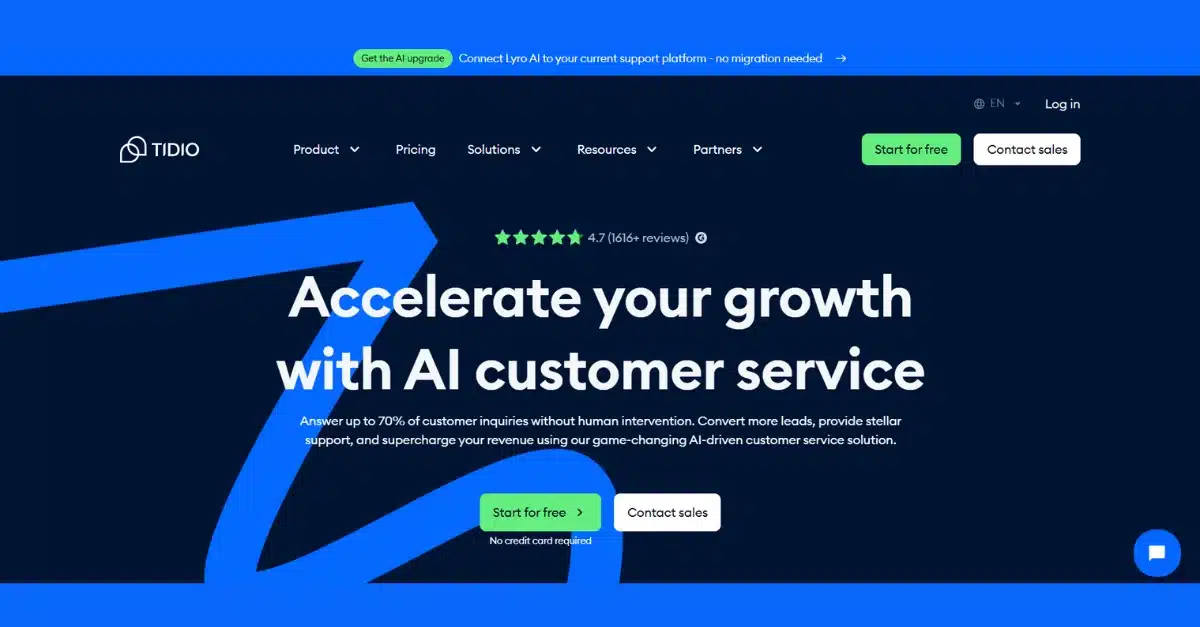
Tidio pairs live chat with an AI agent called Lyro. Lyro reads your help content and answers on its own, and Tidio reports it resolves up to 67 percent of conversations without a human. The WordPress plugin passes 80,000 active installs, and the WooCommerce connection is the best in this list.
Key Features
- Lyro AI agent that answers from your own content.
- Live chat with a shared inbox for your team.
- Native WooCommerce support, including cart and order data.
- One inbox across WhatsApp, Messenger and Instagram.
- Visitor list showing what people are browsing right now.
Pricing
- Free plan with live chat and a monthly allowance of Lyro AI conversations.
- Starter around $29 per month for three seats.
- Lyro AI billed per conversation on top, from roughly $39 per month.
Best For
Small and mid-sized WooCommerce stores that want one tool for both live chat and AI replies. Watch the per-conversation cost as traffic grows.
2. ChatBot.com (Paid)
Overview
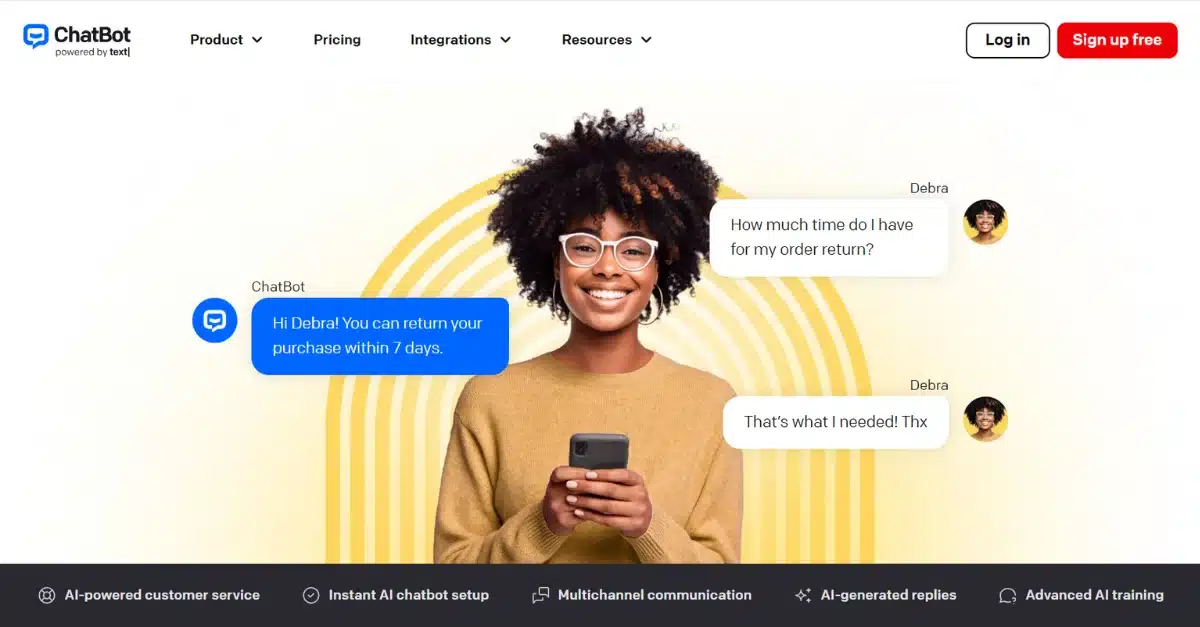
ChatBot.com is a hosted builder from the team behind LiveChat. It is a polished commercial product with a visual editor and solid reporting. There is no free tier, which puts it out of reach for a hobby site.
Key Features
- Visual drag-and-drop conversation builder.
- Trains on your site content and uploaded documents.
- Clean handover into LiveChat for human agents.
- Reporting on resolution rate and unanswered questions.
- Works on WordPress, Messenger, Slack and web widgets.
Pricing
- No free plan, though a trial is available.
- Paid plans start around $52 per month billed annually.
Best For
Businesses already using LiveChat, and teams that want a supported commercial product instead of something they assemble.
3. WPBot (Free & Paid)
Overview
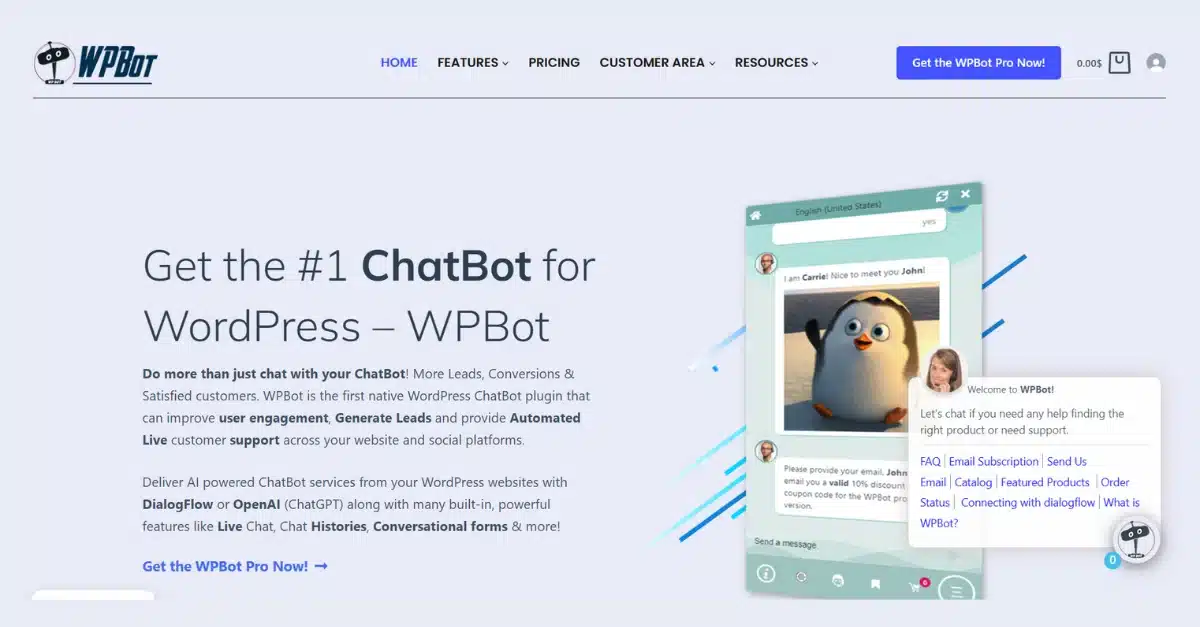
WPBot is the most WordPress-native option here. It builds a searchable knowledge base from your pages, PDFs, CSV and JSON files, then answers from it. You connect your own model key, so there is no per-conversation billing.
Key Features
- Builds a knowledge base from your own pages and files.
- Works with OpenAI, Gemini, Grok and OpenRouter, which includes Claude.
- Runs inside WordPress, not as an external widget.
- WooCommerce product search inside the chat.
- No per-conversation fee, so cost does not scale with traffic.
Pricing
- Free version on the WordPress plugin directory.
- Starter around $39 per year for one site.
- Professional around $99 per year for two sites, Master around $189 per year for five.
- Lifetime licences from around $149.
- Model usage billed separately by your AI provider.
Best For
Content sites and stores that want predictable costs. This is our pick if you are comfortable creating an API key.
4. AI Engine by Meow Apps (Free & Paid)
Overview
AI Engine is the most installed AI plugin for WordPress, past 100,000 active installs. It is a toolkit, not a chat widget alone. It covers a chatbot, content generation and an embeddings index of your site. It replaces Drift on this list, and the next section explains why.
Key Features
- Chatbot that answers from an embeddings index of your content.
- Bring your own key for OpenAI, Anthropic, Google or a local model.
- Shortcode and block placement, so the bot can sit on one page only.
- Usage and cost tracking built into the dashboard.
- Active development with frequent releases.
Pricing
- Free version covers the chatbot and basic AI features.
- Pro from around $49 per year.
- You pay your model provider directly for usage.
Best For
WordPress owners who want the bot inside their own site, with full control over the model and no per-message markup.
5. Chatra (Free & Paid)
Overview
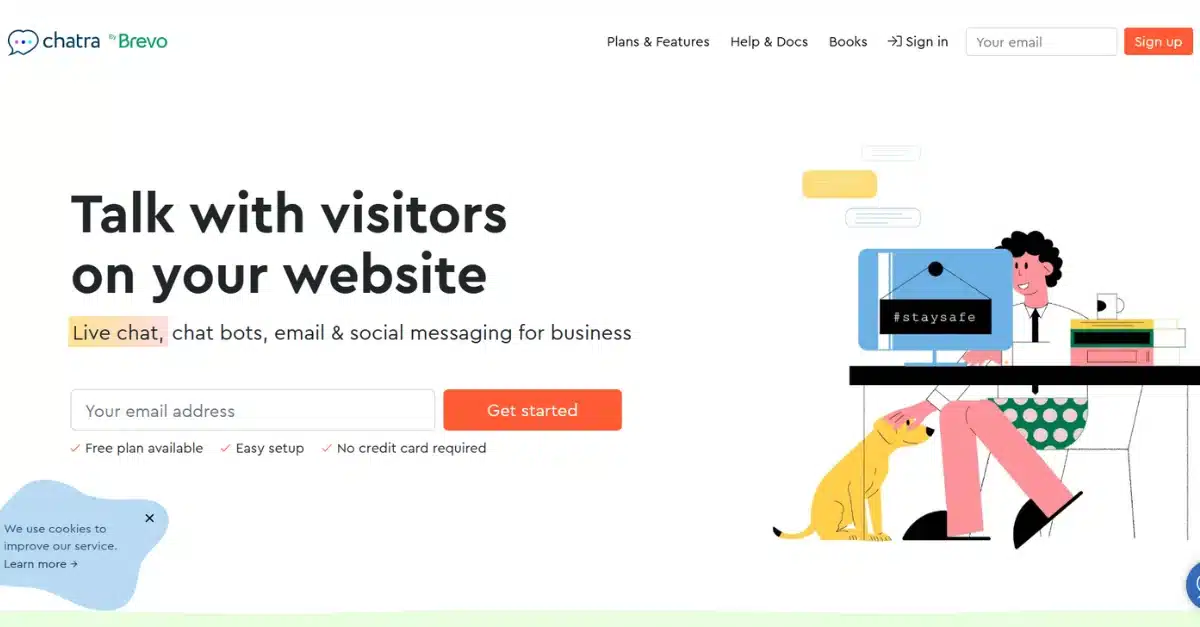
Chatra stays close to its roots as a friendly live chat tool with automation on top. It is not trying to be an AI platform. If you want a human-first widget where a person usually answers, that focus is a feature.
Key Features
- Live chat with a clean, fast agent inbox.
- Sees what a visitor typed before they send it.
- Automated greetings triggered by page or time on site.
- WooCommerce cart visibility for agents.
- Offline messages captured as email.
Pricing
- Free plan for one agent with live chat.
- Paid plans from around $19 per agent per month.
Best For
Small teams that answer chats themselves and want automation only for greetings and out-of-hours capture.
6. Botpress (Free & Open Source)
Overview
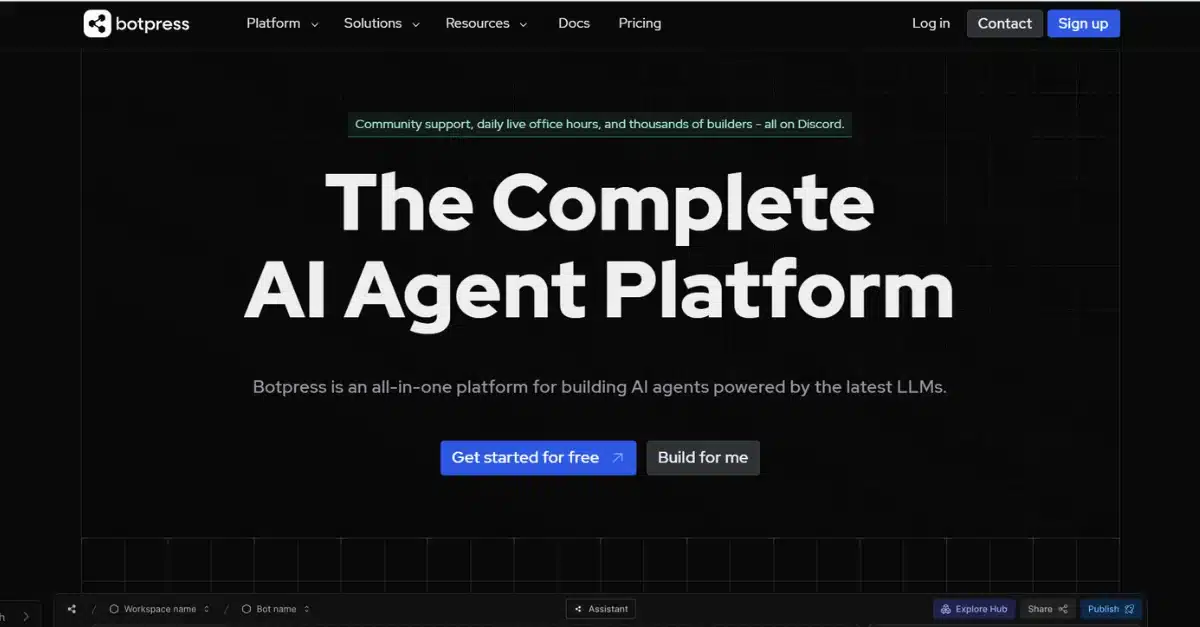
Botpress is a developer platform, not a plugin you install and forget. You build the agent on their platform, then embed it. In exchange for the setup effort you get full control over logic, tools and data.
Key Features
- Open-source core with a hosted option.
- Connects to your own APIs and databases as tools.
- Multiple model providers supported.
- Version control and staging for conversation logic.
- Embeds on WordPress through a script or iframe.
Pricing
- Open-source and free to self-host.
- Hosted plans have a free tier, then usage-based pricing.
Best For
Developers and teams with an unusual workflow that off-the-shelf plugins cannot express. Overkill for a brochure site.
7. Landbot (Paid)
Overview
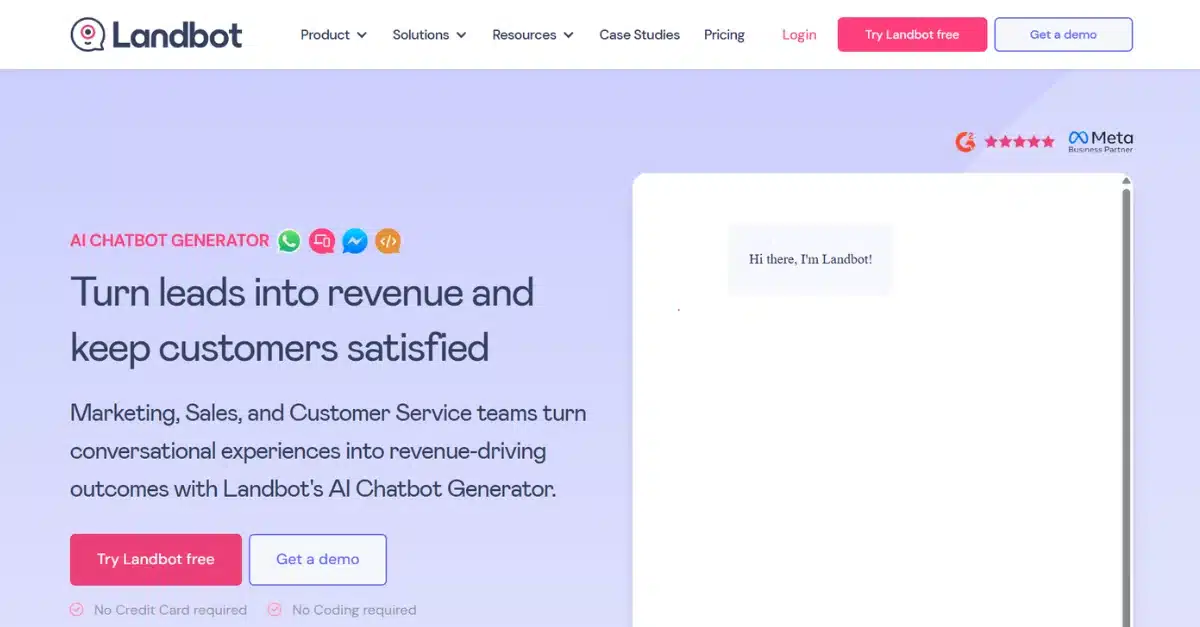
Landbot builds conversations that feel like a form someone enjoys filling in. It is the best tool here for structured data capture, such as qualifying a lead or booking a call. It is a weaker choice for open support questions.
Key Features
- Visual builder with branching logic and no code.
- Conditional questions based on earlier answers.
- Native calendar and CRM connections.
- Full-page conversational landing pages.
- WhatsApp and web channels from one build.
Pricing
- Free tier for a small number of monthly chats.
- Paid plans from around $40 per month.
Best For
Lead qualification, bookings and surveys, where you know the questions in advance and want clean data out.
8. IBM watsonx Assistant (Paid)
Overview
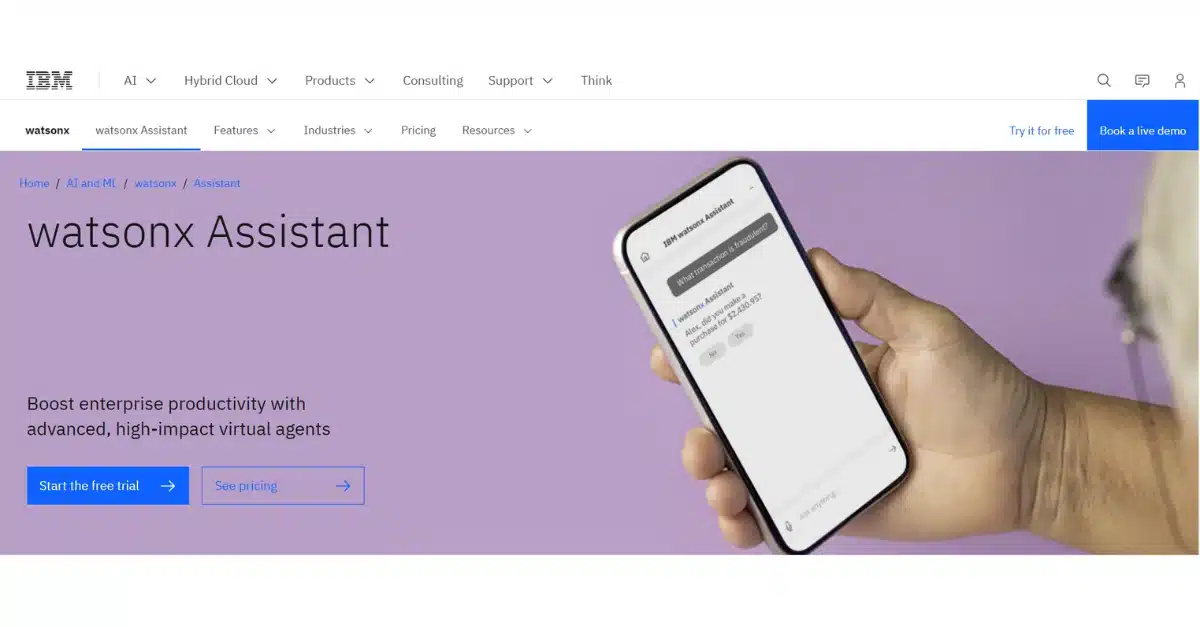
The plugin many guides still call IBM Watson Assistant is now watsonx Assistant. IBM renamed it as part of the watsonx platform, and the WordPress connector still works. It is enterprise software, priced and configured that way.
Key Features
- Strong intent recognition across many languages.
- Detailed control over how the assistant escalates to a human.
- Deploys to web, phone and messaging from one build.
- Compliance and data residency controls larger firms need.
- Free WordPress connector plugin on the directory.
Pricing
- Lite tier is free, limited to around 1,000 monthly active users.
- Plus starts around $140 per month, plus a small per-message charge.
Best For
Large organisations with compliance requirements and someone to configure it. Too heavy for a small business site.
9. Flow XO (Free & Paid)
Overview
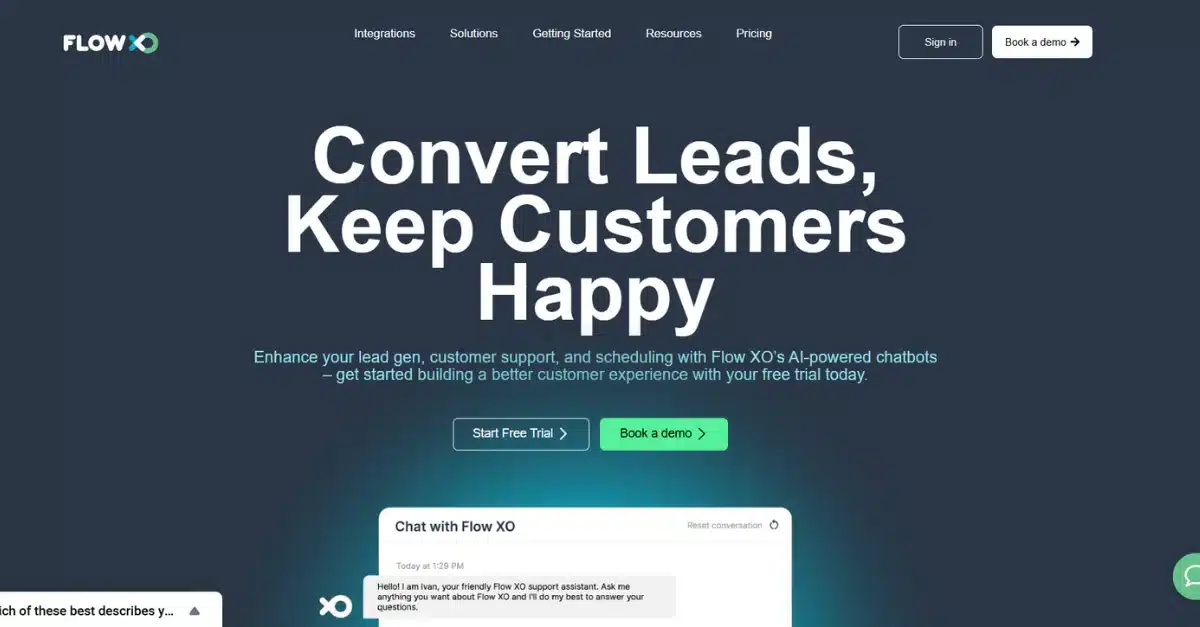
Flow XO connects a chatbot to a long list of other services. Its strength is the integration count, not the conversation quality. Think of it as automation plumbing that happens to have a chat front end.
Key Features
- Over 100 service integrations without extra middleware.
- One bot deployed to web, Messenger, Telegram and SMS.
- Branching flows with saved user attributes.
- Payment collection inside a conversation.
- Prebuilt templates for common support and booking flows.
Pricing
- Free plan with a monthly interaction limit.
- Paid plans from around $25 per month.
Best For
Teams that need the bot to trigger work in other systems, such as creating a ticket or updating a CRM record.
10. Collect.chat (Free & Paid)
Overview
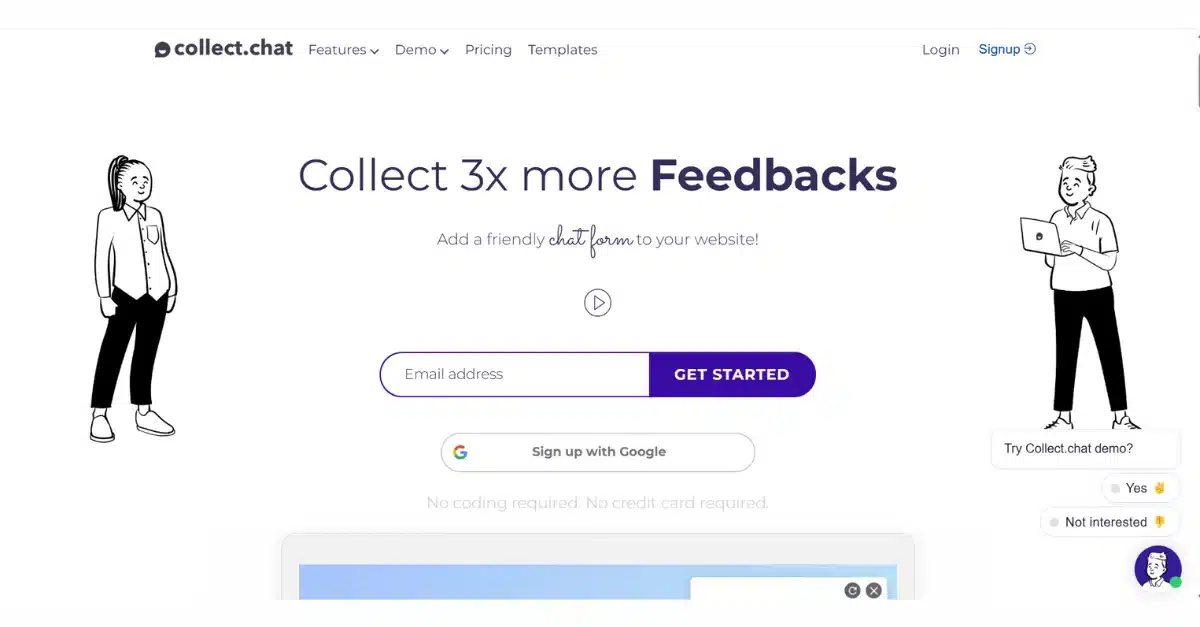
Collect.chat is the simplest tool on this list, and that is the point. You build a short question sequence, drop it on a page, and answers land in your inbox or a spreadsheet. No AI, no model keys, no training.
Key Features
- Template library for feedback, bookings and lead capture.
- Answers exported to Google Sheets automatically.
- Setup measured in minutes, not hours.
- Works without any AI configuration.
- Lightweight script that does not slow the page much.
Pricing
- Free plan with a monthly response limit.
- Paid plans from around $24 per month.
Best For
Bloggers and small sites that want structured answers from visitors, not a support agent.
Why Drift is no longer on this list
Drift appeared on almost every WordPress chatbot roundup for years, including earlier versions of this one. It should not appear on any of them now.
Salesloft acquired Drift in February 2024. In March 2026, Clari and Salesloft announced that Drift would be gradually retired, naming 1mind as the successor for existing customers. Before that, its minimum contract had climbed well beyond what a small WordPress site would spend.
If a 2026 buying guide still recommends Drift, it was not checked in 2026. That is worth remembering when you read the next roundup, including this one. Check the pricing page yourself before you commit.
Quick comparison of WordPress chatbot plugins
| Plugin | Answers from your content | Pricing | Best for |
|---|---|---|---|
| Tidio | Yes, Lyro agent | Free, paid from $29/mo | WooCommerce stores |
| ChatBot.com | Yes | From $52/mo | LiveChat users |
| WPBot | Yes, bring your own key | Free, from $39/yr | Predictable costs |
| AI Engine | Yes, bring your own key | Free, Pro from $49/yr | WordPress-native control |
| Chatra | No, rules only | Free, from $19/agent/mo | Human-first support |
| Botpress | Yes | Free self-hosted | Developers |
| Landbot | No, rules only | Free tier, from $40/mo | Lead capture |
| watsonx Assistant | Yes | Free Lite, from $140/mo | Enterprises |
| Flow XO | Partly | Free, from $25/mo | Tool integrations |
| Collect.chat | No, rules only | Free, from $24/mo | Simple surveys |
The second column is the one that matters most in 2026. A plugin marked “rules only” needs you to write every branch by hand.
Which one we would choose
Picking from a list of ten is harder than picking from three, so here are three.
- Running a WooCommerce store: start with Tidio. The cart and order integration saves real support time, and the free tier is enough to test whether customers use it at all.
- Running a content site and watching costs: use WPBot or AI Engine with your own API key. A busy blog often runs a few dollars a month in model usage, against $40 or more for a hosted plan.
- You only want answers to three questions: use Collect.chat and stop there. Not every site needs AI, and a short question flow converts better than a bot that guesses.
One last thing from our own support inbox. The plugin matters less than the content behind it. A retrieval bot pointed at a thin help page gives thin answers. Write six good answers first, then install the plugin.
If your site needs something none of these do, we build custom WordPress plugins for exactly this kind of gap.
Frequently Asked Questions (FAQs)
Q1. What does a chatbot do on a WordPress website?
It answers common visitor questions without a person present, captures leads outside office hours, and passes harder questions to your team. On a store it also handles order and shipping questions, which are usually the highest volume tickets.
Q2. Are free WordPress chatbot plugins any good?
Yes, and two of the best options here have real free versions. Understand which kind of free you are getting. A free plugin where you pay for model usage often costs less overall than a hosted plan with a free tier and a per-conversation charge.
Q3. Which chatbot plugin is best for a WooCommerce store?
Tidio, because it reads cart and order data natively. That lets the bot answer “where is my order” without a human. If cost predictability matters more than convenience, WPBot with your own API key is the cheaper long-term choice.
Q4. Can I connect a chatbot to my CRM and email marketing tools?
Nearly always. Flow XO and Landbot have the widest native lists. Most other plugins connect through Zapier or Make, which works but adds a monthly cost and a short delay before the record appears.
Q5. Will a chatbot plugin slow down my WordPress site?
It can, because most load an external script on every page. Load the widget only on pages where it is useful, and check your Core Web Vitals before and after. If the numbers move, our WordPress speed optimization service covers this.
Q6. What should I look for when choosing a chatbot plugin?
Ask whether it answers from your own content, whether you control the model, and what happens at ten times your current traffic. Those three answers rule out most of the market quickly.
Q7. Do I still need live chat if I have an AI chatbot?
Yes, for the questions the bot cannot close. Even the best agents resolve roughly two thirds of conversations. The remaining third is where sales are won and lost, so keep a route to a human visible.