

The cost of starting a business typically ranges from $3,000 for a lean online operation to well over $100,000 for a physical storefront, and knowing which category you fall into before you spend a dollar is the difference between a smart launch and a stressful one.
Having built tools for hundreds of online store owners, we’ve seen firsthand how early budgeting mistakes kill businesses that had real potential. Most entrepreneurs don’t run out of ideas. They run out of cash. The fix isn’t raising more money; it’s understanding exactly where that money needs to go.
This guide breaks down every major startup cost category, covers what most budgeting guides quietly skip, and gives you a realistic picture of what starting a business actually costs across different industries and models.
How Much Does It Cost to Start a Business?
The range is wide, but the variables are predictable.
According to a comprehensive breakdown of business startup costs by HomeBase, starting a business costs between $3,000 and $500,000, with online businesses typically under $10,000 and brick-and-mortar locations often exceeding $100,000. That gap comes down to three things: your business model, whether you need physical space, and whether you plan to hire staff from day one.
Here’s a quick reference by business type:
| Business Type | Typical Startup Cost Range |
|---|---|
| Freelance / Service (home-based) | $500 to $5,000 |
| Online store / Ecommerce | $2,000 to $30,000 |
| Retail (brick-and-mortar) | $10,000 to $300,000 |
| Restaurant / Food service | $50,000 to $500,000 |
| Tech startup / SaaS | $5,000 to $500,000 |
| Nonprofit / Social enterprise | $500 to $100,000 |
One number surprises a lot of new founders. According to recent SBA data reviewed by Beancount.io, the median startup cost across all industries is approximately $40,000, though many successful businesses have launched with far less by starting small and scaling gradually.
That $40,000 median gets pulled up by restaurants and retail. If you’re starting an online business or a service-based operation, you can do it for a fraction of that figure but only if you budget correctly from the start.
Online Businesses vs. Brick-and-Mortar: The Cost Gap
Physical space is the single biggest cost lever in any business. Rent, fit-out costs, utilities, and in-person staff all add up before you’ve made a single sale.
As HomeBase’s analysis of startup expenses points out, most online business owners work from home, avoiding rent entirely, which removes what would otherwise be a $2,000 to $8,000 monthly fixed cost from your budget immediately. That’s not a small saving. That’s the difference between surviving month three and not.
The trade-off is real, though. Online businesses still need a reliable tech stack, a marketing budget, and time to build visibility. None of that is free. The advantage is that those costs are variable. You can start small and scale as revenue comes in. Physical businesses often can’t do that. The lease is the lease.
One-Time Costs vs. Ongoing Costs: Know the Difference
Every startup expense falls into one of two buckets, and mixing them up is one of the most common budgeting errors new founders make.
One-time costs are what you pay to get the doors open: registration fees, logo design, initial inventory, equipment, and website setup. You pay them once and move on. The U.S. Small Business Administration notes that one-time startup expenses are generally tax-deductible, which can reduce your tax liability in the first year, so keep track of every receipt and discuss timing with your accountant.
Ongoing costs are what you pay every month to stay open: hosting, payroll, software subscriptions, marketing, and payment processing fees. These determine your burn rate, which is the amount of cash your business consumes each month before revenue covers it.
Most startup guides focus heavily on the one-time list and gloss over the ongoing column. That’s where businesses get into real trouble. You can afford to open. You can’t afford to stay open.
One-Time Startup Costs You Need to Budget For
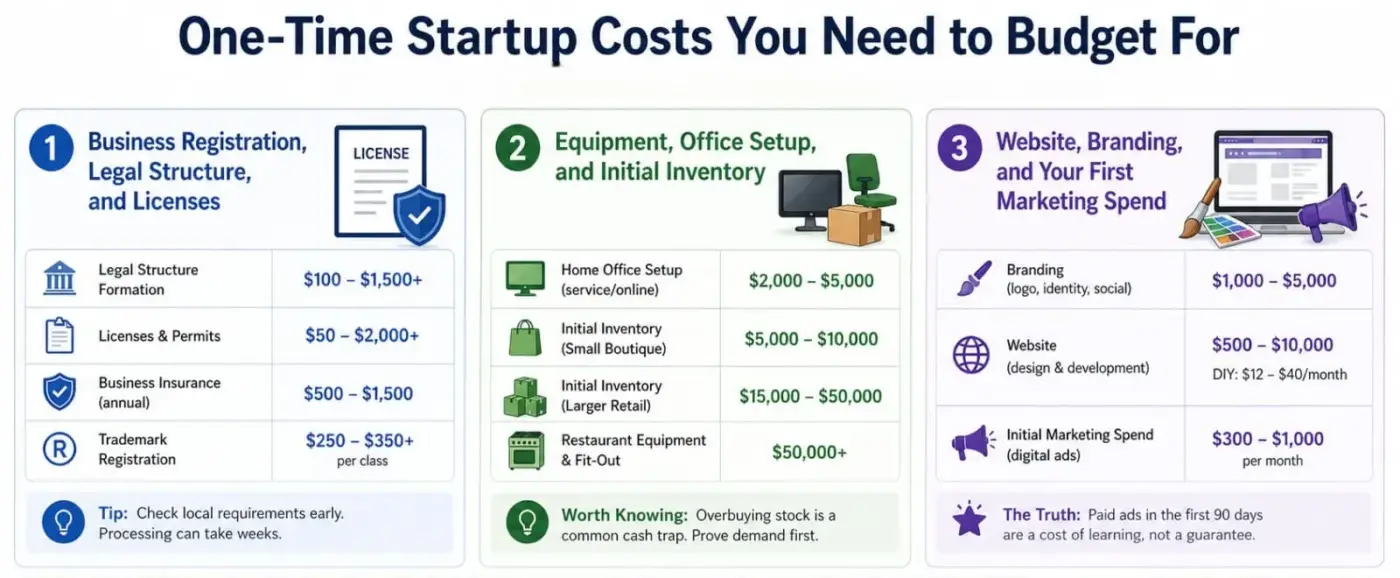
These are the expenses you’ll face before launch or very shortly after. Get them wrong, and you will lose all your capital or funds in a week.
Business Registration, Legal Structure, and Licenses
This is the first thing you pay, and it’s consistently underestimated.
Choosing the right legal structure matters more than most new founders realize. A sole ownership costs almost nothing to set up but offers no personal liability protection. According to HomeBase’s detailed startup cost breakdown, filing articles of incorporation or forming an LLC costs $100 to $250 with your state, with government filing fees adding another $50 to $200 on top. If you hire a lawyer to handle the formation, budget $500 to $1,500.
Beyond formation, you’ll need licenses and permits specific to your industry and location. General business licenses run $50 to $200, depending on your city and state. Industry-specific permits vary widely, such as food service health permits cost $100 to $1,000, while professional licenses can reach $500 to $2,000. Check your local requirements early. Processing takes weeks in some jurisdictions, and you cannot legally operate without them.
Business insurance is another cost that many founders delay until they regret it. General liability coverage for a small business typically runs $500 to $1,500 per year. If you have employees, workers’ compensation is a legal requirement in most states; budget for it separately from the start.
One more item that catches people off guard: trademark registration. If you want to protect your brand name or logo at the federal level, USPTO filing fees start at $250 to $350 per class, not counting attorney fees. Not every business needs this on day one, but it’s worth factoring into your first-year budget if brand protection matters to your model.
Equipment, Office Setup, and Initial Inventory
For service-based and online businesses, this category is lighter than most people expect. A home office setup needs $2,000 to $5,000 for a computer, printer, desk, and chair. If you already own the hardware, this line item drops to near zero.
Product-based businesses face a different calculation. As HomeBase outlines in their cost guide, small boutiques typically start with $5,000 to $10,000 in inventory, while larger retail operations invest $15,000 to $50,000 to properly stock shelves. Service businesses skip this cost entirely.
Worth knowing before you place your first inventory order: Overbuying stock is one of the most common cash traps for new product businesses. Prove demand first. Start with a narrow range and expand based on what actually sells. Sitting on $15,000 of unsold inventory in month two is a fast way to run out of runway.
Restaurants and food businesses face equipment costs that dwarf most other categories. Commercial kitchen appliances, refrigeration, POS systems, and health inspection-compliant fit-outs regularly push equipment costs past $50,000 before a single customer walks in.
Website, Branding, and Your First Marketing Spend
Your brand identity is the foundation that everything else sits on. According to Toast’s analysis of small business startup expenses, a small business owner can expect to spend anywhere from $1,000 to $5,000 on startup branding, covering website design, logo creation, and establishing a social media presence.
For the website itself, the range is genuinely wide. DIY platforms cost $12 to $40 monthly. Professional web design runs $2,000 to $10,000. Most small businesses land somewhere in the middle, spending $500 to $1,500 for a functional site with basic capabilities.
The truth about early marketing spend: organic traffic takes months to build. Search rankings don’t appear overnight. Social media followings grow slowly. For most new businesses, some level of paid advertising is necessary in the first 90 days just to get in front of potential customers. Budget $300 to $1,000 per month for digital ads at launch and treat it as a cost of learning what resonates, not a guaranteed return.
Recurring Monthly Costs That Quietly Drain Your Budget
Getting the business open is one problem. Keeping it running profitably is a different one entirely. These costs hit every single month, regardless of how sales are going.
Payroll, Benefits, and Contractor Fees
Labor is the highest ongoing cost for most businesses, and the real number is almost always higher than the headline salary figure suggests.
According to HomeBase’s payroll cost breakdown for small businesses, businesses with hourly employees spend 25 to 35% of revenue on payroll once operational. A business generating $50,000 in monthly revenue needs to budget $12,500 to $17,500 just for team wages, taxes, and benefits.
And that number still understates the true cost. Workers’ compensation insurance, employment taxes, healthcare, and paid vacation can add around 30% on top of an employee’s base salary. A $50,000 annual salary often becomes $65,000 once you add it all up. Plan accordingly.
For early-stage businesses without the cash flow to take on full-time staff, contractors and freelancers are almost always the leaner path. You pay for the work delivered, not the seat. No benefits. No payroll taxes. No severance complications. Most founders who start with contractors switch to full-time employees once they can genuinely justify the volume of work, not before.
Rent, Utilities, and Physical Infrastructure
If you have a physical location, these costs dominate your monthly budget.
Shared coworking spaces cost $200 to $500 per month. Small retail or restaurant spaces run $2,000 to $8,000 or more in most markets. And rent is just the beginning. First month, last month, and a security deposit are typically required upfront, which is three months of rent committed before your doors open.
Utilities add another significant layer. Electricity, water, phone, internet, heating, and cooling all compound quickly in larger spaces. Budget utilities separately from rent from day one. They rarely go down.
Home-based businesses avoid all of this, which remains one of the strongest financial arguments for starting online and expanding into physical space only when the revenue clearly justifies it.
Marketing, Advertising, and Customer Acquisition
Marketing is not a one-time cost. It is a permanent line item in your operating budget for as long as the business exists.
As noted in Toast’s small business cost analysis, ongoing marketing and public relations efforts typically cost 5 to 10% of annual revenue, and can run higher during growth phases, such as expanding to a second location or launching a new product line.
For a business doing $8,000 per month in revenue, that’s $400 to $800 per month in marketing spend just to maintain current performance. Growing the business costs more.
The metric to watch from day one is your customer acquisition cost (CAC), which is the amount you spend in total marketing to bring in one new paying customer. If your CAC is $45 and your average order value is $38, your business model doesn’t work yet. That math only improves through higher order values, stronger repeat purchase rates, or lower ad costs, and all three take deliberate effort and time to achieve.
Software Subscriptions and SaaS Tools
This is the cost that builds slowly and compounds fast.
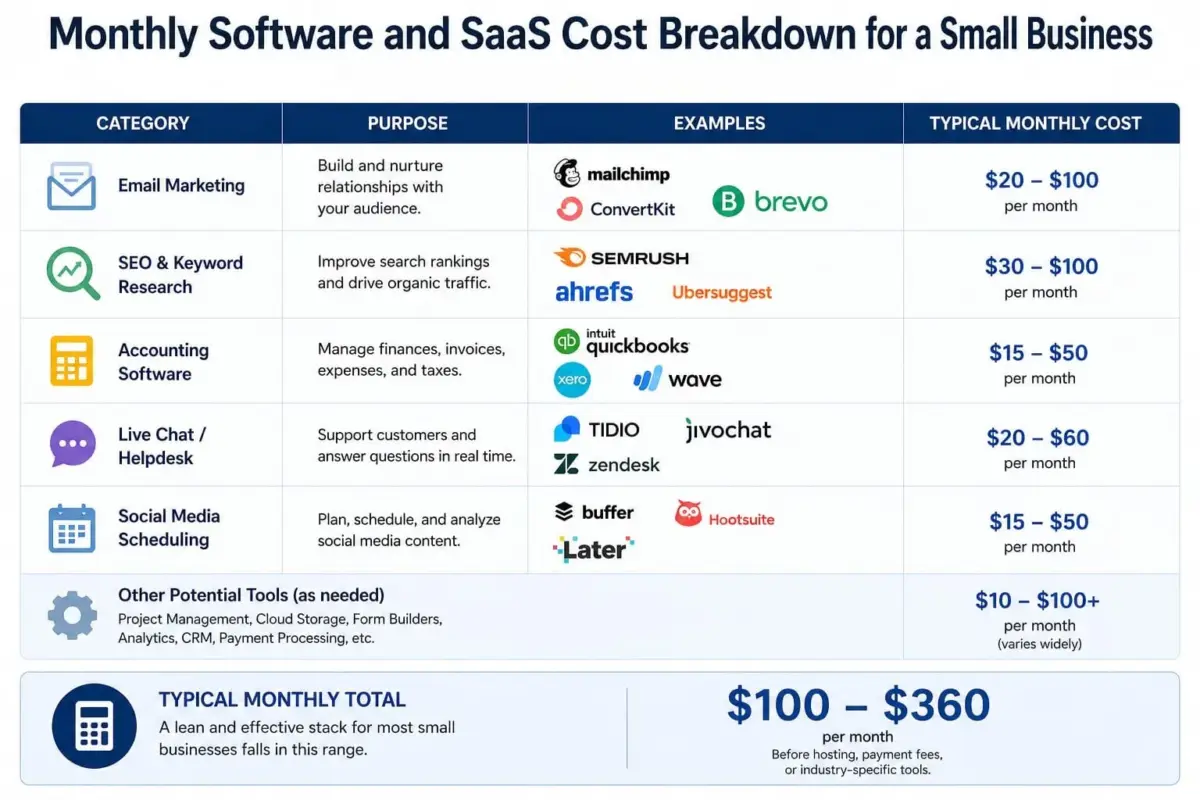
Email marketing, analytics platforms, accounting software, live chat, scheduling tools, SEO tools, and project management are individually cheap, collectively significant. A typical small business accumulates 8 to 12 software subscriptions within its first year, often without realizing the total monthly spend.
A realistic monthly SaaS stack for a small business:
- Email marketing: $20 to $100/month
- SEO and keyword research tool: $30 to $100/month
- Accounting software: $15 to $50/month
- Live chat or helpdesk: $20 to $60/month
- Social media scheduling: $15 to $50/month
That’s $100 to $360 per month before hosting, payment fees, or any industry-specific tools. Audit your subscriptions every six months. Cancel what you don’t actively use. Most businesses carry at least two subscriptions that deliver no measurable value.
Hidden Costs Nobody Tells You About
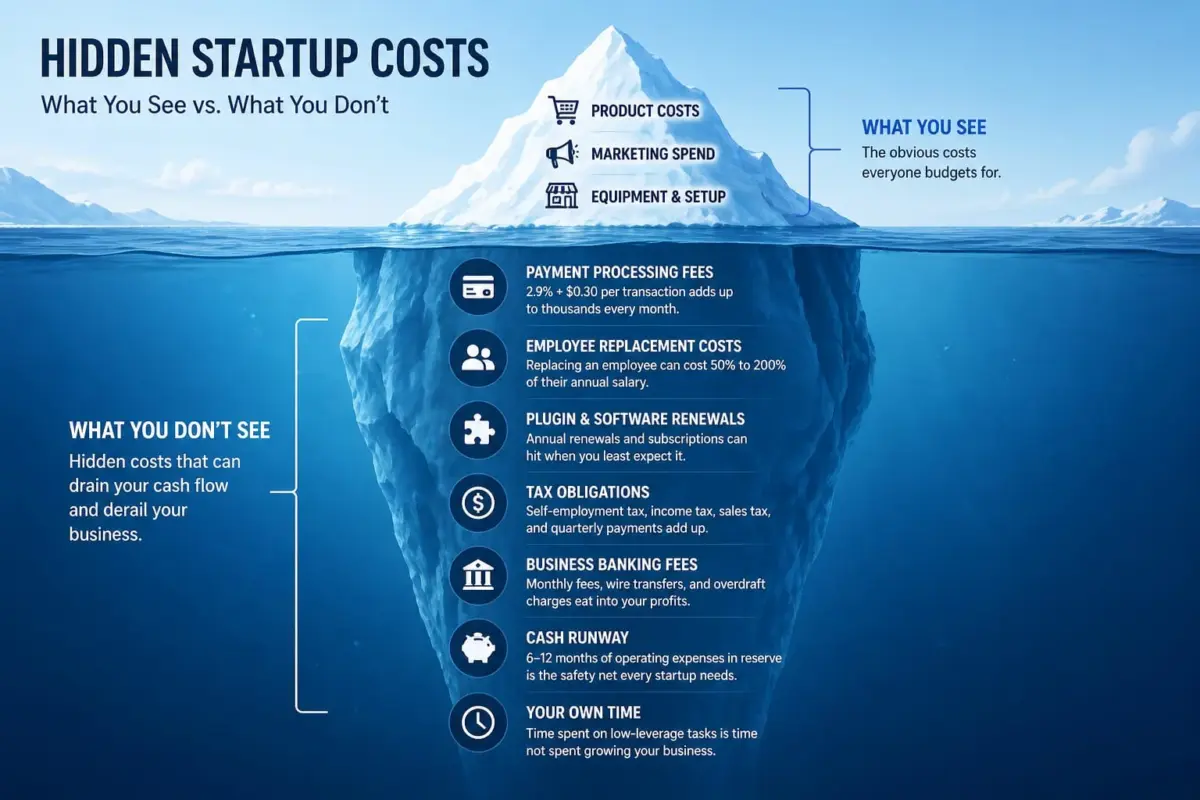
Every startup budget has a visible column and an invisible one. The invisible one is usually what causes the cash flow crisis in months four through nine.
- Payment processing fees: Almost every founder budgets the product cost and the marketing spend. Almost none budget the payment processor’s cut. Stripe, PayPal, and Square typically charge 2.9% plus $0.30 per transaction. On $20,000 in monthly revenue, that’s roughly $610 per month, more than $7,000 per year, going straight to the payment processor before you count a single expense. That is a real line item, not a rounding error. Budget it from day one.
- Employee replacement costs: If you hire people, plan for the fact that some of them will leave. According to Entrepreneur’s analysis of hidden business expenses, replacing an employee can cost 50% to 200% of their annual salary when you account for recruitment fees, training time, lost productivity, and the impact on team culture. A $45,000 employee who leaves after 10 months can cost $22,500 to $90,000 to replace. Build a retention budget alongside your hiring budget.
- Plugin and software renewals: You buy a tool in January, forget about the annual renewal, then get hit with a $200 charge the following January. Multiply that across five or six tools, and it becomes a surprise $1,000 bill arriving when you least expect it. Track every renewal date from day one. A simple spreadsheet is all you need.
- Tax obligations: This one attacks founders more than almost any other hidden cost. Self-employment tax alone runs around 15.3% in the US on top of income tax. Add state taxes, quarterly estimated payments, and sales tax obligations that vary by state and product type. Failing to budget for taxes creates cash flow crises at the worst possible times. Work with a tax professional before your first profitable quarter, not after.
- Business banking fees: Monthly account maintenance charges, wire transfer fees, and overdraft protection costs are easy to miss when you’re focused on revenue. Some banks charge $25 or more per month just to maintain a business checking account. Others offer free accounts for small businesses. Know which you’re signing up for before you open the account.
- Cash runway: This is the one most founders calculate wrong or skip entirely. The LivePlan startup financial guide puts it clearly: figure out how many months it will take before your sales can cover all monthly expenses, multiply that number by your monthly operating costs, and that is how much cash you need in your account when you open. Most financial advisors recommend 6 to 12 months of operating expenses in reserve at launch. If your monthly operating cost is $5,000, that’s $30,000 to $60,000 sitting in reserve before day one. Not many first-time founders have that, which means either raising it or starting leaner than originally planned.
- Your own time: This never appears on a budget spreadsheet, but it has a real cost. Every hour you spend on admin, bookkeeping, customer service, and social media is an hour you didn’t spend building the business. Founders who try to do everything themselves often plateau earlier than founders who outsource strategically. Track your time early and outsource low-leverage work as soon as revenue allows it.
What Does It Cost to Start Different Types of Businesses?
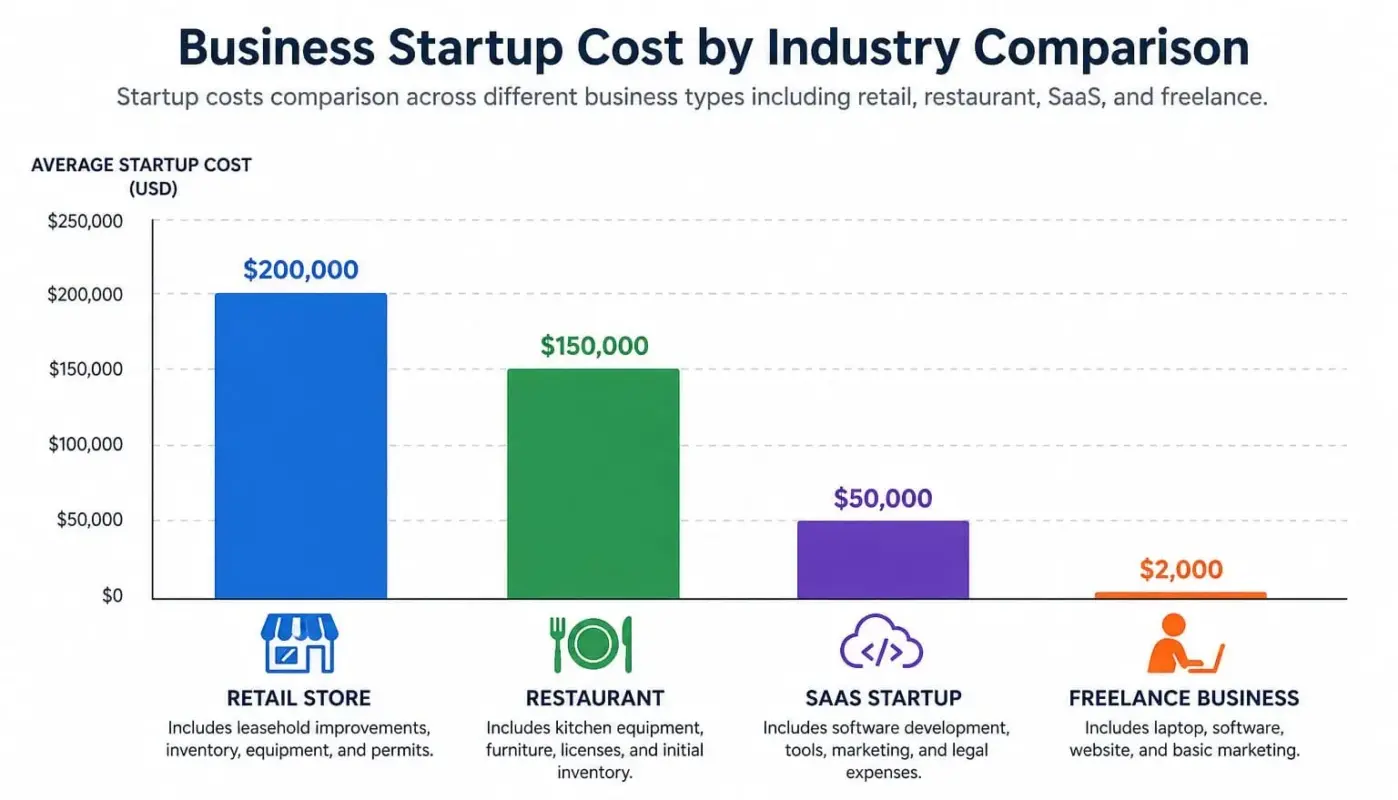
The averages above are a useful orientation. Industry-specific context makes them actionable.
Service-Based and Freelance Businesses
The lowest-cost model available to most founders. A freelance designer, writer, consultant, or coach can realistically launch for $500 to $2,000.
The main costs are business registration ($100 to $300), a professional website ($300 to $800), and a basic contract or proposal tool ($15 to $50 per month). If you already own a computer and have internet access, you’re most of the way there before spending anything significant.
The highest cost here isn’t financial, it’s time. Finding the first three to five clients consistently takes longer than most people plan for. Build several months of personal living expenses into your runway calculation alongside the business costs.
Retail and Product-Based Businesses
Physical retail carries some of the highest upfront costs of any business model. Lease deposits, inventory, signage, fit-out, POS hardware, and permits all arrive before a customer walks through the door.
A realistic budget for a small retail store runs $30,000 to $150,000 to open, depending on location and the level of renovation required. Most of that is the lease deposit and initial inventory. Many retail founders dramatically underestimate fit-out costs, what looks like a simple paint job can cost $15,000 to $50,000 once contractors are involved.
Ecommerce product businesses are significantly cheaper to launch, with inventory and marketing typically the dominant costs rather than physical infrastructure.
Restaurant and Food Service Businesses
Food service businesses have startup costs among the highest of any category, regularly $50,000 to $500,000 before opening day. Commercial kitchen equipment alone can run $15,000 to $200,000, depending on the type of operation. Add licensing, health permits, food safety compliance, staff training, and initial inventory, and the capital requirement becomes substantial fast.
Food trucks have grown popular partly because they cut the real estate cost significantly. A well-equipped food truck typically runs $50,000 to $150,000, considerably less than a full sit-down restaurant. For founders who want to enter food service without the full capital commitment, it’s a proven intermediate step.
Tech Startups and SaaS Businesses
The cost range here is the widest of any category: $5,000 to $500,000, depending entirely on product complexity and whether you’re building in-house or outsourcing development.
A solo founder who can build the product themselves can launch a minimum viable product for $5,000 to $20,000 in total operating costs. A team that needs to hire developers is looking at $50,000 to $200,000 before they have a shippable product. Stay as lean as possible until you have paying customers proving the market exists. Nothing in the startup world is more expensive than building something nobody wants.
How to Calculate Your Total Startup Costs
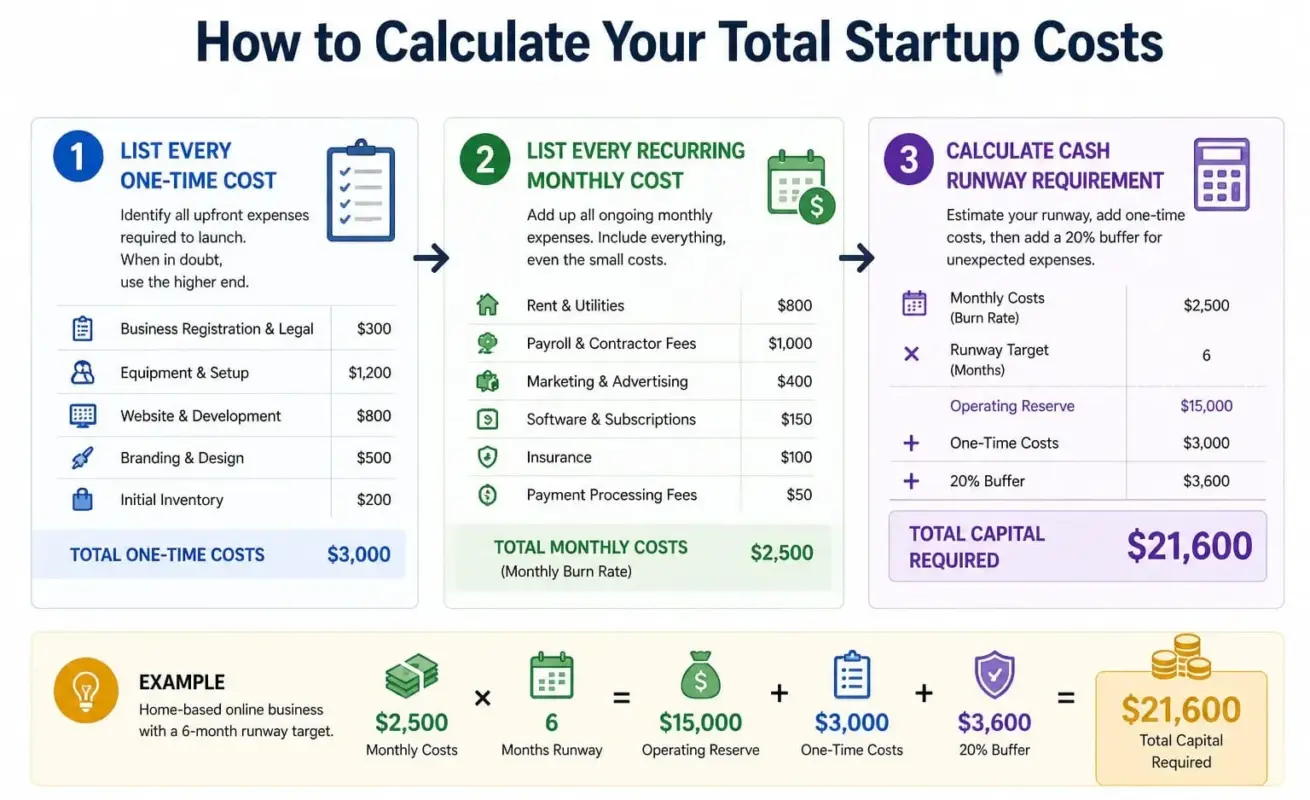
Knowing the categories is half the job. Calculating your specific number is the other half. Here’s a straightforward three-step framework.
Steps:
- List every one-time cost: Work through each category: registration, legal, equipment, website, branding, and initial inventory. Assign a realistic number to each. When in doubt, use the higher end of the range. The SBA’s startup cost calculator recommends creating a formal written report of your expected startup costs. It forces clarity on your numbers and strengthens any conversation you have with a lender or investor.
- List every recurring monthly cost: Rent, utilities, payroll, marketing, software, insurance, and payment processing fees. Add them all up. This is your monthly burn rate. Do not leave anything out, including costs that feel small, as they compound.
- Calculate your cash runway requirement: Estimate how many months it will realistically take before your revenue covers all monthly costs. As LivePlan’s financial planning guide explains, multiply that number of months by your monthly burn rate, then add your total one-time costs. That sum is the capital you need to launch responsibly. Add 20% for the costs you haven’t anticipated yet.
Here’s a simple example. A home-based online business with $2,500 in monthly operating costs and a 6-month runway target needs $15,000 in operating reserve, plus one-time costs of $3,000, plus a 20% buffer of $3,600. Total capital required: around $21,600. That’s a very different number from the “$500 to get started” figure that optimistic startup content throws around, and it’s the honest number this business actually needs.
Knowing your real number before you start is the most valuable planning step you can take.
How to Reduce the Cost of Starting a Business Without Cutting Corners
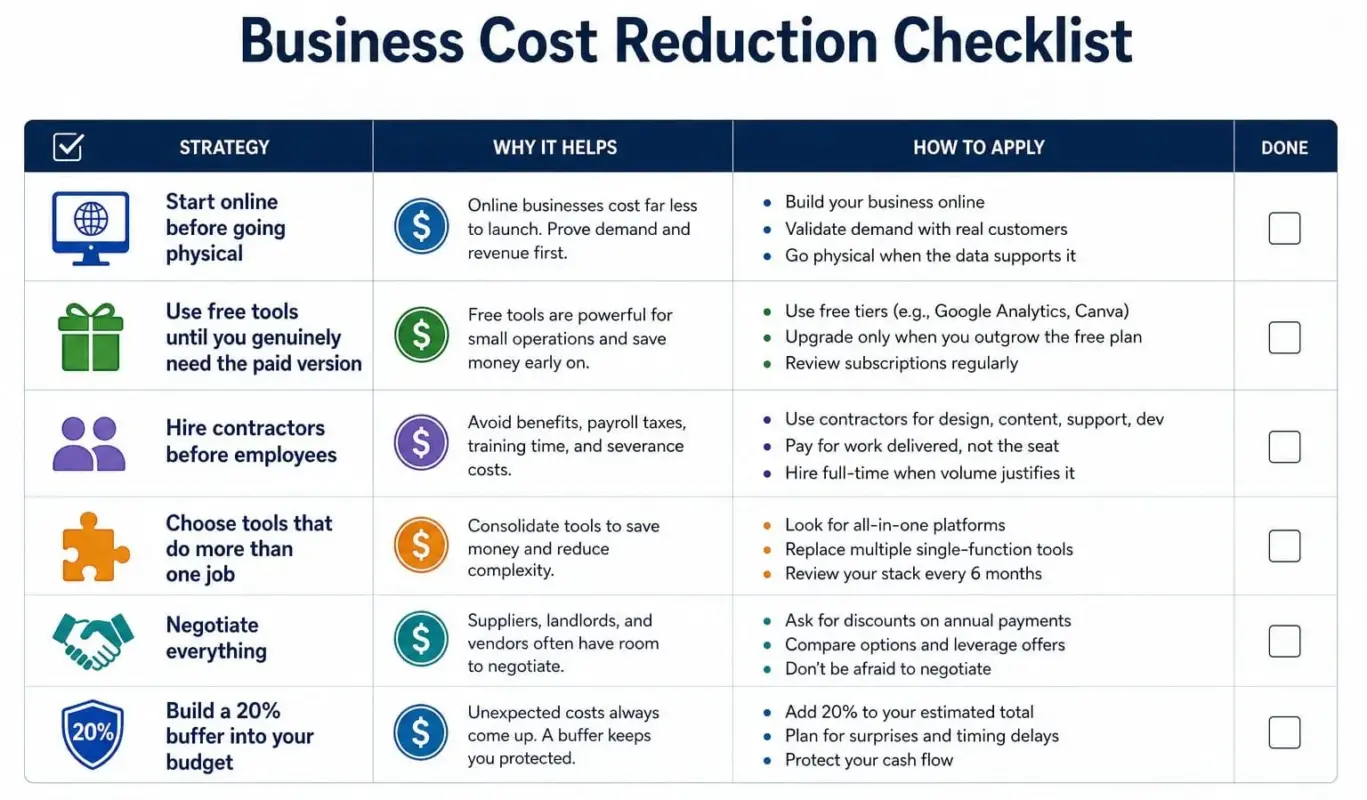
Cutting costs is smart. Cutting the wrong costs is expensive. Here’s how to tell the difference.
- Start online before going physical: An online business costs a fraction of a storefront to launch. Prove demand and build revenue online first. Open a physical location when the data supports it, not because it feels more legitimate or more “real.”
- Use free tools until you genuinely need the paid version: Most SaaS platforms have free tiers that are genuinely functional for small operations. Google Analytics is free. Canva’s free plan covers most early design needs. Delay paid upgrades until you’ve measurably outgrown the free version.
- Hire contractors before employees: You avoid benefits, payroll taxes, training overhead, and severance complications. For design, content, customer support, and development work in the first year, contractors are almost always the leaner option. Bring someone on full-time when the volume of work clearly justifies it, and not a week earlier.
- Choose tools that do more than one job: Every time you can replace two or three single-function subscriptions with one well-built tool, you save money and reduce operational complexity. This applies across your entire stack: email, loyalty programs, customer communication, and analytics. Consolidation is one of the most underrated cost strategies in small businesses.
- Negotiate everything: Suppliers, landlords, software vendors, service providers, almost all of them have room to negotiate, especially for annual commitments. Most people don’t ask. The ones who do regularly save thousands per year.
- Build the 20% buffer into your budget before you start: Every experienced founder gives the same advice. Add 20% to whatever your estimate is. Starting a business always surfaces costs you didn’t know.
For a deeper look at keeping operating costs under control as your business grows, our guide on ways to reduce expenses for your online business covers 11 practical steps you can apply immediately.
And if you’re building a retention strategy to lower your customer acquisition cost over time, the LoyaltyX Points and Rewards plugin and our WooCommerce Wallet plugin are tools worth looking at, both designed to drive repeat purchases without adding to your paid ad spend.
Conclusion
The cost of starting a business is rarely what you expect and almost always more than the first estimate. A lean online business can launch for a few thousand dollars. A full product-based operation with marketing spend and a realistic cash runway might need $15,000 to $30,000 before the first profitable month.
A brick-and-mortar business typically needs $50,000 or more just to reach opening day. The key is knowing which category you’re in, building a budget that accounts for both the visible and the hidden costs, and giving yourself enough runway to reach revenue before the money runs out.
Start lean. Prove demand. Then invest in that order. The businesses that survive the first year are rarely the ones with the biggest budgets. They’re the ones who understood what the money was actually for.
Thinking about what your business could be worth as it grows? Our guide on how to value your eCommerce business walks you through the key metrics that matter to buyers and investors alike.
Frequently Asked Questions
Q1. How much money do you need to start a business?
It depends on your business type. A freelance or service business can launch for $500 to $2,000. An online product business typically needs $2,000 to $15,000. A physical retail store usually requires $30,000 to $150,000 or more. The more important number is your cash runway how much you need to keep operating until revenue covers all monthly costs. Most advisors recommend 6 to 12 months of operating expenses in reserve before you open.
Q2. What is the cheapest type of business to start?
Service-based and digital product businesses are the cheapest to launch. A freelance consultant, writer, or designer can start for under $1,000 a domain, a basic website, and business registration are the essentials. Digital products like online courses, templates, or ebooks are similarly low-cost because there is no physical inventory to purchase or warehouse.
Q3. What are the highest hidden costs when starting a business?
The most overlooked costs are payment processing fees (2.9% on every card transaction adds up to thousands per year at scale), employee replacement costs (replacing a hire can cost 50% to 200% of their annual salary), annual software and plugin renewals that catch founders off guard in year two, self-employment and sales tax obligations, and the cash runway reserve that most founders underestimate or skip entirely in their planning.
Q4. Can I deduct startup costs on my taxes?
Yes, in most cases. One-time startup expenses: registration fees, legal costs, initial marketing, and equipment purchases are generally tax-deductible. The IRS allows businesses to deduct up to $5,000 in startup costs in their first year, with any remainder amortized over 15 years. Rules vary by jurisdiction and business structure, so confirm the specifics with a qualified tax professional before filing.
Q5. What is cash runway, and why does it matter?
Cash runway is how long your business can operate before revenue needs to cover all costs. If your monthly expenses are $4,000 and you have $24,000 in reserve, you have six months of runway. It matters because most businesses take longer to reach profitability than founders expect. Without sufficient runway, you’re forced to make decisions from a position of desperation: cutting corners, accepting bad clients, or closing prematurely when the business might have succeeded with another three months of breathing room.