
WooCommerce Wallet and Store Credit are not the same thing, and choosing the wrong one for your store’s goals can cost you repeat purchases and customer trust.
Having built and supported our WooCommerce wallet plugin across hundreds of stores, we’ve seen both tools used brilliantly and both used in ways that create more confusion than loyalty. Most guides treat them as interchangeable. They’re not.
A wallet is a pre-funded payment method. Store credit is a coupon-based discount mechanism. That single distinction changes everything about how you deploy them.
In this post, you’ll learn exactly about WooCommerce wallet vs store credit, how each system works, where each one earns its place, and when running both together makes more sense than choosing one.
What Is a WooCommerce Wallet?
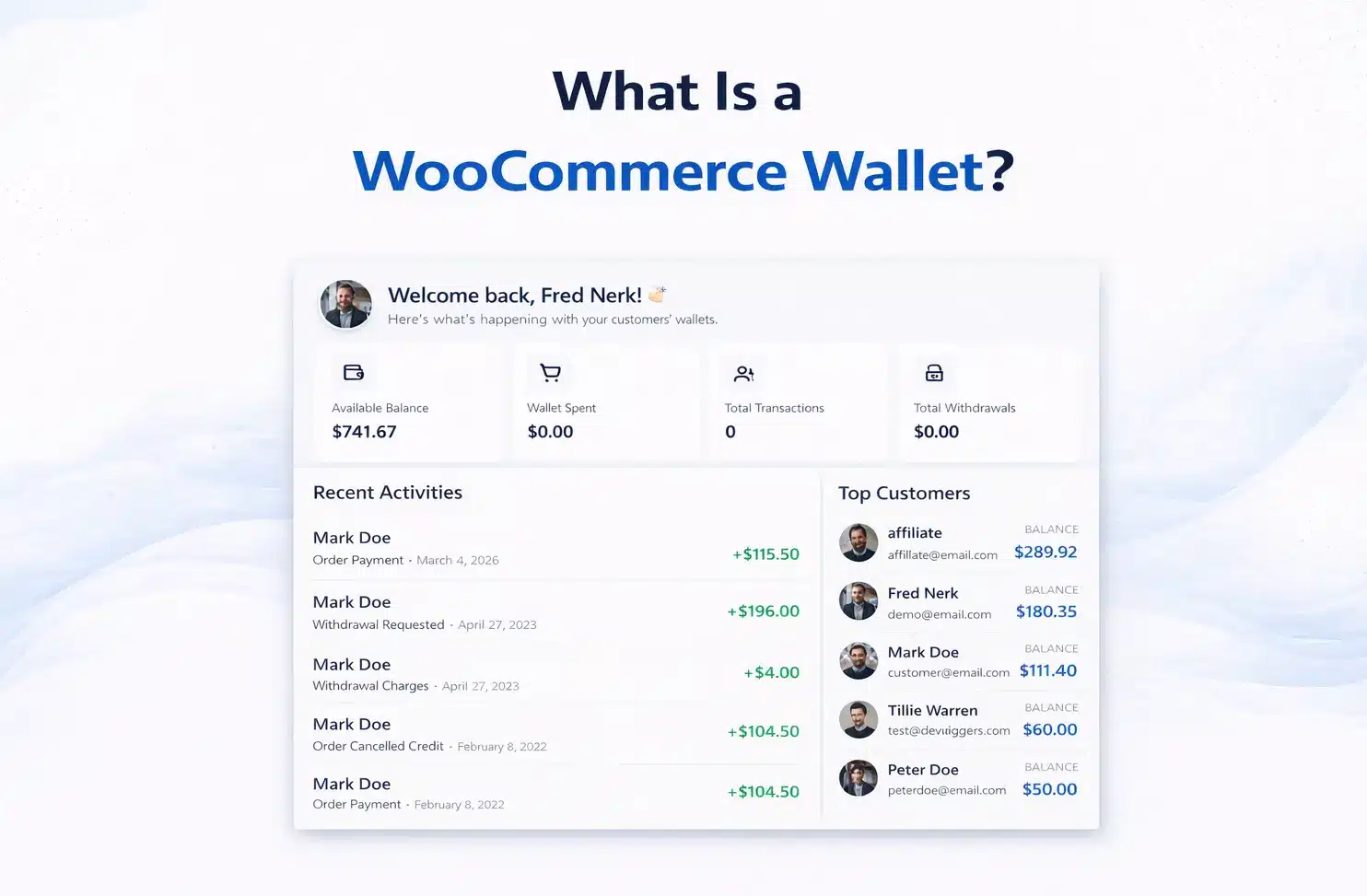
A WooCommerce wallet is a digital account balance that customers fund themselves or receive as a cashback reward. Think of it like a store-specific prepaid card. Customers deposit real money into their wallet, and that balance sits in their account until they choose to spend it.
The keyword is “funded.” Wallet balances represent the actual money a customer has pre-loaded. That matters for how it behaves at checkout, how refunds work, and even how it appears in your books.
How wallet top-up and checkout work in practice
A customer visits your store, navigates to their account, and deposits funds using any payment method you’ve enabled. That balance appears immediately. At checkout, they select the wallet as a payment method, and the amount is deducted from their balance.
If their wallet doesn’t fully cover the order, most WooCommerce wallet plugins, including our Wallet plugin for WooCommerce, support partial payment. The customer pays the shortfall using a standard gateway. This is a checkout experience that standard store credit simply can’t match natively.
Key features: partial payment, cashback, withdrawal, peer transfers
A fully featured WooCommerce digital wallet typically supports:
- Cashback rules: Automatically credit a percentage back to the customer’s wallet after each purchase
- Partial payments: Use wallet balance alongside a credit card or PayPal
- Withdrawal requests: Customers can request funds transferred back to their bank account
- Peer transfers: Some implementations allow one customer to send wallet funds to another
- Refund to wallet: Process a return and instantly restore funds to the customer’s balance
That last point is worth noting. Instant wallet refunds reduce support friction in a way that bank refunds and coupon-based credits don’t. Customers get their money back in seconds, not days.
What Is WooCommerce Store Credit?
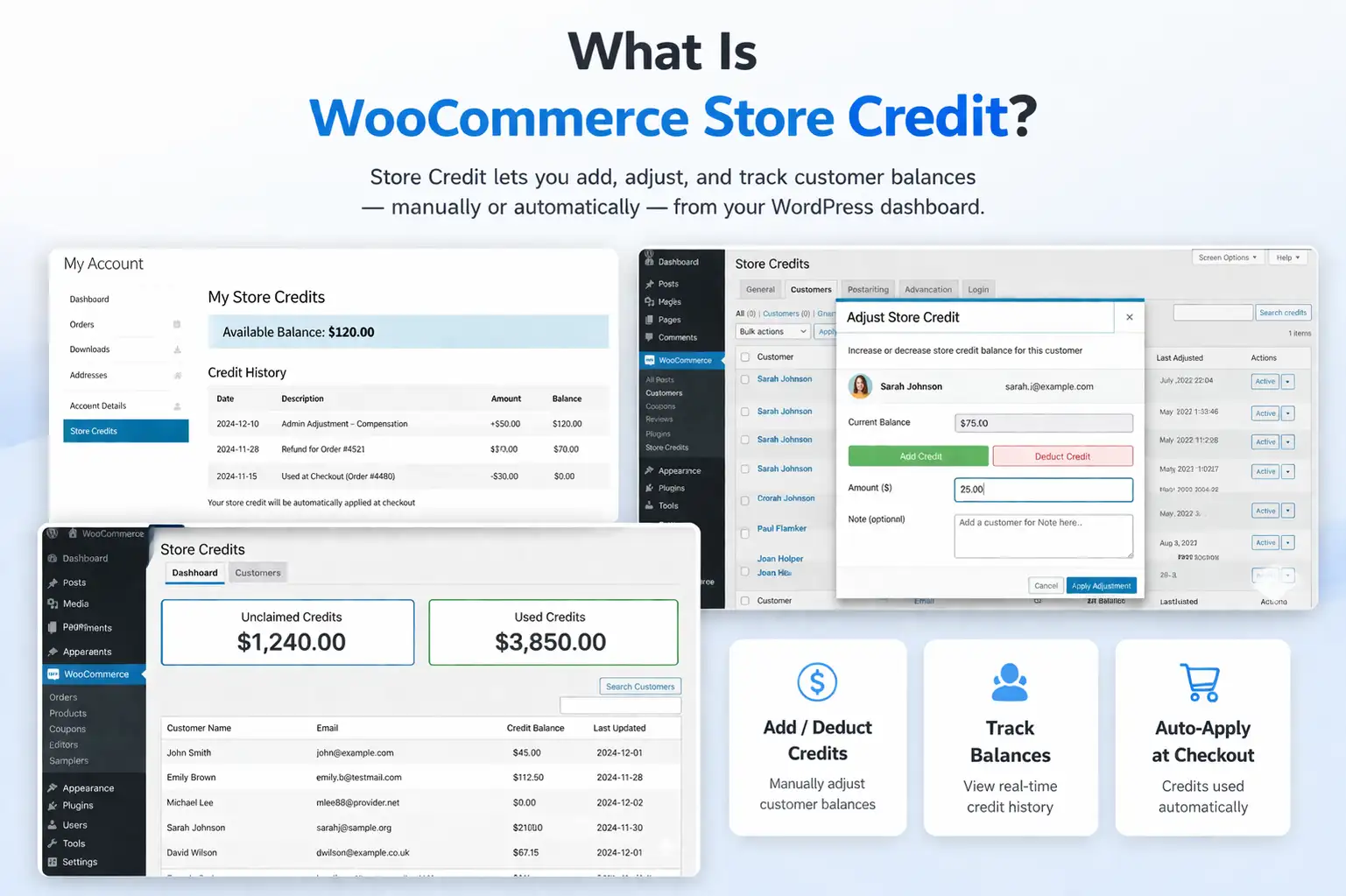
WooCommerce store credit is a credit balance applied to a customer’s account that reduces the cost of a future purchase. Unlike a wallet, store credit is not pre-funded by the customer. It’s issued by the store, usually as a reward, compensation, or refund.
Think of it as the digital equivalent of a gift voucher tied to a specific account. The customer didn’t pay cash for it. You gave it to them.
How store credit is issued and redeemed
Store credit is typically issued manually by an admin, triggered by an automation rule, or applied as part of a refund workflow. The customer sees a balance in their account and can apply it at checkout, usually as a discount against their cart total.
Most WooCommerce store credit implementations work through coupon-based logic under the hood. The system generates a virtual coupon and links it to the customer’s account. When they check out, the credit applies as a discount before payment is calculated.
Store credit vs. coupons: what actually sets them apart
A standard coupon is a code that anyone might find and share. Store credit is account-specific. It can only be used by the customer it was issued to.
That account-specificity is what makes store credit valuable as a retention and compensation tool. You’re giving something of value that only benefits the recipient, not a generic code that could be abused. That said, the coupon-based mechanics mean store credit doesn’t behave like a payment method. It reduces what the customer owes. It doesn’t replace how they pay.
WooCommerce Wallet vs Store Credit: Side-by-Side Comparison
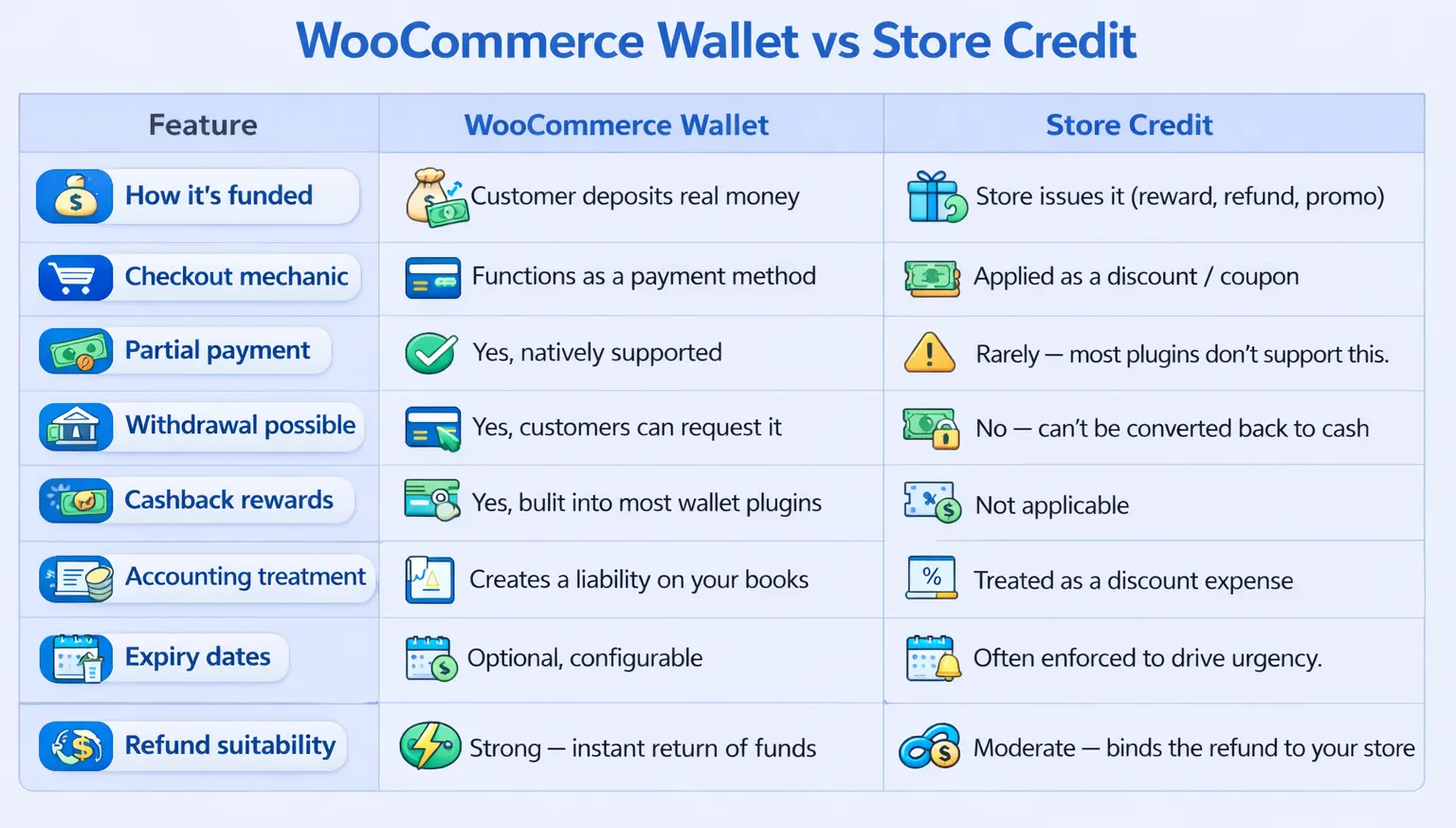
Here’s where most guides are unclear. Let’s be specific.
The critical structural difference most guides miss
Here’s what competitors consistently skip. A wallet top-up is a financial liability. When a customer deposits $50 into their wallet, you hold $50 of their money. It sits on your books as an amount you owe them. That’s a meaningful distinction from an accounting and cash flow perspective. If you’re on any form of accrual accounting, this needs to be tracked correctly.
Store credit, by contrast, is typically treated as a discount expense at the point of redemption. You haven’t received any money up front. You’ve created an obligation to discount a future purchase. The financial footprint is fundamentally different.
This won’t matter much to a store doing $5,000 a month. At scale, it matters a lot.
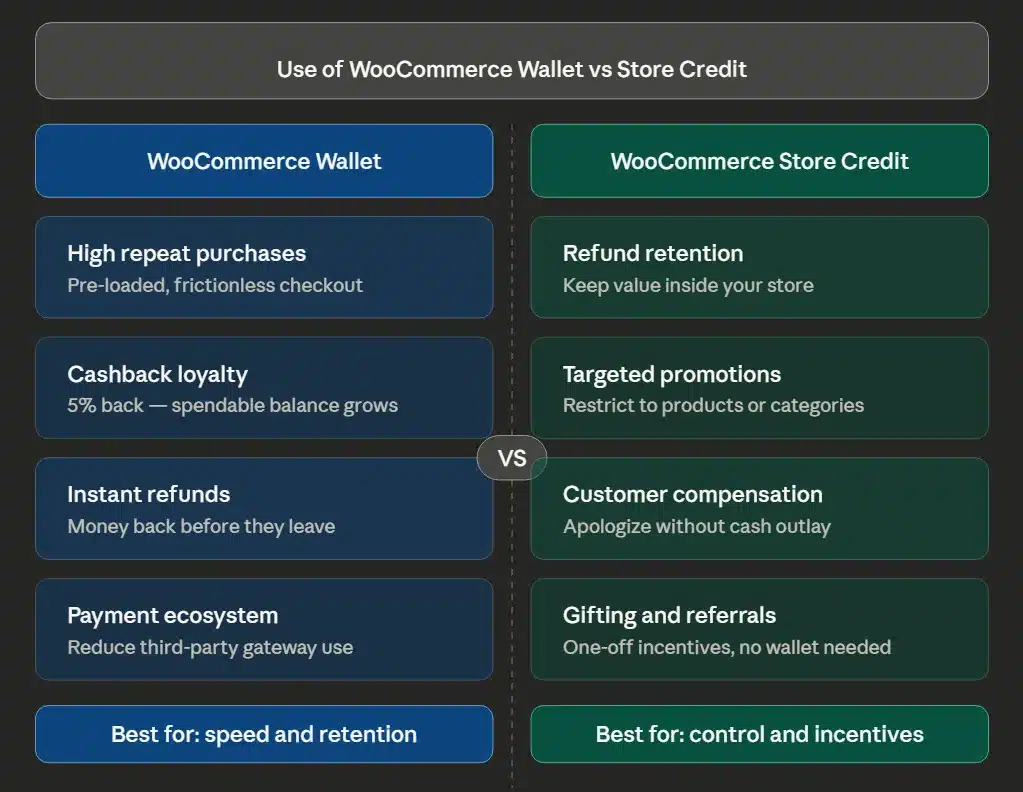
Use of WooCommerce Wallet vs Store Credit
1. WooCommerce Wallet
A wallet earns its place when checkout speed, cashback incentives, or instant refunds are central to your retention strategy. Here are the scenarios where it clearly wins.
- High repeat-purchase stores: If customers buy from you regularly, think about consumables, pet supplies, supplements, digital products on subscription, a pre-loaded wallet removes friction from every single return visit. For stores where maximising sales with your WooCommerce wallet is a genuine growth lever, this checkout speed advantage compounds over time.
- Cashback-driven loyalty: If your loyalty strategy is “reward them for buying”, a wallet is the cleanest delivery mechanism. Issue 5% cashback directly to the customer’s wallet balance. They see the balance grow with each order. That spendable balance creates a reason to return those points.
- Faster, friendlier refunds: A wallet refund is instant. The customer gets their money back before they’ve left your site. From our experience building and supporting the Wallet plugin for WooCommerce, stores that switch to wallet refunds consistently report fewer post-return complaints.
- Stores wanting a payment ecosystem: If you’re building toward a more self-contained checkout experience, understanding how digital wallets work in eCommerce gives useful context. A wallet lets you gradually reduce dependency on third-party payment gateways for returning customers.
2. WooCommerce Store Credit
Store credit has a different purpose. It’s not about payment speed. It’s about giving customers a reason to return when they otherwise might not. It works best in these situations.
- Refund management with retention intent: A customer returns a product. You could offer store credit as the default refund method, keeping the value inside your store. Many customers will accept this, especially if the credit amount matches the refund.
- Targeted promotions with spending constraints: Store credit can often be restricted to specific products or minimum order values. If you want customers to spend credit on products with higher margins, store credit gives you that control.
- Compensating customers without a cash outlay: A customer had a poor experience. Issuing $10 store credit costs you nothing until they redeem it. It demonstrates good faith and keeps the value in your store.
- Gifting and referral bonuses: Refer a friend, get a $15 credit. Join our email list, get a $5 credit. There’s no wallet to fund, no payment infrastructure to set up. It’s just a balance applied when they next check out.
Can You Use Both? The Combined Strategy
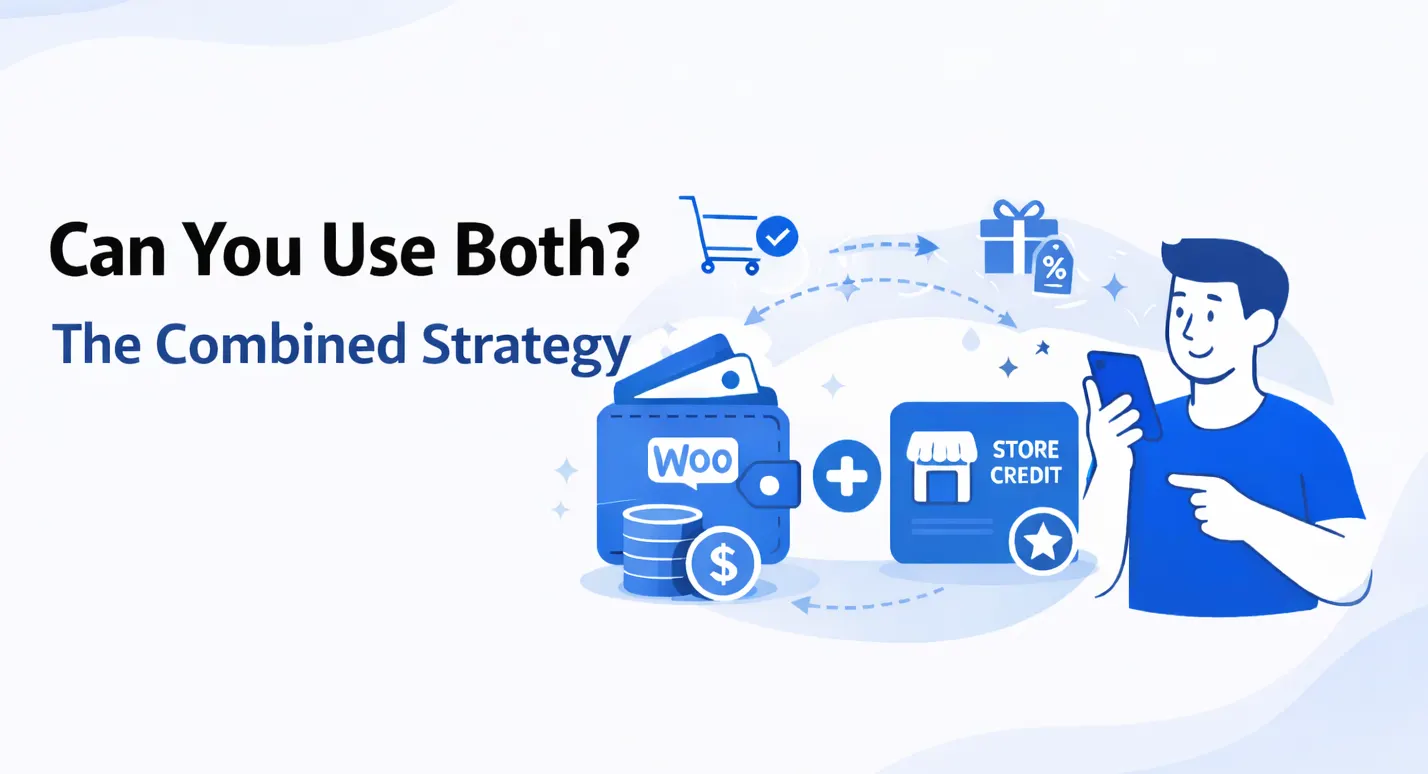
A WooCommerce wallet and WooCommerce store credit are not competing tools. They solve different problems, which means they can coexist in the same store without confusing customers.
Imagine you run a supplement store. You set up a wallet system where customers who pre-load $50 or more get a 3% cashback bonus on every order. Their wallet balance grows passively with each purchase. Checkout is fast. Refunds are instant. This is your retention and payment infrastructure.
Separately, you offer $10 store credit to customers who refer a friend. The credit applies as a discount at their next checkout. It’s a one-time incentive, not an ongoing payment mechanism. It doesn’t interfere with the wallet at all.
And when a customer has a bad experience and contacts support? You issue store credit as compensation. You don’t touch their wallet balance.
For stores running a loyalty program alongside both WooCommerce’s rewards and loyalty extensions, provide a useful reference for how these systems can layer. Our Points and Rewards for WooCommerce plugin fits neatly into this stack as the points layer, sitting alongside a wallet for payment and store credit for targeted incentives.
The one thing to avoid is issuing both wallet cashback and store credit for the same action. Customers find it confusing when their rewards appear in two different places. Pick one mechanism per reward type and communicate it clearly.
For stores with strong mobile traffic, optimising your WooCommerce wallet for mobile shoppers becomes even more relevant when running a combined strategy. Fast wallet checkout matters twice as much on a phone screen.
Conclusion
WooCommerce wallet vs store credit comes down to one question: are you building a payment system or a discount mechanism?
A wallet gives customers a funded balance they control, with partial payment support, cashback rewards, and instant refunds. It’s a payment infrastructure tool that happens to drive loyalty. Store credit is an account-specific discount that you control, useful for refunds with retention intent, targeted promotions, and low-cost compensation.
Most growing stores need both. Use the wallet as the foundation for repeat-purchase engagement and checkout speed. Layer store credit on top for campaigns, compensation, and referral incentives.
If you’re ready to add a WooCommerce wallet to your store, our WooCommerce Wallet plugin handles everything from cashback rules and partial payments to withdrawal requests and wallet-based refunds, all from one admin dashboard.
Frequently Asked Questions(FAQs)
Q1. Can WooCommerce store credit expire?
Yes. Store credit can be set with an expiry date, which most plugins support as a configurable option. Expiry creates urgency and encourages customers to return before the credit lapses. A wallet balance, by contrast, does not usually expire unless you specifically enable that setting.
Q2. Can a customer withdraw WooCommerce store credit to their bank account?
No. Store credit is account-specific and cannot be converted to cash or withdrawn. A WooCommerce wallet, however, can support withdrawal requests, allowing customers to transfer their funded balance back out. Whether you enable this is up to the store admin.
Q3. Is a WooCommerce wallet the same as gift cards?
Not exactly. A gift card is typically a fixed-value voucher that can be shared or gifted to someone else. A wallet balance is tied to a specific customer account and is usually funded by that customer or through cashback. Some plugins blur this line, but mechanically they are different.
Q4. Which is better for handling refunds: wallet or store credit?
Both work, but for different reasons. A wallet refund is faster, feels more like getting real money back, and can even be partially withdrawn. Store credit refunds are better when you want to keep the value inside your store and give the customer a reason to return rather than simply recoup their money.
Q5. Does using a WooCommerce wallet affect my accounting?
It can. Wallet top-ups represent funds that customers have deposited but not yet spent. On an accrual basis, these are a liability on your books. Store credit issued as a future discount is typically recognised as a discount expense only when it’s redeemed. If you’re managing significant wallet volumes, talk to your accountant about how to track these correctly.
Q6. Can WooCommerce wallet and store credit work together in the same store?
Yes, and this is often the smartest approach. Use the wallet as your ongoing payment and cashback infrastructure. Use store credit for one-off incentives, compensation, and referral bonuses. They serve different purposes and can run in parallel without conflicting, as long as you don’t issue both for the same customer action.