
Building a solid digital marketing strategy for a new product launch is completely possible, and you can have the core plan ready in a few days. Most guides skip the single most important step: deciding what happens before you announce anything. Get that wrong, and the rest of the plan doesn’t matter much.
Here’s the uncomfortable truth. Around 95% of new products fail, according to research tracking Harvard Business School data. That’s not because the products are bad. It’s because most teams start marketing too late, target too broadly, and have no plan for what to do when the first week’s numbers disappoint.
This guide walks you through a six-phase digital marketing strategy, a channel ranking framework, and the metrics that tell you whether your launch is working.
What is a Digital Marketing Strategy for a New Product Launch?
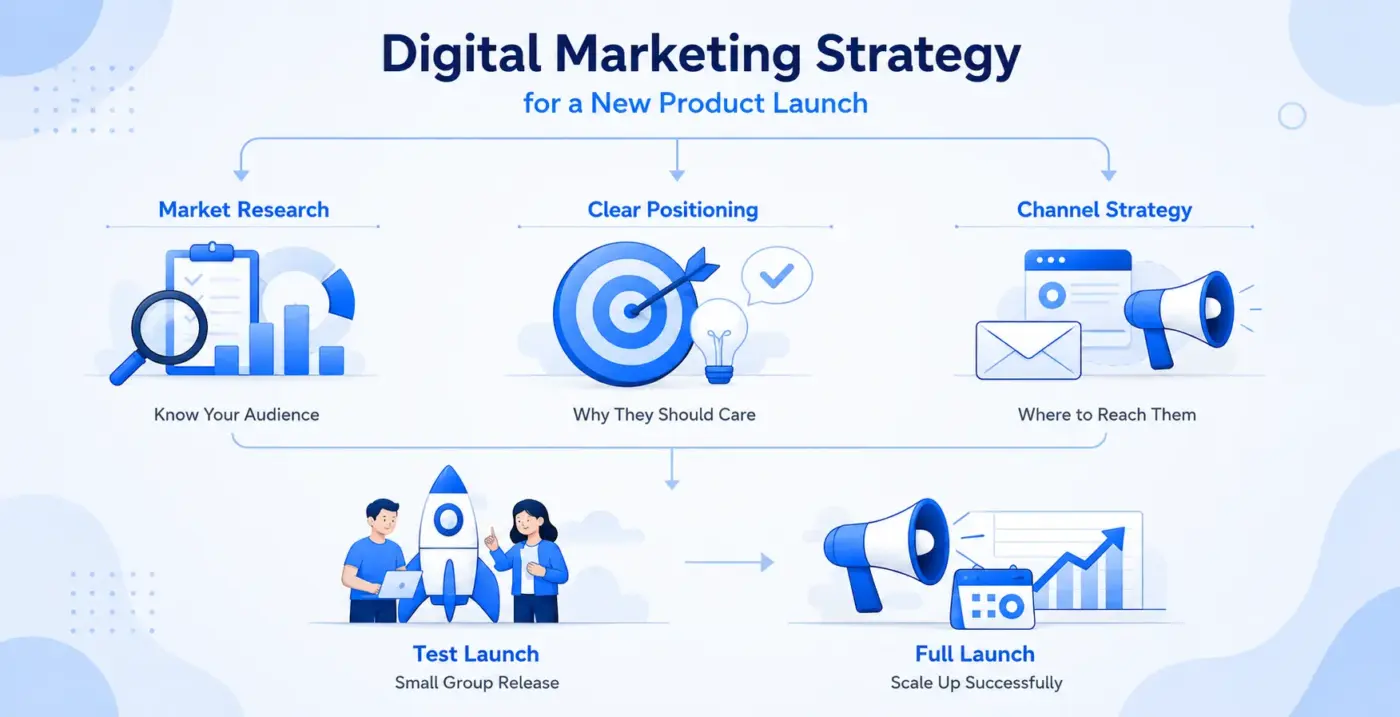
A digital marketing strategy for a new product launch is a planned approach to building awareness, demand, and sales for a product using online channels. It covers everything from the first teaser post to the follow-up email you send 30 days after launch day.
Worth separating from a launch plan. Your strategy sets the direction: who you’re targeting, what message you’re leading with, and which channels carry that message. Your plan is the execution detail: dates, budgets, copy, and assets. Both matter. But most teams write the plan and skip the strategy, which is why the plan falls apart under pressure.
A strong go-to-market strategy answers three questions before you spend a single dollar:
- Who specifically is this for?
- Why should they care right now?
- Where will you find them, and what do you say?
If you can’t answer all three clearly, you’re not ready to run ads or write launch emails. You’re guessing.
Why Most Launches Fail Before They Begin
Harvard Business School research puts the product launch failure rate at about 95% of the roughly 30,000 new consumer products released every year. That number gets cited a lot. What gets cited less is why.
Poor market research is the main cause. Thorough market research raises the likelihood of a successful launch by up to 30%, according to CB Insights data. Yet most product launch marketing plans skip this phase or treat it as a checkbox. Teams survey their existing customers, hear positive responses, and assume that’s proof. It’s not. It’s biased thinking.
The second cause is timing. Teams start the product launch marketing plan too late, which compresses everything into a rushed two-week push. Paid ads go live before there’s an email list to retarget. Social posts go out before there’s an audience to see them. Launch day arrives, and the numbers are quiet.
A third cause that nobody talks about: launching to everyone at once. The brands that succeed tend to launch to a small, committed group first, prove the product works, and then scale up. That approach builds word-of-mouth before the big spend starts.
Step-by-Step Digital Marketing Strategy for a New Product Launch
This is the main work. Six phases, each with a specific focus. The timeframes below are based on a mid-sized launch. Adjust them for your product and resources, but keep the sequence.
Most store owners get into trouble when they collapse these phases or run them out of order. Running paid ads before you have a list to retarget is a common one. Announcing on social before your landing page is live is another. The sequence matters.
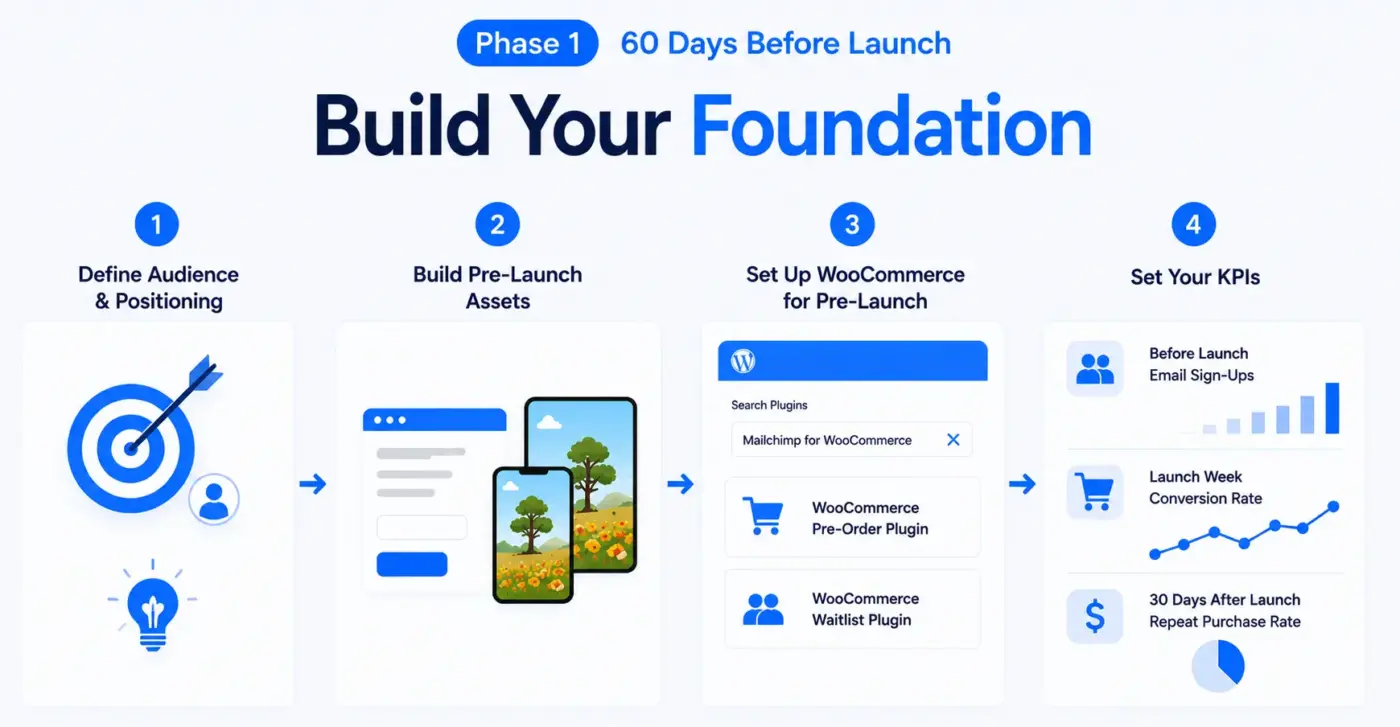
Phase 1: 60 Days Before Launch: Build Your Foundation
Before anything goes public, you need the groundwork in place.
Define your target audience precisely. Not “women aged 25 to 45 who like fitness.” Something more specific: “women in their 30s who already buy supplements online but are frustrated that most products don’t have transparent ingredient sourcing.” The more specific, the better your messaging will be. Vague audiences produce vague copy.
Research your market positioning. Look at what competitors are saying. Find the gap. Not “better quality”, that’s what everyone says. Find the angle that is both true about your product and not already claimed by competitors. This positioning statement becomes the core of every piece of content you write over the next 60 days.
Build your pre-launch assets:
- Write your landing page copy
- Set up your email capture with a lead magnet (early access, a discount, or a useful free resource)
- Draft a 4 to 6-email pre-launch sequence
- Outline 8 to 10 pieces of social content for the pre-launch period
For WooCommerce stores, this is the time to set up your WooCommerce Pre-Order plugin if you’re allowing early purchases, or your WooCommerce Waitlist plugin to capture demand before stock arrives. Either one gives you a real number to work with. You’ll know exactly how much interest exists before launch day, which means you can size your paid ad budget with data instead of guessing.
Set your Key metrics now, not later. Decide what success looks like at each phase. Email sign-ups before launch. Conversion rate on launch week. Repeat purchase rate at 30 days. If you wait until after launch to decide what you’re measuring, you’ll measure the numbers that look best instead of the ones that matter.
Phase 2: 30 Days Before Launch: Run Your Pre-Launch Campaign
Your landing page is live. Your email capture is running. Now you turn on the pre-launch campaign.
The goal here is not sales. It’s list building and awareness. You want as many of the right people as possible to know your product exists before you ask them to buy.
Email is your highest-value channel at this stage. Research from McKinsey shows 71% of consumers expect customised communication from brands, and 76% get frustrated when it doesn’t happen. Your pre-launch sequence should feel like it’s written for the reader, not broadcast to a crowd. Use their name. Reference what they signed up for. Show them behind-the-scenes content about the product they’re waiting on.
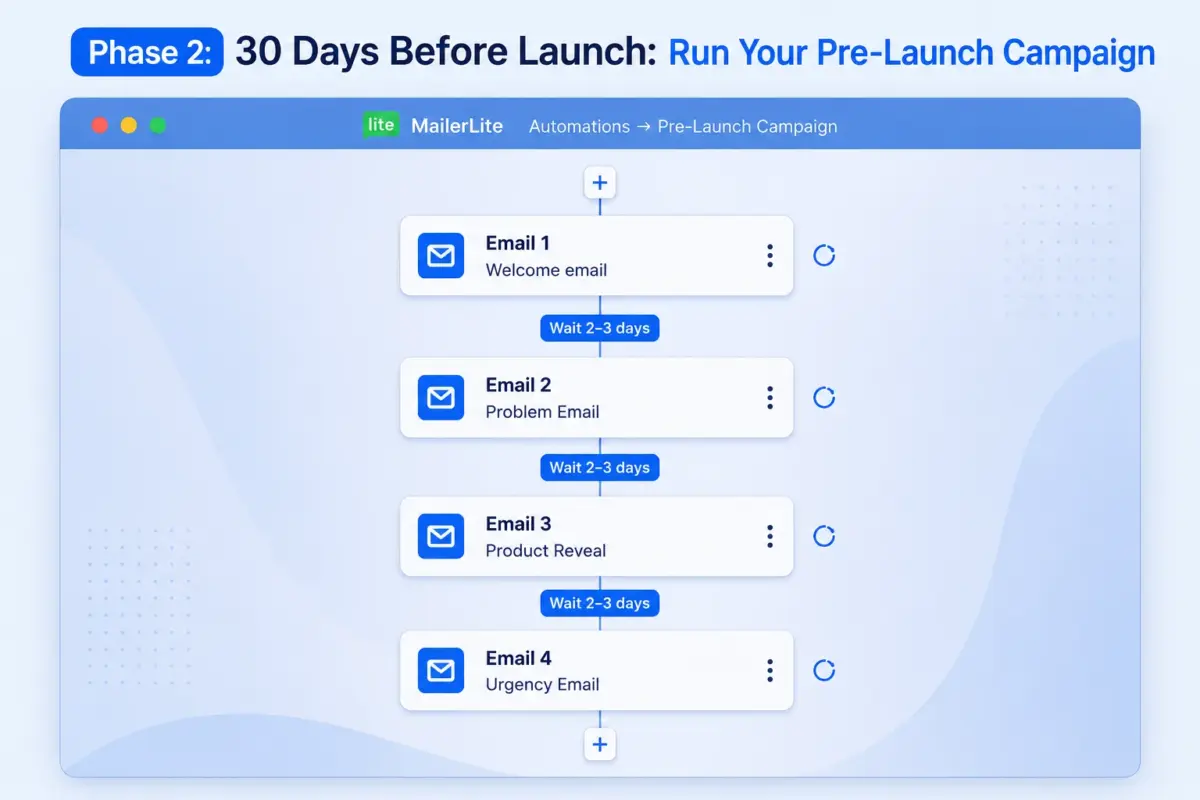
A four-email pre-launch sequence that works:
- Welcome email: who you are, what’s coming, why it matters to them
- Problem email: the specific problem your product solves, with a real story or example
- Product reveal: first look, key features, what makes it different
- Urgency email: launch date confirmed, early access or launch discount available
Set this up inside MailerLite → Automations → Create Automation. Add each email as a step, set a 2 to 3-day wait between each send, and activate it before your first signup comes in. It’s free, takes about 20 minutes to set up, and runs automatically for every new subscriber from that point on.
Social media in this phase should be preview-based. Partial reveals. Behind-the-scenes moments. A countdown. Not a full feature list that comes on launch day. The goal is to get people curious enough to click through to your landing page and join your list.
Influencer or partner outreach also belongs here. If you’re sending product samples to reviewers or creators, do it now so their content is ready to post during launch week. Chasing reviews after launch is too late.
Phase 3: 14 Days Before Launch: Channel Activation
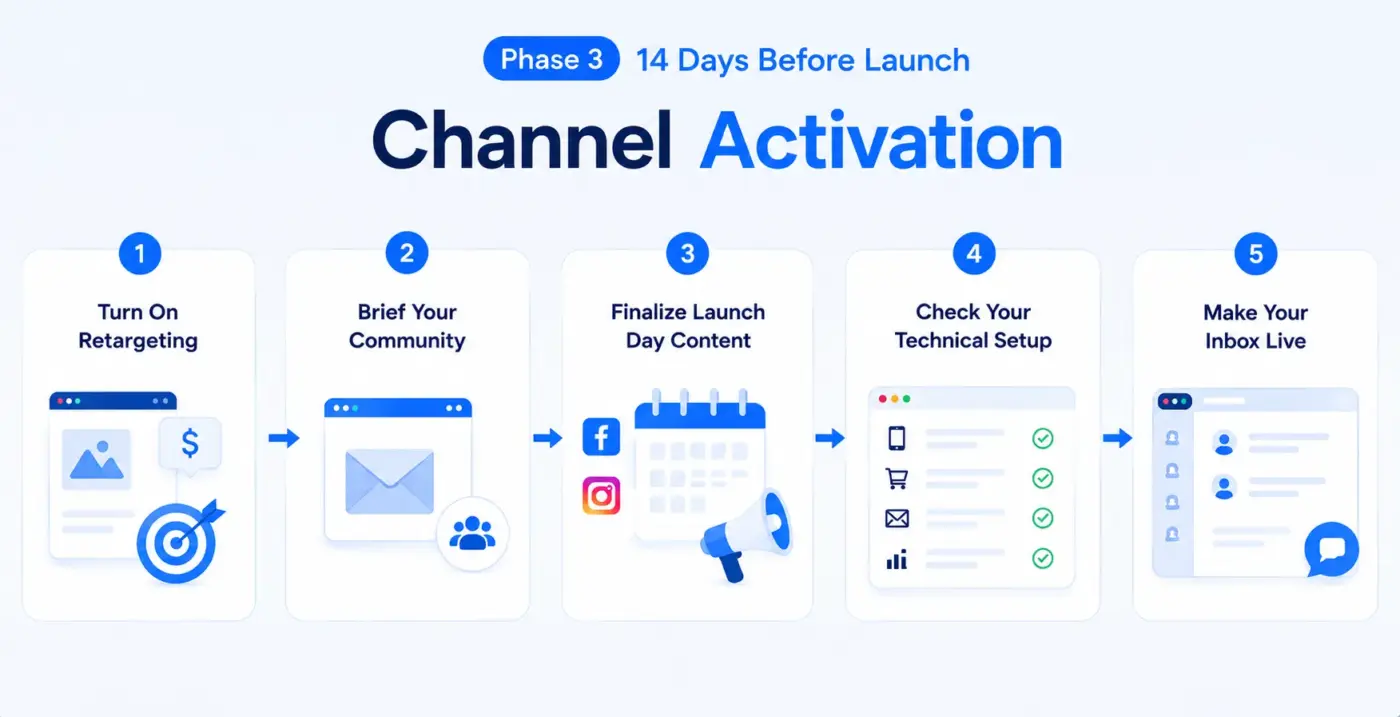
- Turn on retargeting: Anyone who visited your landing page but didn’t sign up gets a retargeting ad. The budget here doesn’t need to be large because you’re working with a warm audience. Even $5 to $10 a day can pull back people who showed interest but didn’t commit.
- Brief your community: If you have an existing customer base, email them separately from new sign-ups. They already trust you. A simple “you’re getting first access” email to existing customers consistently outperforms any cold ad campaign. This is something we see often: stores with existing customers who run launch campaigns like they’re starting from zero, ignoring the people who already like them.
- Finalise your launch day content: By day 14, every piece of launch-day content should be written and scheduled — emails, social posts, ads, product page copy, and press mentions, if applicable. This is not the week to be writing first drafts.
Check your technical setup:
- Product page live and tested on mobile, open your product page in Chrome, press
F12, click the mobile icon, and select a device to confirm it renders correctly. - Check out working end-to-end by visiting your checkout page and walking through the full flow as a customer.
- Email sequences triggered correctly.
- Analytics tracking confirmed (Google Analytics, Meta Pixel, or equivalent)
- Make your inbox live
Phase 4: Launch Week: Execute and Monitor
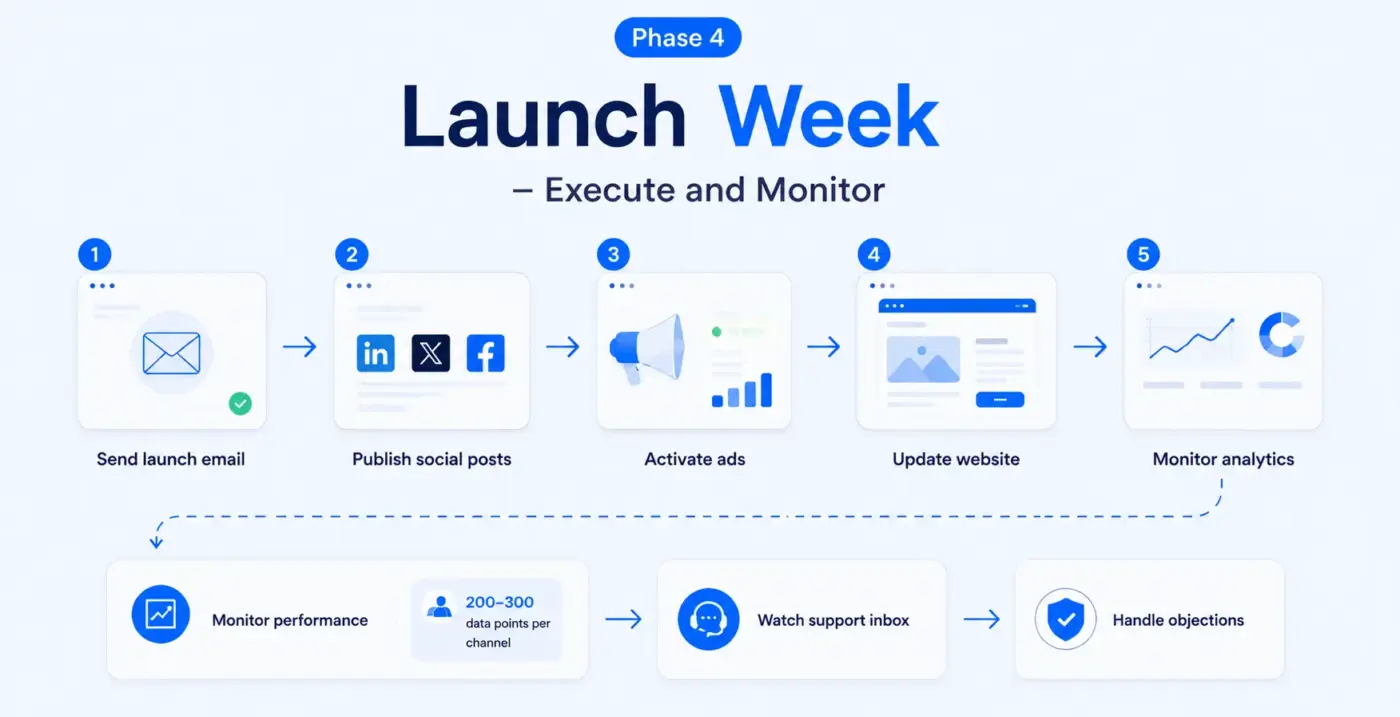
Launch day is not the time to make decisions. It’s time to execute the decisions you already made.
On day one:
- Send your launch email to your full list
- Publish your launch social posts
- Activate any paid ad campaigns you planned
- Update your website and product pages
- Monitor your analytics from the first hour
The first 48 hours of data matter more than almost anything else. The conversion rate on your product page tells you whether your copy is working. Email open rate tells you whether your subject lines landed. Click-through rate on ads tells you whether your creative is right.
Don’t panic-adjust too early. Small sample sizes look dramatic. If you’ve had 50 visitors and 2 conversions, that’s a 4% conversion rate, which is good for eCommerce. Give each channel at least 200 to 300 data points before drawing conclusions.
Do watch your customer support inbox. Launch day questions reveal exactly what your product page isn’t explaining clearly. Every repeated question is a signal to update your copy.
This is also where your objection handling matters most. Before you push a customer toward the buy button, answer the thing that’s stopping them. If the most common concern is “what if it doesn’t work for me,” your product page needs a clear return policy or money-back guarantee visible above the fold.
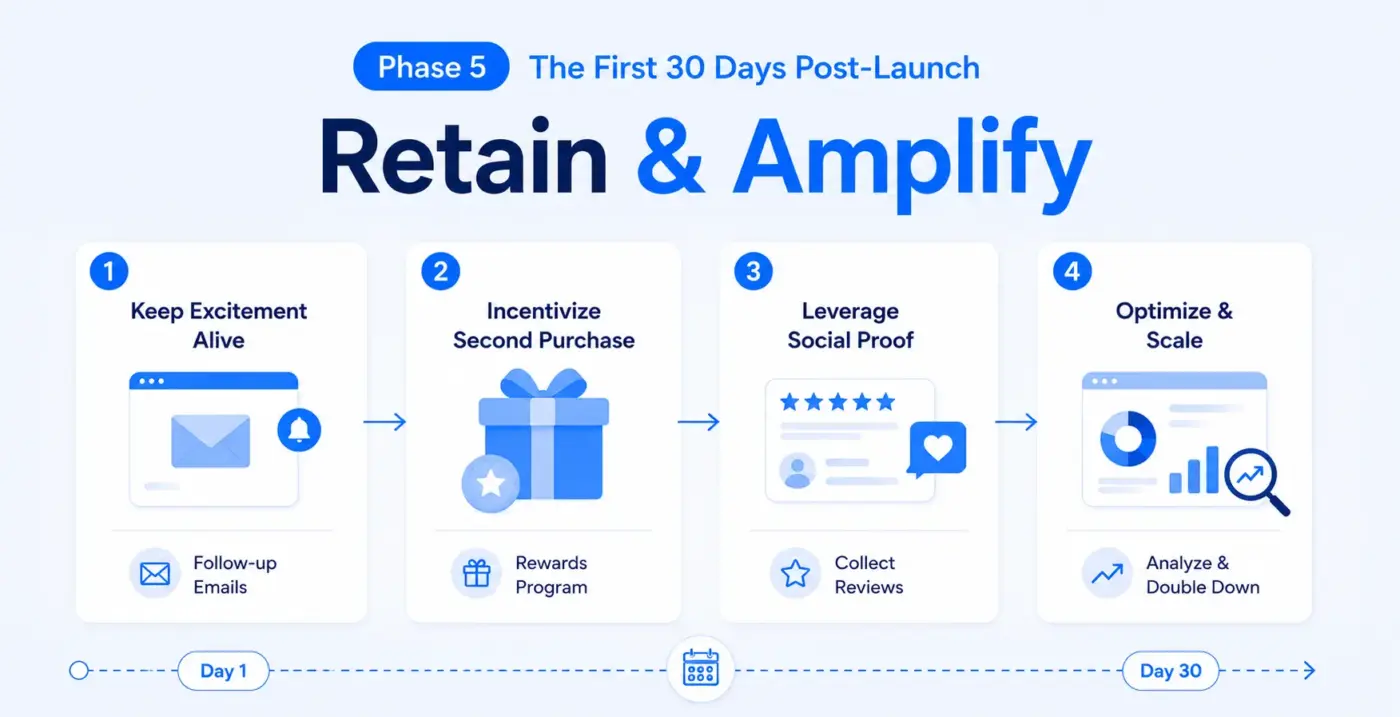
Phase 5: The First 30 Days Post-Launch: Retain and Increase
Most launch guides stop at launch day. This is where most of the real work begins.
Research tracking Nielsen data shows 56% of consumers learn about new products from friends and family, not from ads. That means word-of-mouth is your most effective post-launch channel, and it’s free. But it doesn’t happen on its own. You have to build a reason for people to share.
New customers from a launch are the most fragile in terms of customer loyalty. They bought out of excitement. In the first 7 days, that excitement fades. Sending a follow-up email on day 3 and day 7 with useful content about the product, how to use it, what results to expect, and tips from other customers keeps that excitement from fading into indifference.
A points and rewards program added right after launch gives new customers a reason to come back for a second order. We see this regularly with WooCommerce stores: the stores that set up a loyalty reward in the first 30 days post-launch consistently retain more of their launch-day buyers than those that don’t. The second purchase is worth more than the first, because the customer’s gain cost is zero.
Other post-launch amplifiers:
- Ask buyers for reviews, ideally 5 to 7 days after delivery
- Share user-generated content on social channels
- Run a referral reward (a discount or credit for successful referrals)
- Look at which traffic sources performed best and double down on them
Phase 6: Recovery and Scaling: The Phase Nobody Writes About
Here’s what nobody tells you: the launch rarely goes exactly as planned.
According to Gartner, 80% of product launches require significant changes after the initial rollout due to market changes and changing customer needs. The Product Marketing Alliance puts it even higher, 90% of companies make significant post-launch changes. That’s not failure. That’s normal.
The question is whether you have a recovery process or whether you’re just reacting.
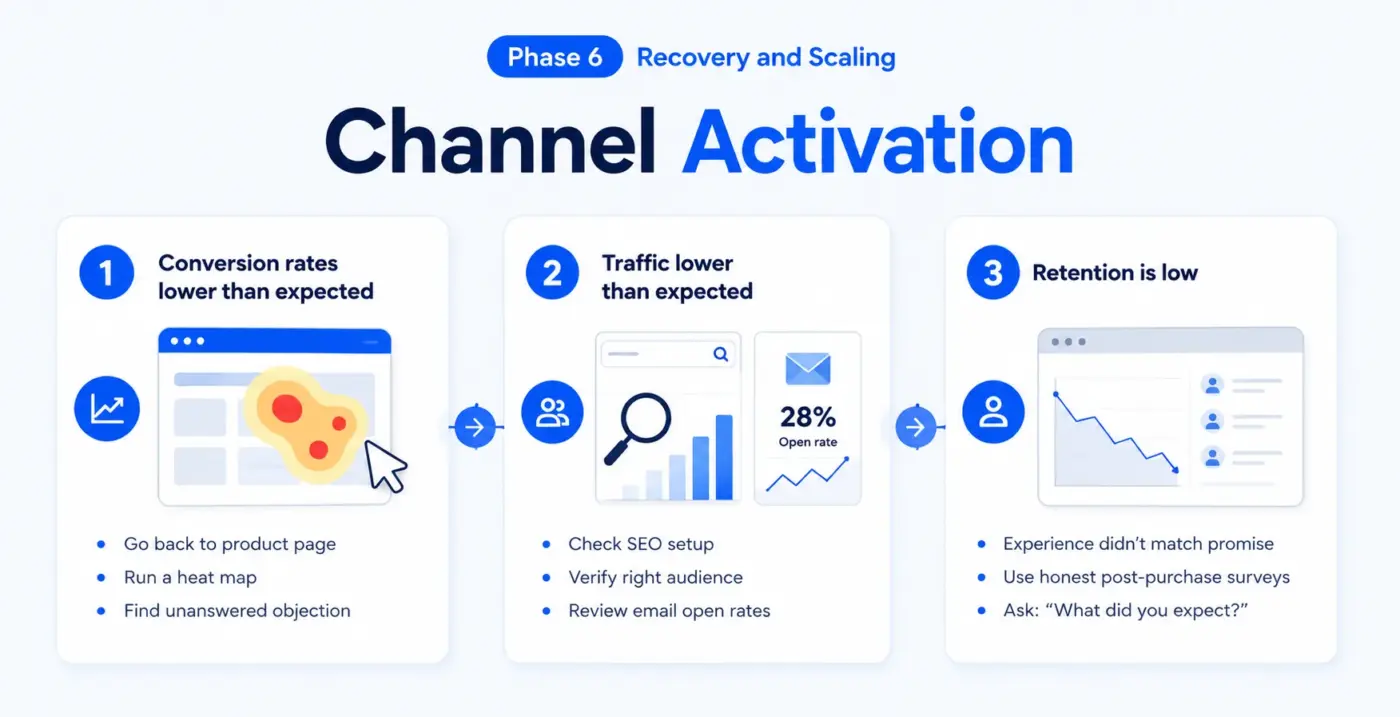
If conversion rates are lower than expected, go back to the product page first. Most conversion problems live there, not in the traffic. Run a user activity map. Read the support emails. Find the objection that isn’t being answered. Fix the copy before increasing ad spend.
If traffic is lower than expected, check whether your SEO setup is correct, whether your ads are reaching the right audience, and whether your email open rates are healthy. Low open rates usually mean your subject lines are weak or your list quality is poor — not that nobody wants the product.
If retention is low, the product experience likely didn’t match the promise. This is harder to fix with marketing. Honest post-purchase surveys will tell you exactly where the gap is. Ask “what were you hoping this would do?” and “did it do that?”
Scaling only makes sense once the fundamentals work. Increasing the ad budget on a campaign with a poor conversion rate makes the problem bigger, not better. Fix the conversion rate first, then scale.
Check out the latest eCommerce trends to understand what buyers expect from new products. This is worth reading before you finalise your positioning.
Which Digital Marketing Channels to Prioritise?
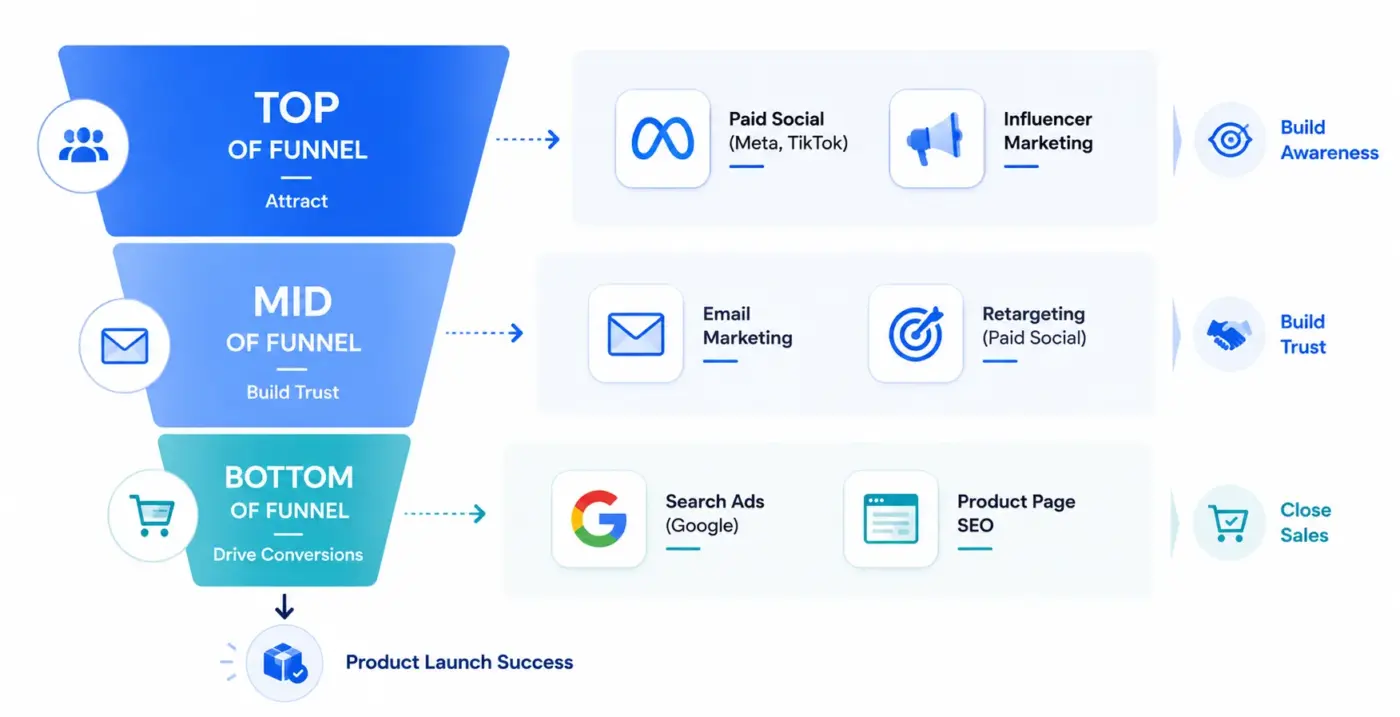
Every guide tells you to “use multiple channels.” That’s not wrong, but it’s not useful either. Here’s the honest version.
- Email marketing is the highest ROI channel for most launches. A warm email list that you built over 4 to 6 weeks pre-launch will outperform cold paid ads every time. The return on email is well above any other channel in eCommerce; no other digital channel is close.
- Paid social (Meta, TikTok) works well for awareness and re-engagement. It works badly for cold audiences with no social proof. Run paid social after you have some reviews and user-generated content, not before. Cold ads for a product nobody has heard of convert poorly and cost more than you’d expect.
- Search ads (Google) work best when people are already searching for your product category. If your product is genuinely new and no one is searching for it yet, search ads won’t find your audience. Your audience hasn’t started looking yet. Wait until organic demand exists, or use search ads to capture competitor terms instead.
- SEO and content marketing are long-game channels. They won’t drive launch-week sales. But a well-improved product page and a few supporting blog posts around the launch topic will drive organic traffic for months. Read our WooCommerce SEO guide if you’re building this on a WooCommerce store; the product page optimisation tips alone are worth the read.
- Influencer marketing is unpredictable. A single well-matched creator can drive more sales than a month of paid ads. A poorly matched one wastes product samples and your time. The key variable is audience alignment, not follower count. A creator with 8,000 engaged followers in your exact niche will outperform one with 200,000 general lifestyle followers.
- Referral marketing is the least used channel in product launches. As noted, 56% of consumers learn about new products from friends and family. Building a referral reward into your post-launch sequence costs almost nothing and can produce your cheapest customer acquisitions.
- The honest skip list for most small and mid-sized launches: PR outreach to major publications (takes months, rarely converts directly), podcast sponsorships (expensive and hard to measure), and any channel you’re not already familiar with. Adding a new platform mid-launch is how campaigns fall apart.
According to G2 research, 77% of buyers want different content at different stages of their research process. That means your channel mix should match where buyers are in their journey. Awareness stage channels (social, paid awareness) get attention. Mid-funnel channels (email, retargeting) build trust. Purchase stage channels (search ads, product page SEO) close the sale. Every channel has a job. Don’t ask one channel to do all three.
How to Know If Your Launch Strategy Worked
Measuring a launch is straightforward if you set your Key metrics before you start. Here’s what to track at each phase.
Pre-launch (60 to 14 days before):
- Email sign-up rate on your landing page — a healthy rate is 20% to 35% of visitors
- Email open rate on your pre-launch sequence — aim for 30% or higher
- Landing page traffic volume — you want to know how many people are finding you before launch day
Launch week:
- Product page conversion rate — 2% to 4% is average for e-commerce; above 4% is strong
- Revenue on day 1, day 3, and day 7 — look for the trend, not just the total
- Email click-through rate — 2% to 5% is healthy; below 1% means your copy needs work
- Cost per acquisition on paid ads — compare this to your product margin, not to an industry benchmark
Post-launch (30 days after):
- Repeat purchase rate — if less than 10% of launch buyers have returned at 30 days, your post-purchase sequence needs attention
- Review collection rate — aim for at least 5% of buyers to leave a review
- Referral conversion — how many new customers came from existing ones
- Return and refund rate — above 8% is a signal that something in the product promise doesn’t match the product reality
Successful launches lead to about a 25% revenue increase in the first year, according to Deloitte research. That doesn’t happen from launch week alone. It happens because the post-launch retention and referral systems grow over time.
The number most people ignore: only 11% of new product buyers remain engaged after 52 weeks, per G2 data. That means a launch without a retention plan loses almost all its customers within a year. The launch is the beginning, not the end.
Conclusion
A digital marketing strategy for a new product launch works best when it’s built in phases, not assembled in a panic. Start 60 days out. Build the list before you spend on ads. Launch to your warmest audience first. Then measure what’s happening, not what you hoped would happen, and adjust from there.
Three things to take away: pre-launch list building is more important than launch-day ad spend; post-launch retention is more valuable than post-launch traffic; and word-of-mouth is a system you build, not something that just happens.
If you’re running your store on WooCommerce, tools like the Waitlist for WooCommerce plugin and the Pre-Order for WooCommerce plugin make the pre-launch phase significantly more manageable and give you real demand data before you commit your launch budget.
Frequently Asked Questions(FAQs)
Q1. How early should I start my digital marketing strategy before a product launch?
Sixty days is the minimum for a product with a new audience. If you already have an existing customer base, 30 days can work, but only if you’re launching to that warm audience first. Starting later than 30 days means you’re compressing the list-building and awareness phases into a period that’s too short for them to grow.
Q2. Do I need a big budget to run a successful product launch campaign?
No. Email marketing and organic social cost almost nothing. A $500 to $1,000 paid ad budget is enough to run retargeting campaigns to a warm audience during launch week. The mistake most small businesses make is spending on cold paid ads before they have any social proof. Build the list and collect a few reviews first, then add paid spend.
Q3. What should I do if my product launch doesn’t hit its sales targets?
Go back to the product page before touching the ad campaigns. Most underperforming launches have a conversion problem, not a traffic problem. Read your support emails, check your analytics for drop-off points, and find the question your page isn’t answering. Fix the page, then look at your traffic sources.
Q4. How is a product launch strategy different from a go-to-market strategy?
A go-to-market strategy is the full plan for how a product enters a market, including pricing, distribution, positioning, and the sales approach. A product launch strategy is specifically the marketing and communications plan tied to the launch moment. The go-to-market strategy is broader; the launch strategy is the execution layer for the marketing piece of it.
Q5. Should I launch on multiple channels at once or focus on one?
Start with the channels where your audience already exists. If they’re on email, lead with email. If they’re on Instagram, lead with Instagram. Running five channels at once with a small team means all five are done poorly. One channel done well beats five channels done badly. Add channels after you’ve proven the first one works.
Q6. What metrics matter most in the first week after a product launch?
Product page conversion rate and email click-through rate. These two numbers tell you whether your message is landing with your audience. Revenue is important, but it’s a lagging indicator. By the time you see a revenue problem, the conversion problem has already been there for days. Watch conversion rate and click-through rate in real time, and you’ll catch issues before they become expensive.