
WordPress is not dying. It powers over 42.2% of all websites on the internet and holds more than 60% of the CMS market, a lead so large that its closest competitor, Shopify, would need to grow tenfold just to catch up. But the headline number only tells part of the story.
Here’s what most articles on this topic get wrong: they treat “Is WordPress dying?” as a single question. It’s three separate questions with three different answers. The software is stable and actively developed. The raw market share is still growing. The ecosystem, though, has some genuine cracks worth understanding before you make any decisions.
In this post, we’ll cover what the data shows, what the Automattic vs. WP Engine drama means for your site, where WordPress genuinely struggles in 2026, and who, if anyone, should be worried.
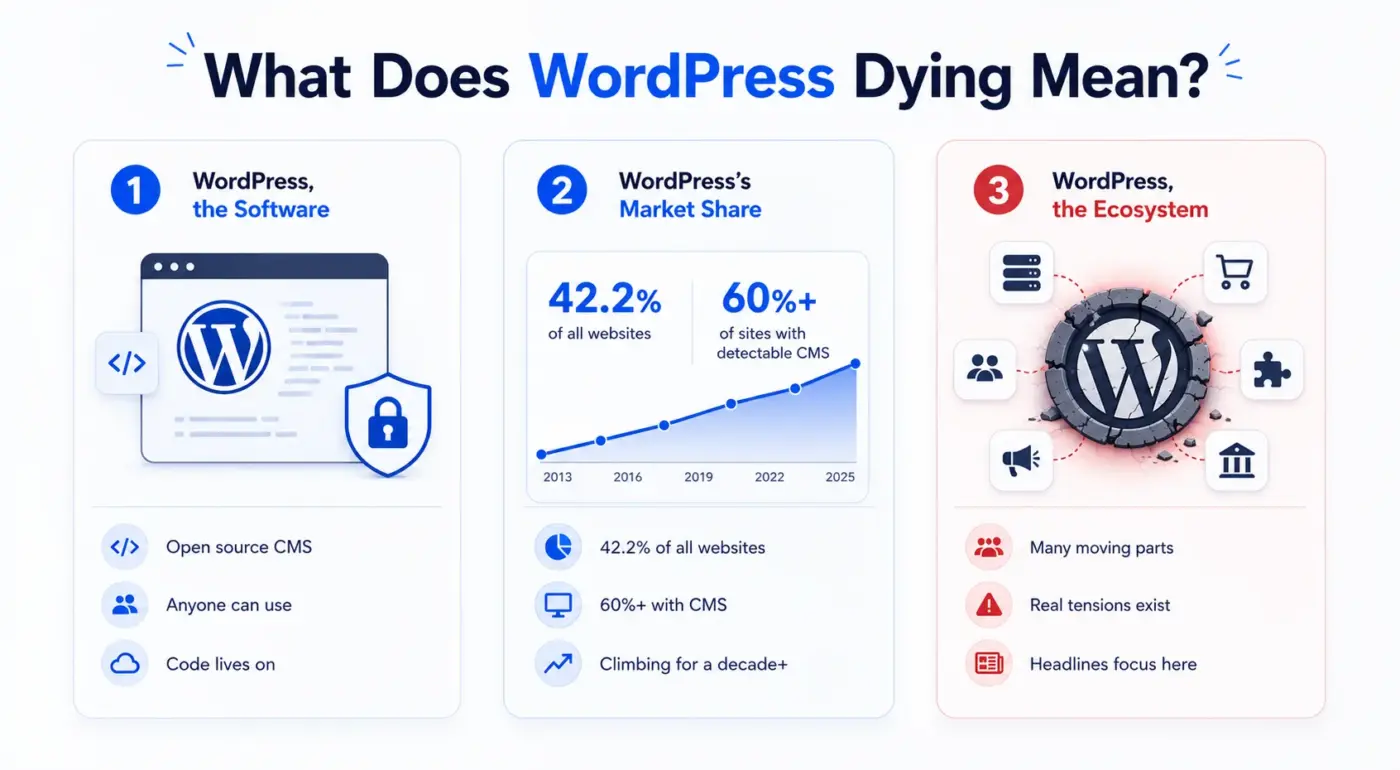
What Does WordPress Dying Mean?
Before looking at the numbers, it helps to separate the question into its parts.
- WordPress, the software, is an open-source CMS released under the GNU General Public License. That license means anyone can use, modify, and redistribute the code freely. No single company can “kill” it. Even if Automattic shut down tomorrow, the code would live on.
- WordPress’s market share is what W3Techs and similar trackers measure. Right now, it shows WordPress on about 42.2% of all websites and above 60% of sites with a detectable CMS. That number has been climbing, not falling, for over a decade.
- WordPress, the ecosystem, is where things get more interesting. This covers the commercial hosting providers, the plugin marketplace, the developer community, the WordCamp network, and the control structure around WordPress.org. This is the layer where real tensions exist and the layer most “is WordPress dying” headlines are really about, even when they don’t say so directly.
Keeping these three layers separate is the only way to answer the question honestly. The software is fine. The market share is dominant. The community has some real friction right now.
Popular WordPress Stats: The Real Story Behind the Numbers
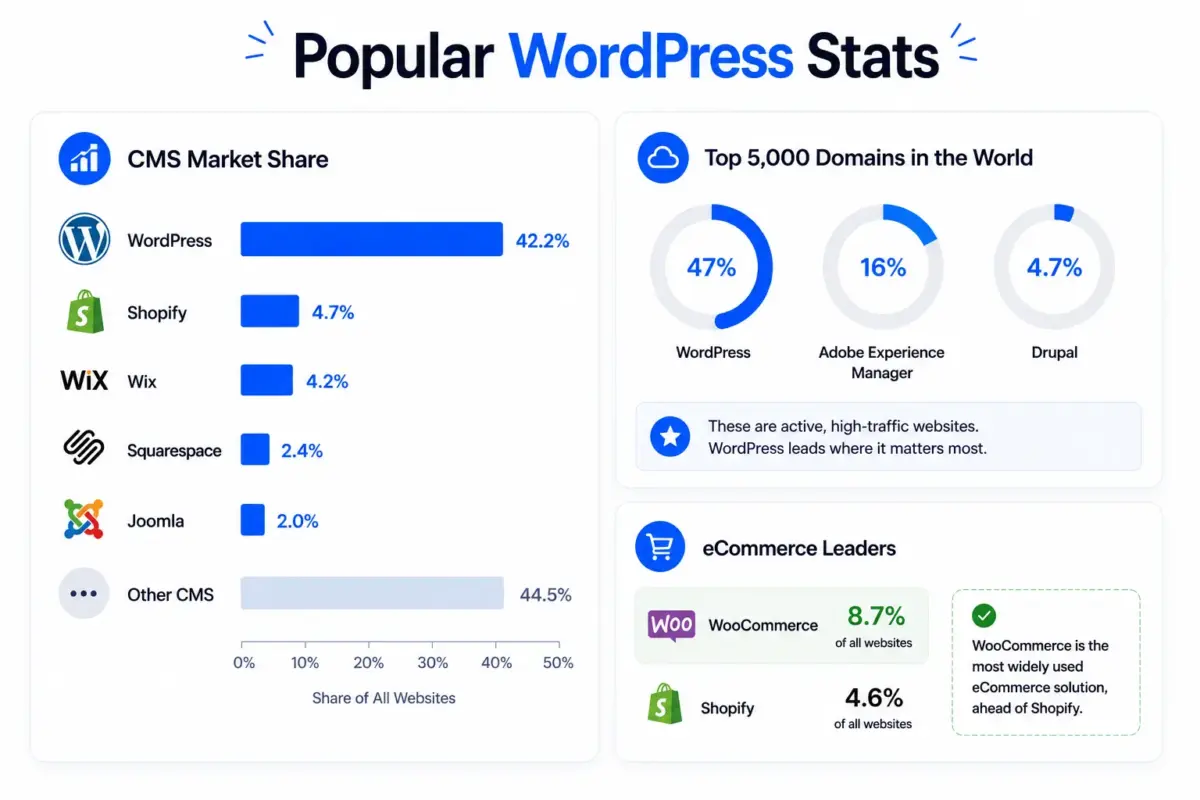
The most-repeated stat in this conversation is that WordPress powers 43% of all websites. Let’s look at what that figure represents and where it gets a little complicated.
According to W3Techs, WordPress holds about 42.2% of all websites and over 59% of the CMS market. Its closest CMS competitor is Shopify at around 5%. Wix sits at 4.2%. Squarespace is at 2.4%.
That gap is not closed. It’s not even in the same conversation.
Worth knowing: W3Techs counts any site where WordPress code is detectable, including abandoned installs, half-finished test sites, and domains that were never launched. The real number of actively maintained WordPress sites is lower. Nobody knows exactly how much lower, but the honest answer is that the 43% overstates active usage to some degree.
That said, even if you cut it in half, WordPress would still beat every competitor. The platform’s dominance isn’t an illusion.
There’s a more telling stat that doesn’t get enough attention. Cloudflare’s 2025 Year in Review, covering the technologies used by the top 5,000 domains in the world, found that WordPress powers 47% of them. These are not abandoned installs. These are active, high-traffic websites. Adobe Experience Manager, the next platform on the list, powers 16%. Drupal handles 4.7%.
That’s the number that matters most. WordPress isn’t just popular because it’s free and easy to install. It’s the default choice for serious publishers and businesses at scale.
For store owners, the WooCommerce picture is just as strong. According to data from WordPress.com, WooCommerce is installed on about 8.7% of all websites, making it the most widely used eCommerce solution on the internet, ahead of Shopify.
Shopify’s transaction fees, monthly costs, and closed codebase are the reasons many businesses stay on WooCommerce. Full ownership of your store data and no revenue cut on every sale still matter, especially at volume.
Why People Keep Asking This Question?
The “WordPress is dying” narrative keeps coming back. Here’s what’s driving it.
- Slow, broken sites get blamed on the platform: Someone builds a site with 50 plugins on shared hosting, it loads in seven seconds, and the conclusion is “WordPress is slow.” That’s like blaming your car brand because someone never changed the oil. Poor setup creates performance problems. The platform itself, on a properly configured server with a sensible plugin stack, is not the bottleneck.
- Competing platforms market aggressively: Wix and Squarespace spend heavily on advertising. Webflow, Framer, and Shopify are constantly positioned as “WordPress killers” in tech circles. Aggressive marketing creates the impression of displacement, even when the underlying numbers don’t support it.
- The Gutenberg transition frustrated developers: WordPress’s shift to the block editor (Gutenberg) starting in 2018 was disruptive. Developers who had built workflows around the Classic Editor were annoyed. Some left. That friction created real negative sentiment in developer communities, some of which hasn’t faded. Worth noting: the transition is largely settled now. Block themes and full site editing have matured significantly, and WordPress’s version history shows consistent improvement through each release.
- The CMS market share among sites with a known CMS has slid slightly: From a peak of around 65% in early 2022 to about 61% now, that’s a real decline, not invented. The absolute number of WordPress sites is still rising, but competitors are growing faster among new CMS-based projects. This is worth acknowledging honestly.
For context on how WordPress compares to the newer alternatives gaining attention, our Ghost vs WordPress breakdown goes deeper into the specifics.
The Automattic vs. WP Engine Situation
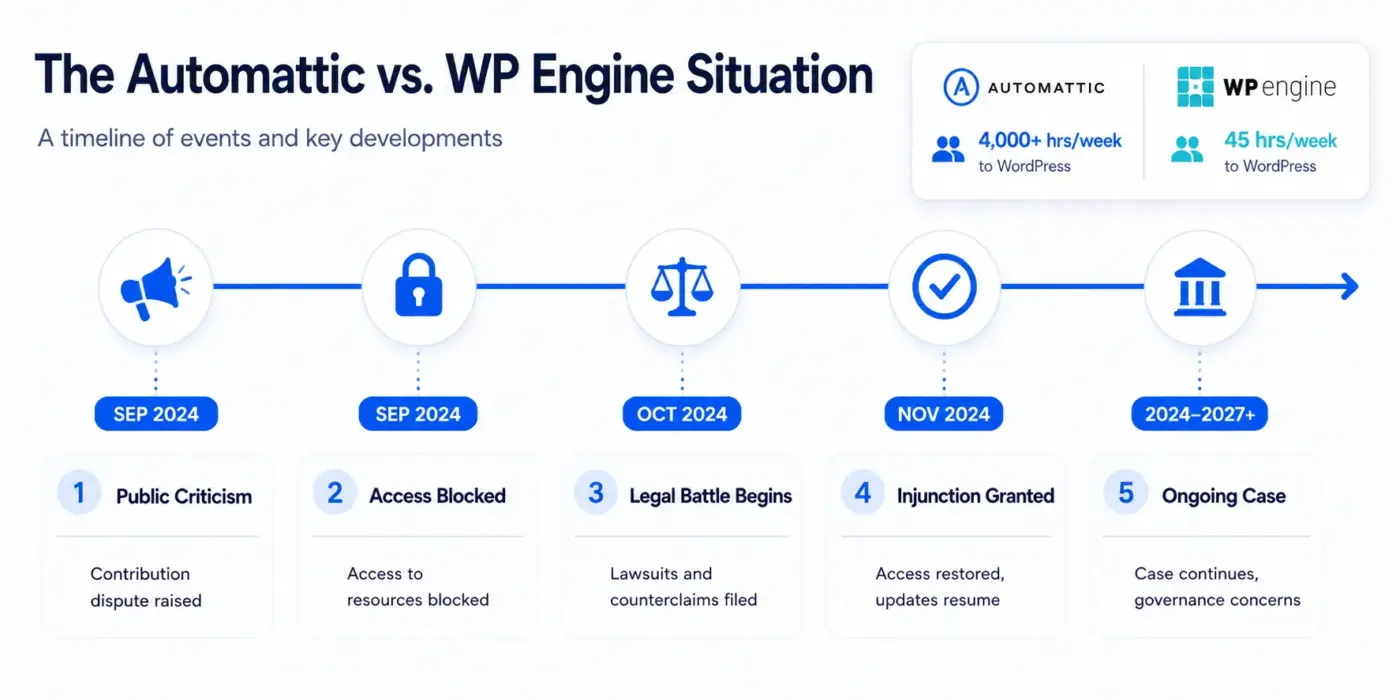
This is the story most “is WordPress dying” articles either skip or handle badly. Here’s a plain-English summary.
In September 2024, Matt Mullenweg, WordPress co-founder and CEO of Automattic, publicly called WP Engine, one of the largest WordPress hosting providers, a “cancer to WordPress” at WordCamp US. His core argument: WP Engine profits heavily from the WordPress ecosystem while contributing very little back to core development. Automattic claims WP Engine was contributing only 45 hours per week compared to Automattic’s 4,000+ hours.
Things escalated fast. Automattic blocked WP Engine’s access to WordPress.org resources, including plugin and theme updates. WP Engine sued Automattic and Mullenweg, alleging threats, defamation, and unfair competition. A court granted WP Engine a court order, restoring its access. Automattic filed counterclaims, accusing WP Engine of trademark misuse and misleading marketing. The case is still moving through the courts and could run into 2027 or beyond.
For WP Engine customers, the injunction means the practical disruption has been resolved. Plugin and theme updates work normally.
For everyone else, the question is what this says about WordPress governance. And the honest answer is: it exposed a real structural tension. Mullenweg controls WordPress.org as a personal project. That gives one individual significant leverage over infrastructure that millions of sites depend on. That’s a legitimate concern.
What it doesn’t change: the WordPress software itself is protected under the GPL. The code is freely available and cannot be locked away, regardless of who controls WordPress.org. Forks of the project are possible. Several community members have already discussed shared governance models.
Automattic recommitted to full contributions to WordPress Core, Gutenberg, and related projects in mid-2025. Development resumed normally. The drama was real. The platform kept running. These are both true.
What’s Still Strong in 2026?
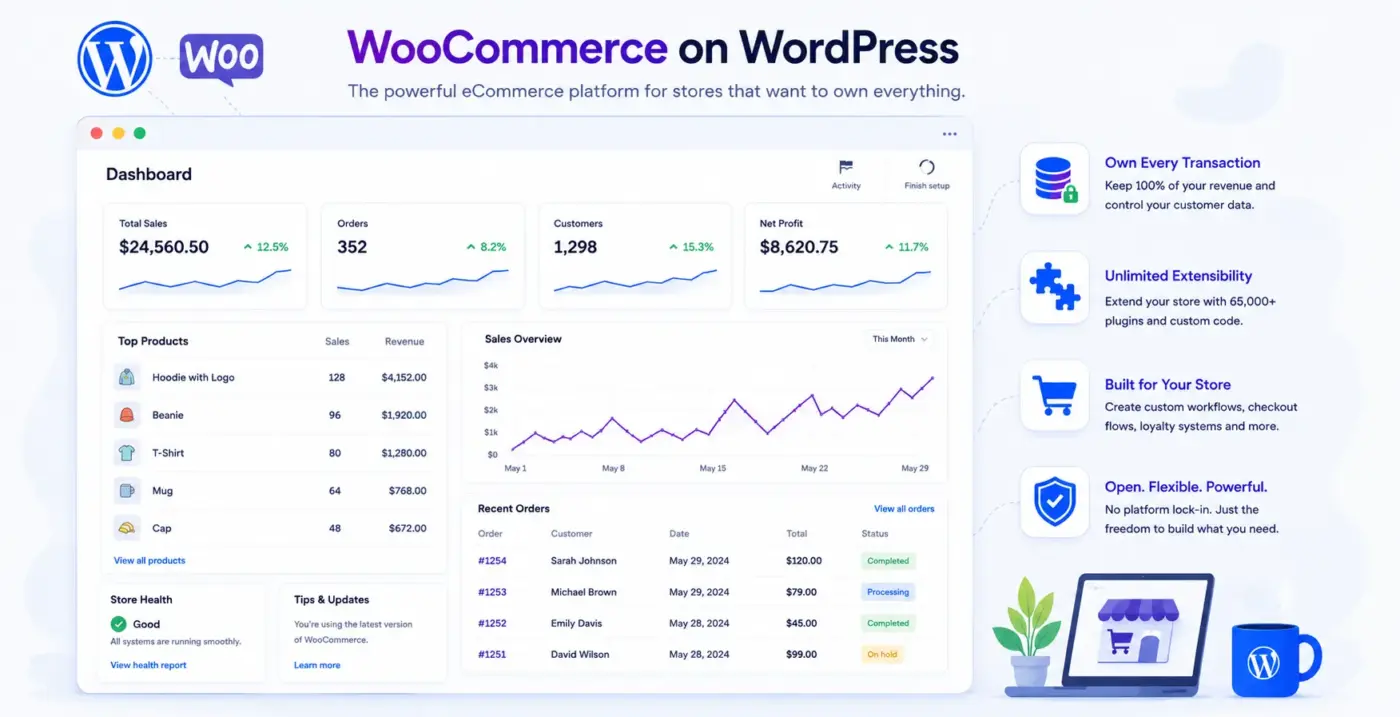
The parts of WordPress that work extremely well. Here’s where the platform genuinely thrives.
- Publishing and content: WordPress remains the default infrastructure for publishers, bloggers, and media companies. Time, CNN, The White House, Rolling Stone, these are not organisations that choose platforms carelessly. The block editor’s maturity, combined with a deep theme and plugin ecosystem, means content teams can move fast without touching code.
- WooCommerce for independent eCommerce: If you’re building or running a store and you want to keep 100% of every transaction, own your customer data, and extend your store’s behaviour without being locked into a platform’s feature roadmap, WooCommerce is still the strongest option available. Setting up WooCommerce on WordPress is well-documented,, and the tooling has matured significantly. For stores with specific needs, custom checkout flows, loyalty systems, and wallet payments, the plugin ecosystem handles things Shopify would charge significantly more to replicate or simply doesn’t support at all.
- The developer and agency ecosystem: Over 65,000 plugins in the official directory. Tens of thousands of agencies are built entirely around WordPress. A talent pool that no other CMS comes close to matching. When something breaks at 2 am, you can find someone who knows WordPress. That’s not true for most alternatives.
This is where we spend most of our time at DevDiggers, building custom WooCommerce plugins for stores that need functionality the standard toolkit doesn’t cover. The flexibility of the platform is genuinely unmatched. We haven’t found a store requirement yet that WordPress couldn’t handle with the right build.
For store owners considering WooCommerce development to extend what’s already built, the platform’s open architecture makes that straightforward in a way that closed platforms simply can’t match.
The Real Challenges WordPress Faces Right Now
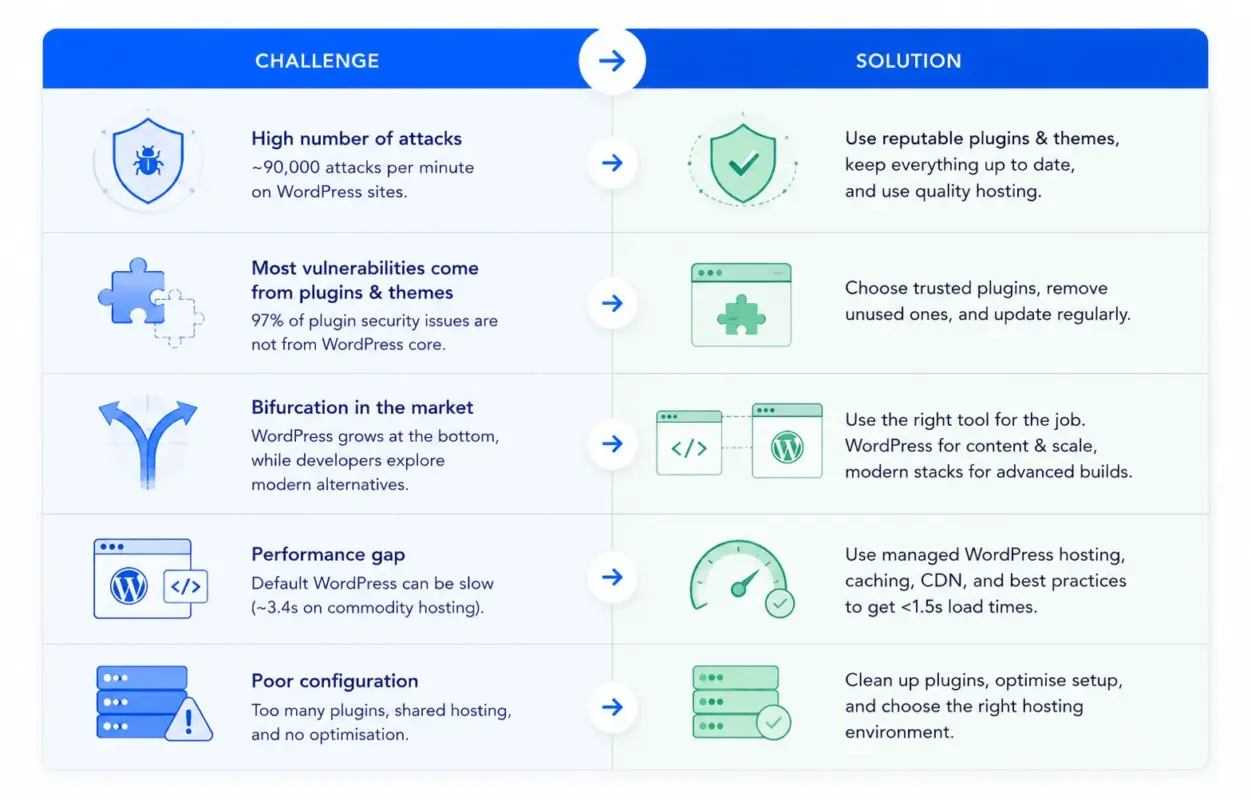
WordPress isn’t perfect. Here’s what’s worth paying attention to.
According to data from Digital Applied’s WordPress statistics, WordPress sites face about 90,000 attacks per minute. 97% of WordPress plugin security vulnerabilities originate in plugins and themes, not WordPress core. The core software is maintained by a large, experienced team and is generally well-secured.
What this means in practice: a WordPress site run on reputable plugins, kept up to date, on quality hosting, is not especially vulnerable. A site built on abandoned plugins from 2019, running on shared hosting with no updates, that’s a different story. This is a maintenance and configuration problem, not a fundamental platform flaw.
This is the split trend that most “is WordPress dying” articles miss entirely. WordPress’s total market share is still growing. At the same time, developer communities increasingly choose React-based frameworks, headless CMS solutions, or dedicated tools like Next.js for new builds.
These aren’t the same thing. An existing install base of 500+ million websites doesn’t shrink overnight. But the first choice for new developer-led projects is gradually shifting. WordPress is growing from the bottom while the top end of the developer market explores alternatives.
Headless WordPress setups, where WordPress manages content on the backend while a modern JavaScript frontend handles the display layer, are increasingly popular as a middle path. You get WordPress’s content tools and the plugin ecosystem’s breadth, with a modern frontend’s speed and flexibility. This isn’t WordPress dying. It’s WordPress adapting.
On cheap hosting with a default WordPress install, page load times average around 3.4 seconds, compared to under a second for well-optimised modern frameworks. On managed WordPress hosting, that gap often closes significantly, to under 1.5 seconds. But it requires intentional configuration. You can’t install WordPress and walk away.
We see this constantly. Supporting a store running 40+ active plugins on shared hosting isn’t a WordPress problem. It’s a configuration problem. The fix isn’t switching platforms; it’s cleaning up the setup.
Should You Still Use WordPress in 2026?
Here’s a practical framework, not a generic answer.
- You run a WooCommerce store with proper maintenance: No reason to move. Your investment is sound, your data is yours, and your costs are lower than equivalent Shopify setups at most revenue levels.
- You’re starting a new content site or blog: WordPress is still the best default choice by a large margin. The tooling, the theme ecosystem, the SEO infrastructure, nothing else comes close at this price point.
- You’re starting a new project with a developer team that prefers modern JavaScript stacks: WordPress might genuinely not be the right fit. That’s fine. React-based frameworks and headless CMSs are excellent for the right project. The keyword is the right project, not every project, and not as a replacement for WordPress across the board.
- You had a slow, broken WordPress site and blamed the platform: The platform probably wasn’t the problem. Hosting quality, plugin bloat, and lack of maintenance are behind the overwhelming majority of bad WordPress experiences. A clean build on good hosting performs well.
- You’re worried about the Automattic/WP Engine situation affecting your site: If you’re not hosted on WP Engine, the dispute has had no practical impact on you. If you are on WP Engine, the court injunction restored normal access. Either way, the software itself is protected under the GPL and is not going anywhere.
Conclusion
Is WordPress dying? No, not by any meaningful measure. It powers more than 43% of the web, dominates the CMS market by a factor of ten over its closest competitor, and remains the infrastructure of choice for publishers and businesses at every scale.
What’s true is that the ecosystem had a rough 2024-2025; the developer community is exploring alternatives for new builds, and the platform requires real maintenance to perform well. None of that is dying. That’s just maturity.
If your WordPress site is built well and kept up to date, you have nothing to panic about. If you’re running a WooCommerce store and thinking about the future, the platform’s open-source foundations and the depth of the plugin ecosystem still make it the strongest independent eCommerce option available.
Need help making sure your WordPress or WooCommerce setup is solid? Our custom WordPress development services are built specifically for that.
Frequently Asked Questions(FAQs)
Q1. Is WordPress still worth using in 2026 for a new website?
Yes, for most use cases. WordPress remains the most widely supported CMS on the web, with the largest plugin ecosystem and the deepest pool of developers. If you’re building a blog, a business site, or an eCommerce store, it’s still the most practical default choice. Developer teams building complex applications with modern JavaScript stacks may find alternatives better suited to their workflow.
Q2. Did the Automattic vs. WP Engine lawsuit hurt WordPress?
It created real uncertainty in the community and exposed governance tensions that are worth watching. In practical terms, though, the WordPress software kept running normally throughout the dispute. The court restored WP Engine’s access to WordPress.org resources. Automattic returned to full contributions to WordPress core in mid-2025. The lawsuit is ongoing but has not disrupted the platform for the vast majority of users.
Q3. Why is my WordPress site slow if the platform is so popular?
Popularity doesn’t guarantee performance, but setup does. Most slow WordPress sites share the same root causes: too many poorly coded plugins, shared hosting with limited resources, no caching layer, and images that were never optimised. A well-configured WordPress site on managed hosting with a lean plugin stack loads fast. The platform isn’t the bottleneck in most cases.
Q4. Is WooCommerce still better than Shopify in 2026?
It depends on your priorities. WooCommerce gives you full ownership, no transaction fees, and complete control over your store’s data and functionality. Shopify is easier to set up and manage with less technical knowledge. For stores that need custom behaviour-specific checkout flows, loyalty programs, and wallet systems, WooCommerce’s open source handles complexity that Shopify would require expensive apps or custom development to match. For a small store that wants a simple, hosted solution with minimal maintenance, Shopify is a fair choice.
Q5. What is headless WordPress, and does it solve the performance problem?
Headless WordPress uses WordPress to manage content on the backend while a modern frontend framework, typically Next.js or Nuxt, handles what visitors see. It solves the performance gap because the frontend can be pre-rendered and served from a CDN, delivering sub-second load times. The trade-off is added complexity and development cost. It’s a good fit for high-traffic sites where performance is a priority and developer resources are available. For most small and medium sites, a well-optimised traditional WordPress setup is a more practical route.
Q5. Is the 43% WordPress market share figure accurate?
Roughly, yes, but with an important caveat. W3Techs counts any site where WordPress code is detectable, including abandoned installs and sites that were never fully launched. The real number of actively maintained WordPress sites is lower. Even accounting for that, WordPress’s lead is not in serious doubt. The Cloudflare data showing WordPress on 47% of the top 5,000 active domains in the world provides a better picture of real-world usage.