
Connective eCommerce is a low-risk approach to selling online that lets you start a store without building a website from scratch, storing inventory, or spending money on paid ads.
Most people who search for this term have heard it thrown around in online business communities and want a straight answer on what it actually means. Here’s the thing: depending on who you ask, you’ll get two different definitions, and that confusion is worth sorting out before anything else.
This post covers what connective eCommerce is, how it works in practice, how it compares to plain dropshipping, where it genuinely falls short, and whether WooCommerce is a good fit for it.
What Is Connective Ecommerce?
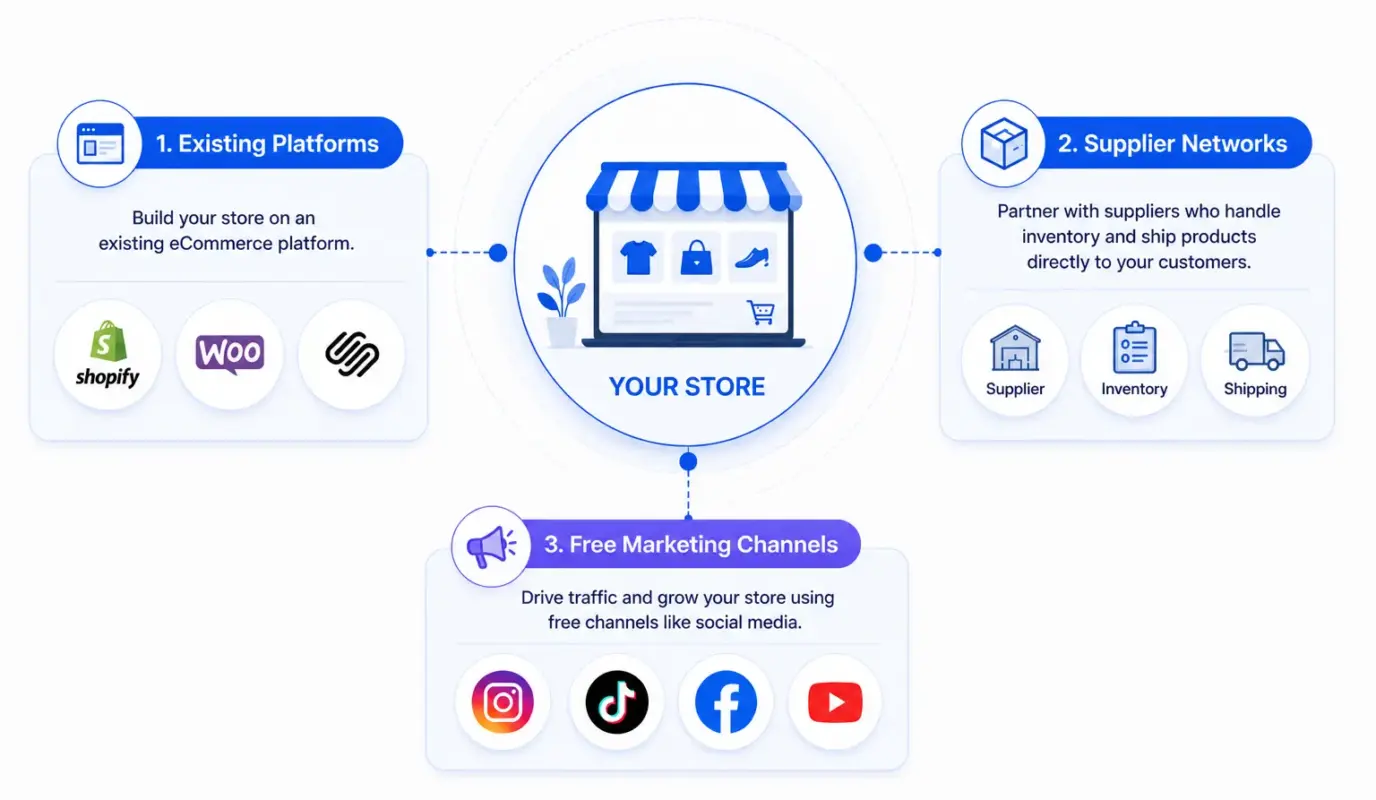
Connective eCommerce is an online selling strategy that reduces startup costs by using existing platforms, supplier networks, and free marketing channels instead of building your own setup from the ground up. You build a store on an existing eCommerce platform, find suppliers who ship products directly to your customers, and drive traffic through social media rather than paid advertising.
The term was created by Cortney Fletcher, founder of the eCom Babes course, as a way to describe a beginner-friendly system for launching an online store without a large starting money. According to Shopify’s overview of the model, the three areas it targets are website setup, inventory management, and product promotion, each addressed by using tools and third parties that already exist.
Worth knowing before you go further: The phrase “connective eCommerce” also gets used by web development agencies to describe something entirely different, the technical integration of platforms, APIs, and data systems within a store’s backend. If you’ve seen both definitions and felt confused, that’s why. This post focuses on the original meaning: the startup-friendly business model.
If you want to understand how this sits within the latest eCommerce trends, the connective model reflects a broader shift toward lower-difficulty entry points for new online sellers.
How Connective Ecommerce Works?
The model runs on three main parts. Each one replaces a cost that traditionally stops people from starting.
- Store setup without a developer: Instead of hiring someone to build a custom site, you use a platform like WooCommerce, Shopify, or BigCommerce. These give you templates, payment processing, and product pages out of the box. You are the one building it, but the tools do most of the heavy lifting.
- Inventory handled by suppliers: You don’t buy stock upfront or rent warehouse space. When a customer places an order on your store, you forward that order to a third-party supplier. The supplier picks, packs, and ships it directly to the customer. This mirrors how the dropshipping model operates at the order delivery level.
- Marketing through free channels: Rather than running Facebook or Google ads, you build an audience through Instagram, TikTok, Facebook Groups, or organic search. The idea is to drive traffic without spending money on ads while your business is still finding its footing.
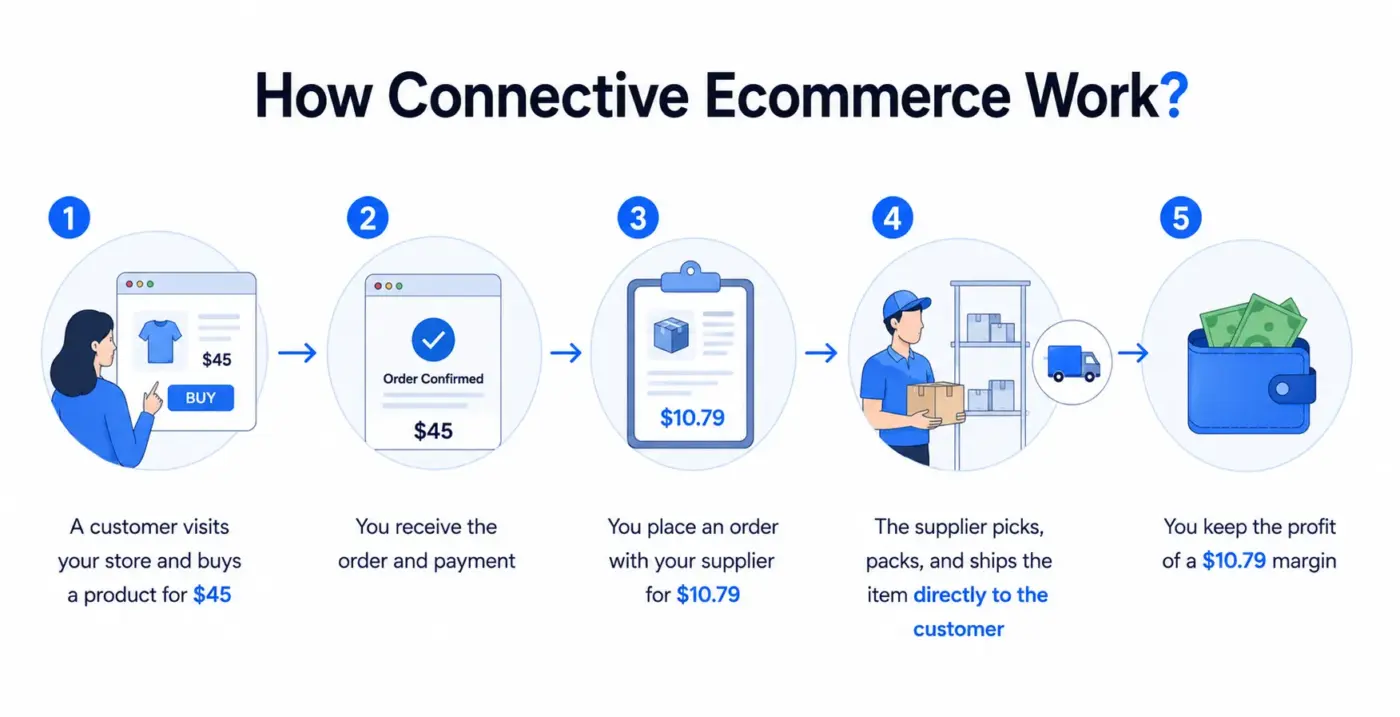
Here’s what a real transaction looks like in practice:
- A customer visits your store and buys a product for $45
- You receive the order and payment
- You place an order with your supplier for $10.79
- The supplier ships the item directly to the customer, and you keep the profit of a $10.79 margin
A well-known example of this model working is Gymshark. The brand started on Shopify using a dropshipping model to sell supplements, minimising financial risk while testing demand. It eventually moved to owning its products and operations and is now valued at over $1.45 billion. That transition point matters, and we’ll come back to it.
Connective Ecommerce vs. Dropshipping
This is where most explanations go vague. Let’s be direct about it.
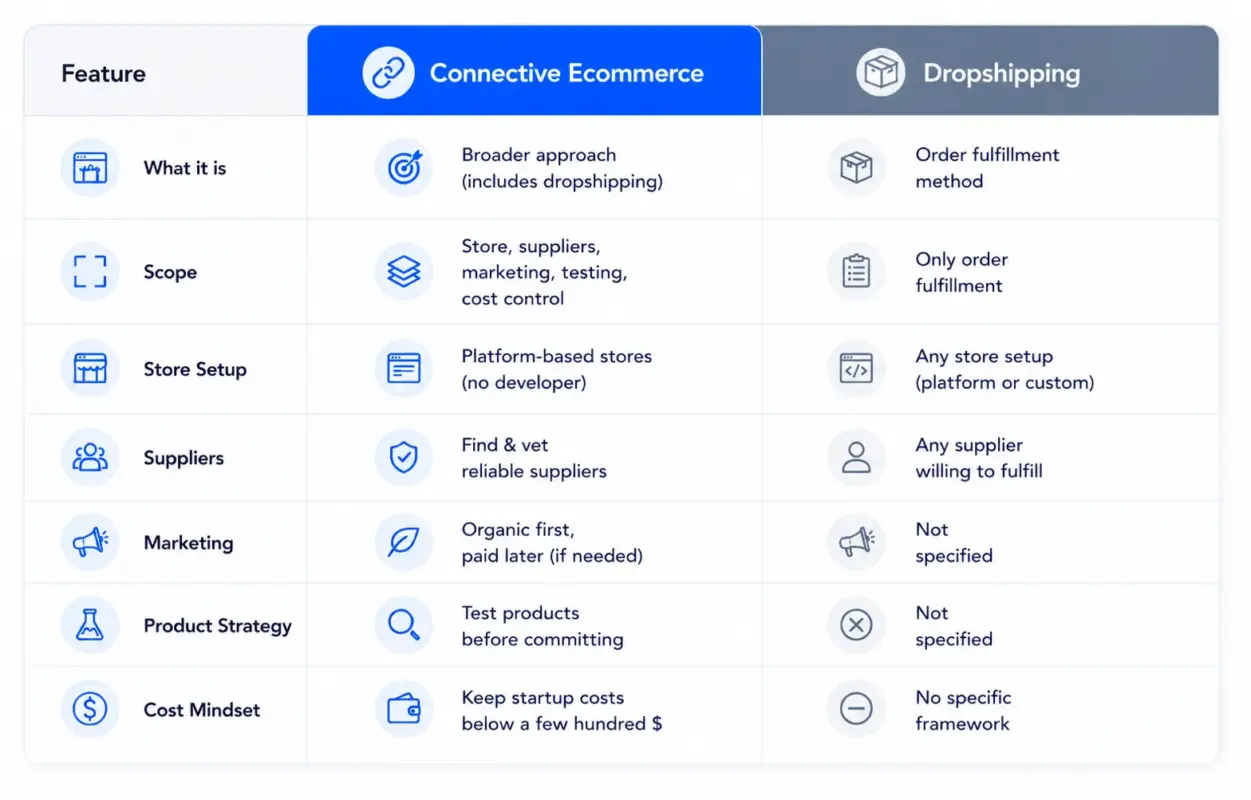
Dropshipping is a fulfilment method. It describes how your orders are processed, a third-party supplier holds the stock, and ships it to your customer. That’s the whole definition.
Connective eCommerce is a broader framework. It includes the dropshipping model as its fulfilment method, but it also wraps in how you build your store (no developer, use a platform), how you find and check suppliers properly, and how you market (free channels first, paid ads later if at all). It’s essentially dropshipping with a structured approach to the other parts of the business.
Here’s the honest view most guides skip: The practical day-to-day difference between connective eCommerce and basic dropshipping is smaller than the branding suggests. As one analysis puts it, connective eCommerce is largely a repackaging of dropshipping with added focus on organic marketing and using website builders rather than custom development.
That’s not a criticism. Knowing what it actually is helps you set realistic expectations. You’re not adopting a fundamentally different business model. You’re adopting a structured, lower-cost approach to starting an online store, one that uses existing tools rather than building from scratch.
The real additions connective eCommerce makes on top of plain dropshipping:
- A specific preference for platform-based stores over specially made ones
- An emphasis on organic marketing before any paid advertising
- A mindset of testing products before fully investing in them
- A framework for keeping startup costs below a few hundred dollars
If you’ve been doing dropshipping already, you may already be doing connective eCommerce without using that name.
The Real Pros and Cons
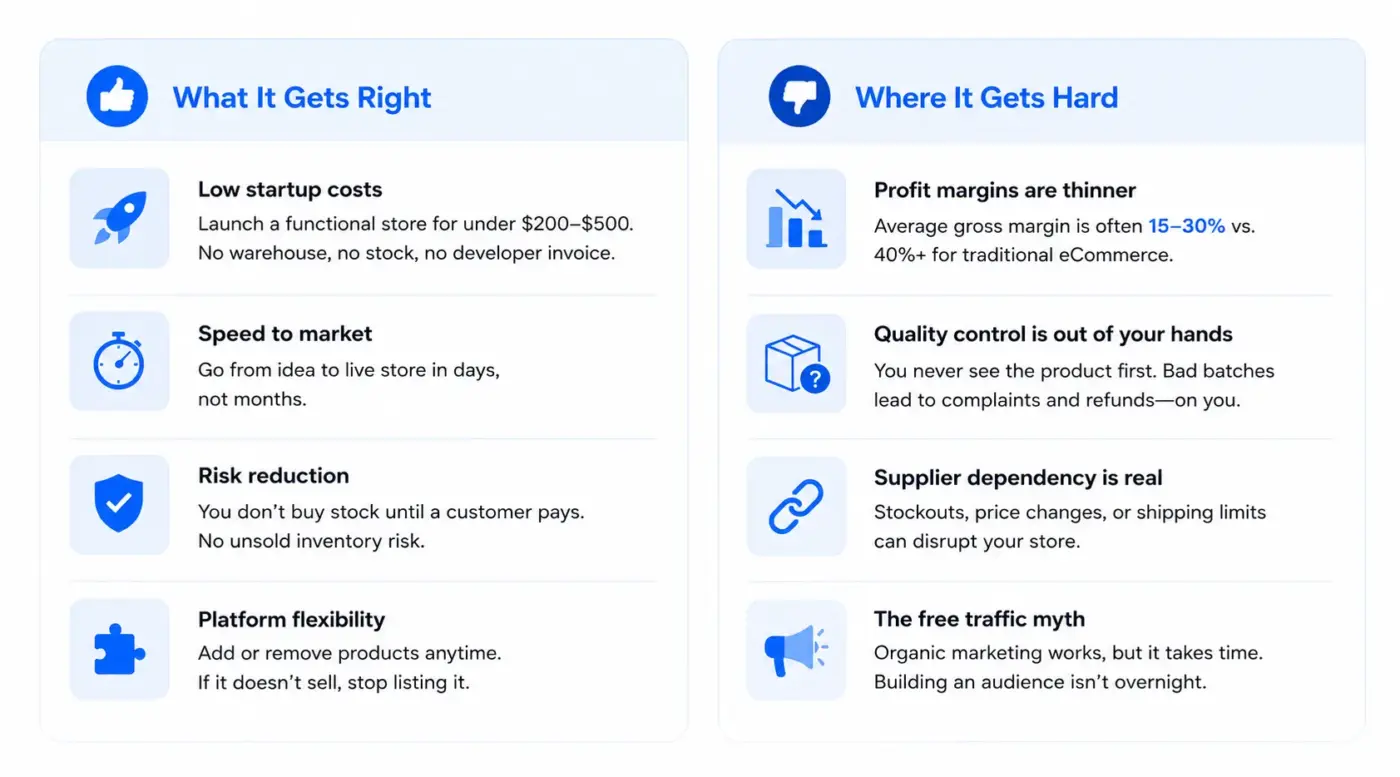
The benefits of connective eCommerce are real. The limitations are just as real.
What It Gets Right
- Low startup costs: You can launch a functional store with low startup costs, often under $200 to $500, covering a domain, hosting, and a platform subscription. No warehouse, no stock, no developer invoice.
- Speed to market: With no inventory to source upfront and no site to build from scratch, you can go from idea to live store in days rather than months.
- Risk reduction: Because you are not buying stock until a customer has already paid you, you are never left holding unsold inventory. That is a real advantage for testing product ideas.
- Platform freedom: You can add or remove products without worrying about stock. If something doesn’t sell, you just stop listing it.
Where It Gets Hard
- Profit margins are thinner: When a third-party supplier handles fulfilment, they charge for that service. Your margin per sale is lower than if you bought wholesale and fulfilled orders yourself. The average gross margin for traditional eCommerce can exceed 40% for dropshipping and connective models, but it’s often closer to 15–30% depending on the niche and supplier.
- Quality control is out of your hands: You never see the product before it reaches your customer. One bad supplier stock can generate a wave of complaints and refunds that you’re responsible for handling.
- Supplier reliance is real: If your supplier runs out of stock, raises prices, or stops shipping to certain regions, your store is directly affected. Diversifying suppliers reduces this risk but adds harder management.
- The free traffic myth: Connective eCommerce promotes organic marketing as the alternative to paid ads. That works, but it takes time. Building an audience on Instagram or TikTok doesn’t happen overnight. Relying entirely on free channels in a crowded category is hard.
Here’s the one stat that puts it in perspective: One analysis found that about 90% of new eCommerce ventures fail within their first 120 days. The connective model reduces startup cost risk, but it does not reduce the need for good product selection, consistent marketing, and customer service. Those remain with you.
Most tutorials skip this part. That’s why so many stores end up with a supplier, a theme, and no customers.
Can You Use WooCommerce for Connective Ecommerce?
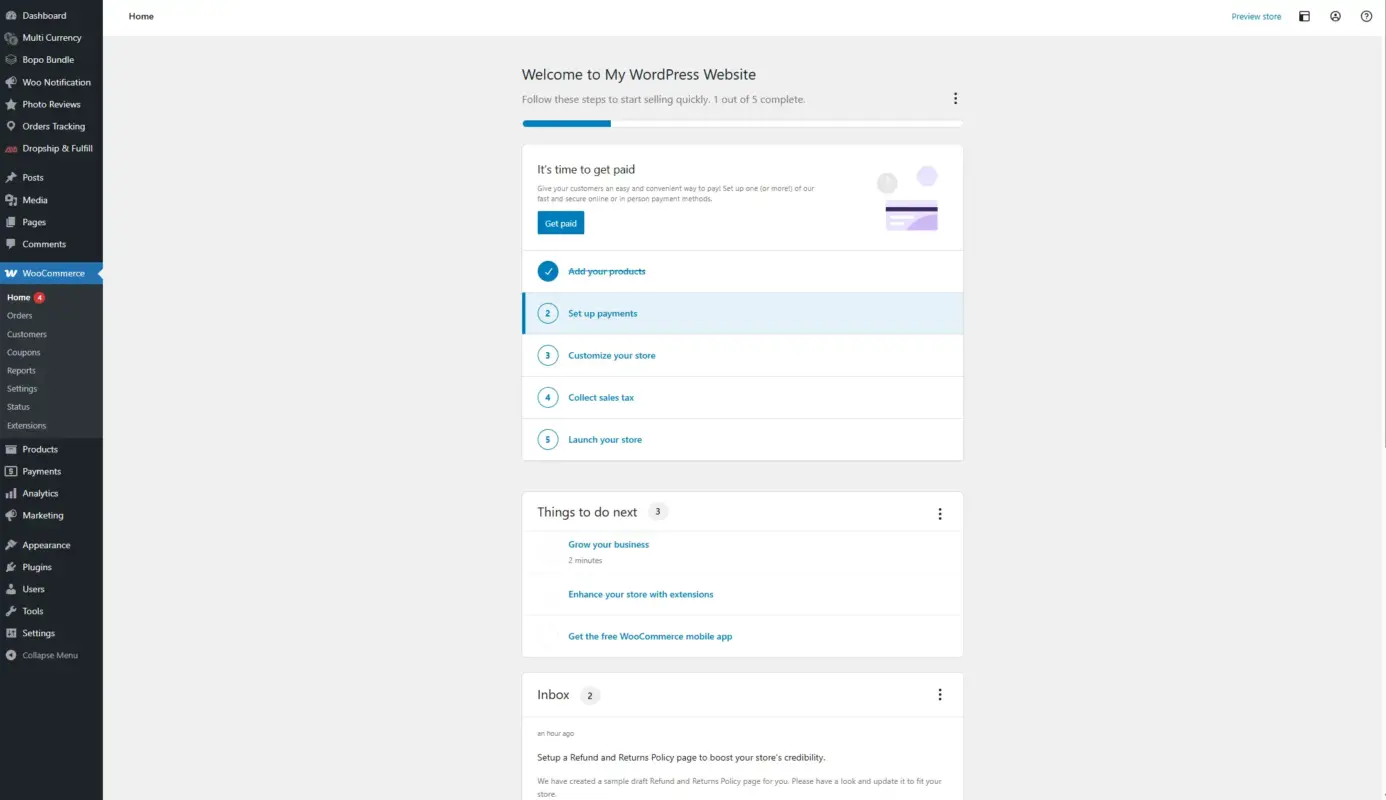
Yes. WooCommerce is a solid option for connective eCommerce, and it gets far less attention than it deserves in most guides on this topic, which usually default to Shopify.
Here’s what WooCommerce gives you that Shopify does not:
- Full ownership: Your store lives on your own WordPress installation. You own the platform, the data, and the design. There are no Shopify-style monthly fees that increase as your plan tier rises.
- Lower ongoing cost: WooCommerce itself is free. You pay for hosting, a domain, and any plugins you choose. For a store just starting out, this can mean significantly lower monthly costs compared to a paid Shopify plan.
- More flexibility: Because WordPress is open source, you can customise your store at the code level if needed. Most connected eCommerce beginners won’t need this straight away, but it matters when you start growing.
- The trade-off: WooCommerce requires more technical setup than Shopify. You install WordPress, set up hosting, configure WooCommerce, and handle updates yourself or hire someone to. It is more work at the start. Whether that trade-off is worth it depends on your budget and long-term plans.
If you want to understand WooCommerce alternatives and how the platforms compare at a practical level, that’s worth reading before you commit. For driving customers to your store once it’s live, a solid WooCommerce SEO guide is also worth bookmarking — organic traffic is the primary marketing channel in the connective model, which means SEO matters from day one.
When to Move Beyond the Connective Model
Connective eCommerce is a starting point. For most serious sellers, it stops being enough at some point, and recognising that point matters.
Signs you’ve outgrown it:
- You’re selling the same products as dozens of other dropshippers and competing only on price
- Customer complaints about shipping times or product quality are becoming a regular pattern
- Your margins are too thin to invest back into the business
- You have a clear best-selling product and consistent demand, but no control over its supply chain
At that point, the right move is to start taking ownership of the things the connective model handed to others. That might mean buying your first batch of inventory wholesale. It might mean finding a manufacturer and putting your brand on a product. It might mean setting up your own fulfilment process or working with a 3PL provider.
None of that is complicated. It’s just the natural next stage. The connective model does what it’s designed to do: let you test the market cheaply and learn what actually sells. Once you know, you use that knowledge to build something with better margins and more control.
If you’re at that stage and running on WooCommerce, moving to WooCommerce from Magento or any other platform or upgrading how your WooCommerce store operates is a natural next step.
Most guides on connective eCommerce don’t cover this part. They stop at “here’s how to get started.” But knowing the exit increase is just as useful as knowing the on-increase.
Conclusion
Connective eCommerce is a real, practical way to start selling online with low startup costs and minimal risk. It bundles together three existing approaches: platform-based store building, dropshipping fulfilment, and organic marketing, into a structured framework for beginners. It’s not magic, and it’s not a scam. It’s a lower-cost version of dropshipping with a clearer method behind it.
The model works best as a starting point. Use it to test product ideas, learn how eCommerce actually operates, and build your first sales without betting large on inventory. When you outgrow it, and most successful stores do, you’ll have the knowledge and revenue to do it.
If you’re building on WooCommerce and want to set up your store the right way from the start, our guide on how to set up WooCommerce on WordPress is a good place to begin.
Frequently Asked Questions(FAQs)
Q1. Is connective eCommerce the same as dropshipping?
Not exactly, but the two are very similar. Dropshipping is a specific fulfilment method where you sell products that a supplier ships directly to your customer. Connective eCommerce is a broader framework that includes dropshipping as its fulfilment approach, but also covers how you build your store and how you market it. Think of dropshipping as one component of the connective eCommerce model.
Q2. Is connective eCommerce real?
Yes. It’s a real business model used by many online sellers. It’s not a guaranteed path to income, and it requires consistent work on product selection, customer service, and marketing. The term was introduced by Cortney Fletcher through the eCom Babes course, and the underlying approach using platforms and suppliers to reduce startup costs is a well-established eCommerce practice.
Q3. How much does it cost to start a connective eCommerce business?
You can start for well under $500. The main costs are a domain name (about $10–$15 per year), web hosting (roughly $5–$30 per month depending on the provider), and a platform subscription if you’re using Shopify. WooCommerce is free, which makes it a lower-cost starting point for the store setup portion of the model.
Q4. What is the main risk with connective eCommerce?
The biggest practical risk is supplier dependency. Since a third-party supplier handles your inventory and shipping, any problem on their end, such as stock shortages, slow shipping, or quality issues, directly affects your customers and your reputation. The best way to reduce this is to vet suppliers carefully and maintain relationships with more than one.
Q5. Can connective eCommerce work long-term?
It can, but most successful sellers eventually move beyond the pure connective model. As your store grows, margin pressure from supplier costs and the limits of organic-only marketing tend to push you toward owning more of your supply chain. The connective model is excellent for getting started and testing what sells. It’s less suited to building a high-margin, scalable brand over the long run.
Q6. Does connective eCommerce work with WooCommerce?
Yes. WooCommerce is a fully capable platform for running a connected eCommerce store. It gives you more control and lower monthly costs than Shopify, with the trade-off of requiring more initial setup. For sellers who want to own their platform rather than rent it, WooCommerce is a strong choice.