
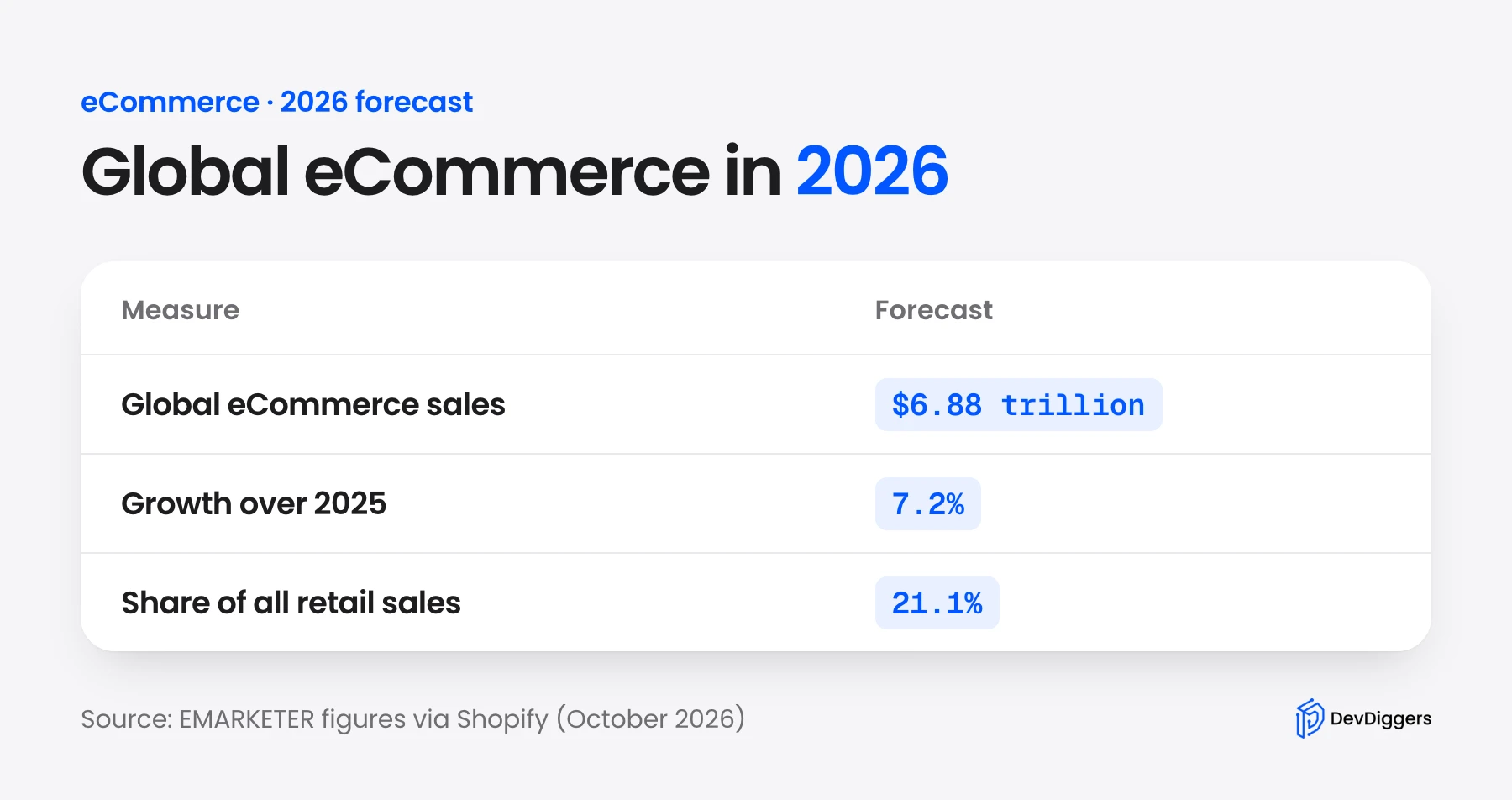
The eCommerce trends that matter most for small WooCommerce stores in 2026 are AI shopping agents, value-seeking buyers, smarter returns and loyalty. Global eCommerce sales are forecast at $6.88 trillion in 2026, or 21.1% of all retail. That number shows the market is big. It does not tell you which trends will move your revenue.
We checked every number in this guide against the original report or vendor page in October 2026. DevDiggers has built 26+ WooCommerce plugins. We also say which trends a small store can act on this quarter.
This guide covers the 10 eCommerce trends shaping 2026, the data behind each one, and an honest look at which ones are worth your time right now. We’ll also name the ones that probably aren’t.
The eCommerce Market in 2026: The Numbers Worth Knowing
Before the specific trends, here is a quick look at the market they sit inside.
According to EMARKETER figures in Shopify’s global eCommerce sales forecast, global eCommerce sales are forecast to reach $6.88 trillion in 2026. That is a 7.2% increase from the previous year. eCommerce is expected to make up 21.1% of total retail sales. That growth rate is steady and not explosive. The “growth at all costs” era is over. What’s replacing it is a harder game: winning on retention, trust and experience rather than cheap customer acquisition.
Payments and product discovery are shifting too. Wallet checkout, AI shopping agents and social shops all shorten the path from interest to order.
For platform numbers such as store counts and market share, see the WooCommerce statistics for 2026.
That’s the backdrop. Here’s what is changing inside it.
The 10 eCommerce Trends Shaping 2026
1. AI-Powered Personalization
This one has been on trend lists for three years. The difference in 2026 is that the gap between stores using it and stores ignoring it has become measurable.
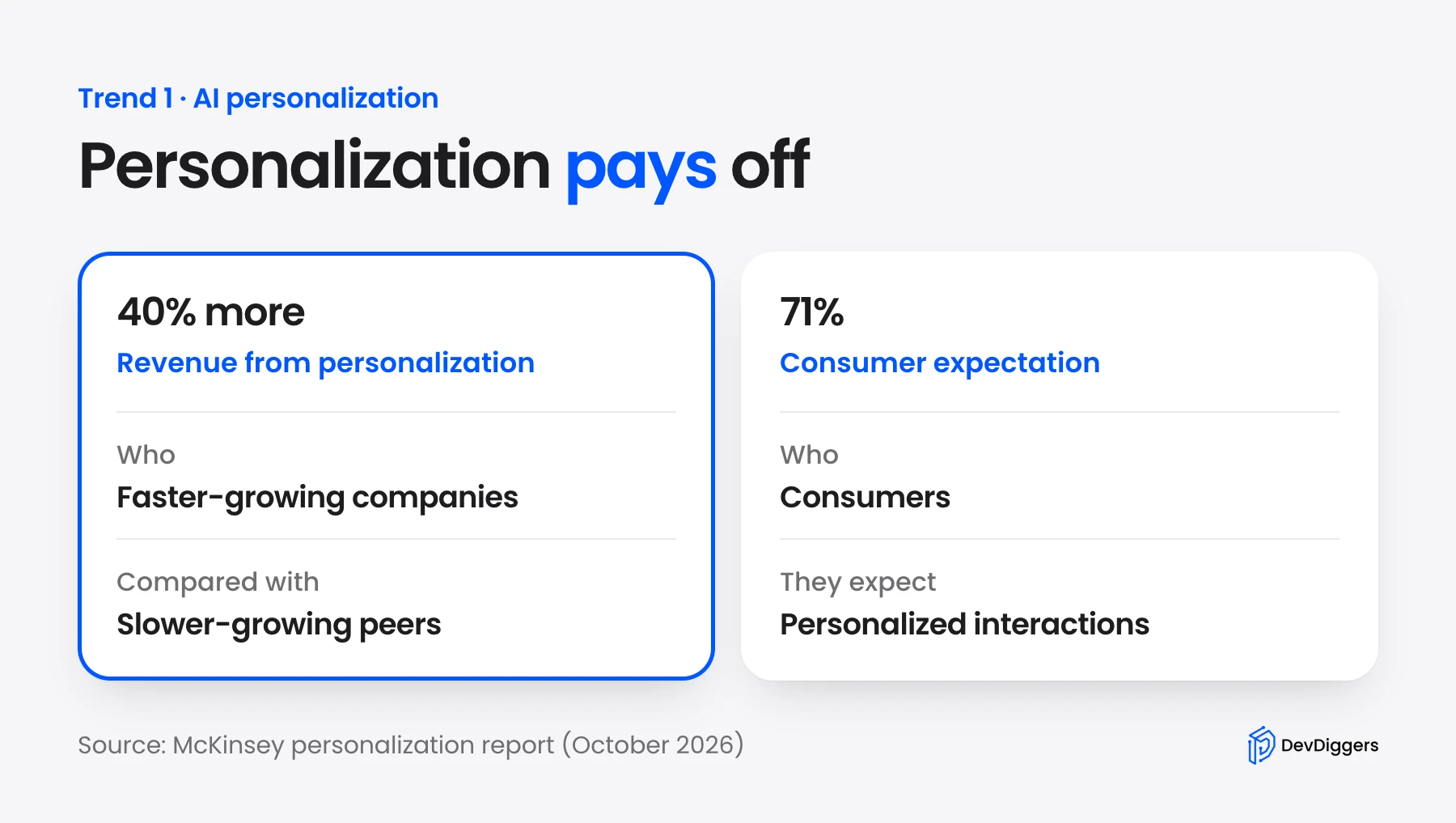
McKinsey research on personalization found that faster-growing companies drive 40% more of their revenue from personalization than slower peers. The same study found that 71% of consumers expect personalized interactions from the brands they buy from.
Most WooCommerce stores still show every visitor the same homepage. That gap is where a small store can gain ground on bigger rivals.
The good news is that you don’t need Amazon’s setup. Basic behavioral recommendations, email flows based on browse history and product suggestions at checkout all help. Stores that start now will be harder to catch in 12 months.
- Who this applies to: Every store with repeat-purchase potential. If your average customer buys once a year, personalization still helps, but it’s less urgent than for stores selling consumables or fashion.
- What to do now: Add a product recommendation plugin to your WooCommerce store and connect it to purchase history. Start with “frequently bought together” and “recently viewed.” That’s the foundation.
2. Agentic Commerce
This is the most talked-about trend of 2026 and the most misunderstood. Here’s the plain version.
AI agents, tools like ChatGPT’s shopping feature, Google’s AI Mode, and Gemini, are now browsing, comparing, and in some cases completing purchases on behalf of users. A shopper says, “Find me the best magnesium supplement under $30 with same-day shipping,” and an AI agent handles the whole search, comparison, and checkout. No Google. No typing.
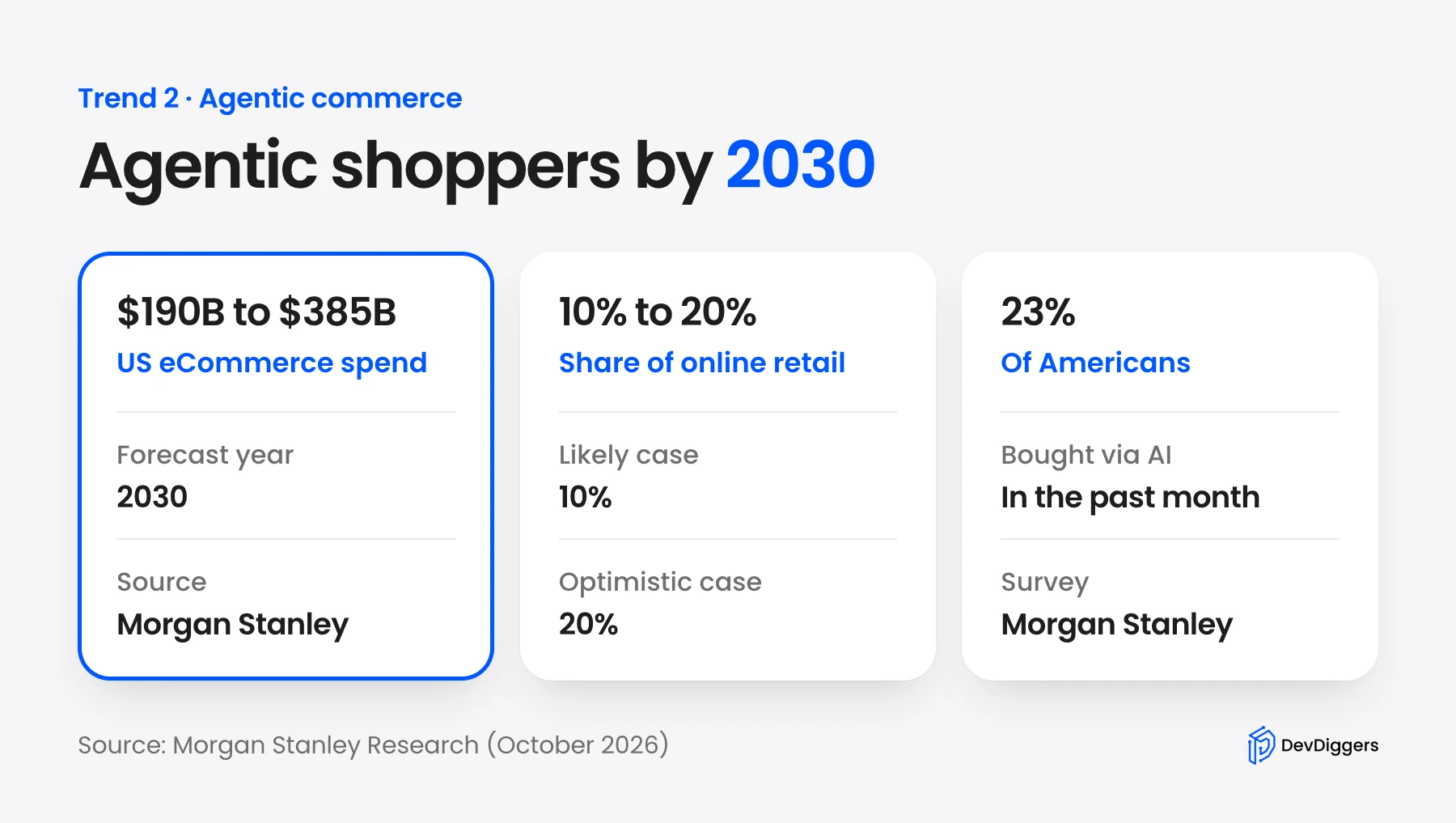
Morgan Stanley Research estimates that agentic shoppers could reach $190 billion to $385 billion in US eCommerce spending by 2030. That December 2025 forecast is not about tomorrow. Its consumer survey also found that nearly 23% of Americans made an AI-assisted purchase in the past month.
The practical implication for your store: AI agents can only recommend products they can read and understand. If your product titles are vague, your descriptions are thin, or your structured data is missing, you’re invisible to these systems. This is what people mean by AEO (Answer Engine Optimization). It’s not about keywords. It’s about making your product data legible to machines.
Google’s official Search documentation covers the structured data requirements that help AI systems understand and surface your products.
- Who this applies to: Most urgent for stores in high-consideration categories where shoppers research before buying: supplements, electronics, apparel, home goods. Less urgent for impulse buy or highly visual categories.
- What to do now: Audit your WooCommerce product data. Every product needs a clear title, a detailed description, a defined use case, and schema markup. If those aren’t in place, fix them before worrying about anything else in this section.
3. Social Commerce and Live Shopping
Social media has moved from a discovery tool to a sales channel. Shoppers find a product in a feed and buy it through an in-app shop or a product link.
You don’t need TikTok Shop or a creator team to take part. An Instagram Live session for a small group of buyers in your niche is a cheap test. The format works because it’s interactive, time-bound and personal.
- Who this applies to: B2C stores selling visual or demonstrable products like fashion, beauty, home goods, and food. Less relevant for digital products or B2B.
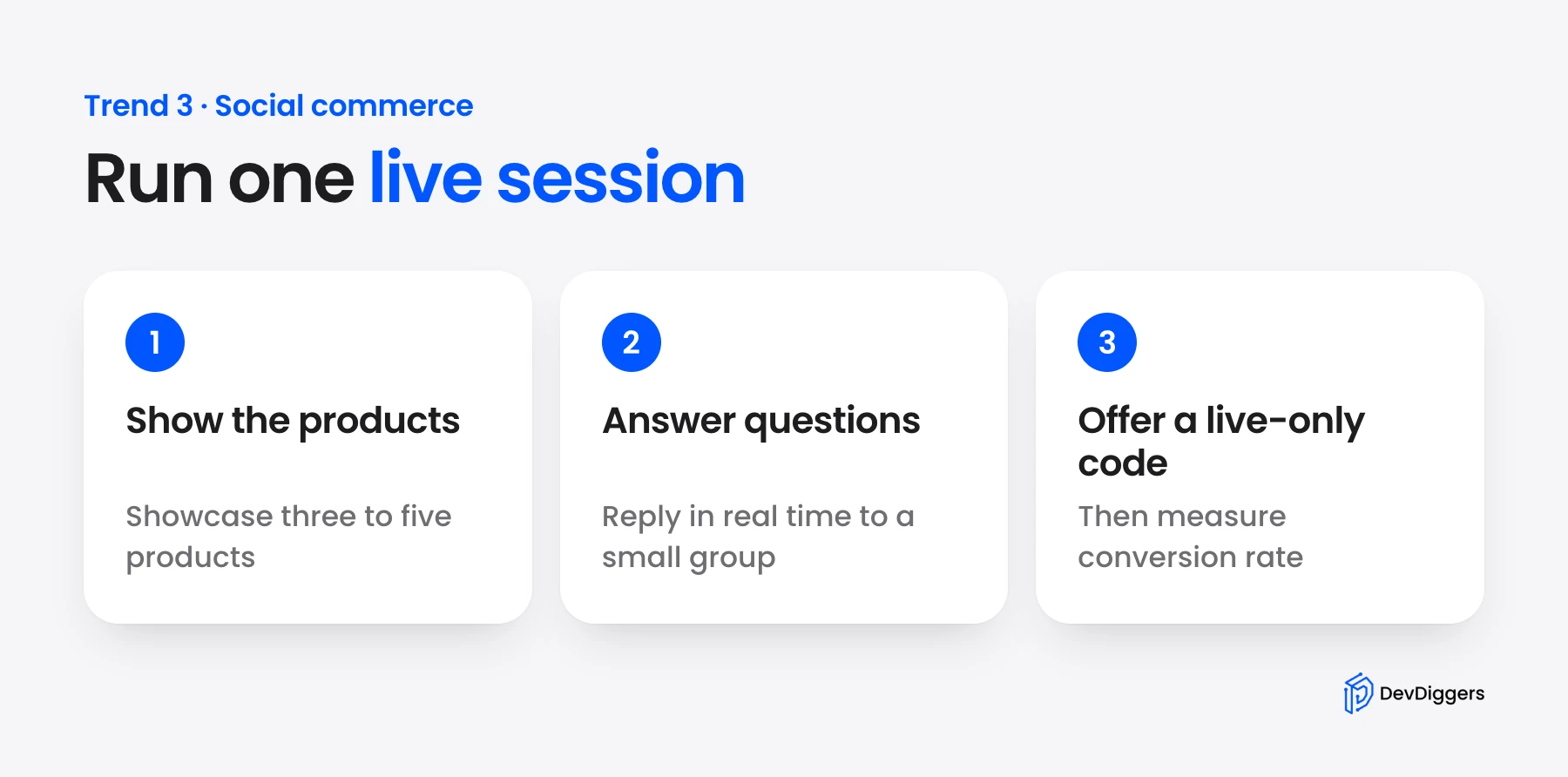
- What to do now: Run one live selling session on Instagram or TikTok this quarter. Keep it simple: showcase three to five products, answer questions in real time, and offer a live-only discount code. Measure conversion rate and go from there.
4. The Rise of the Value-Seeking Consumer
This trend doesn’t get a flashy name. It’s also the one most likely to affect your margins.
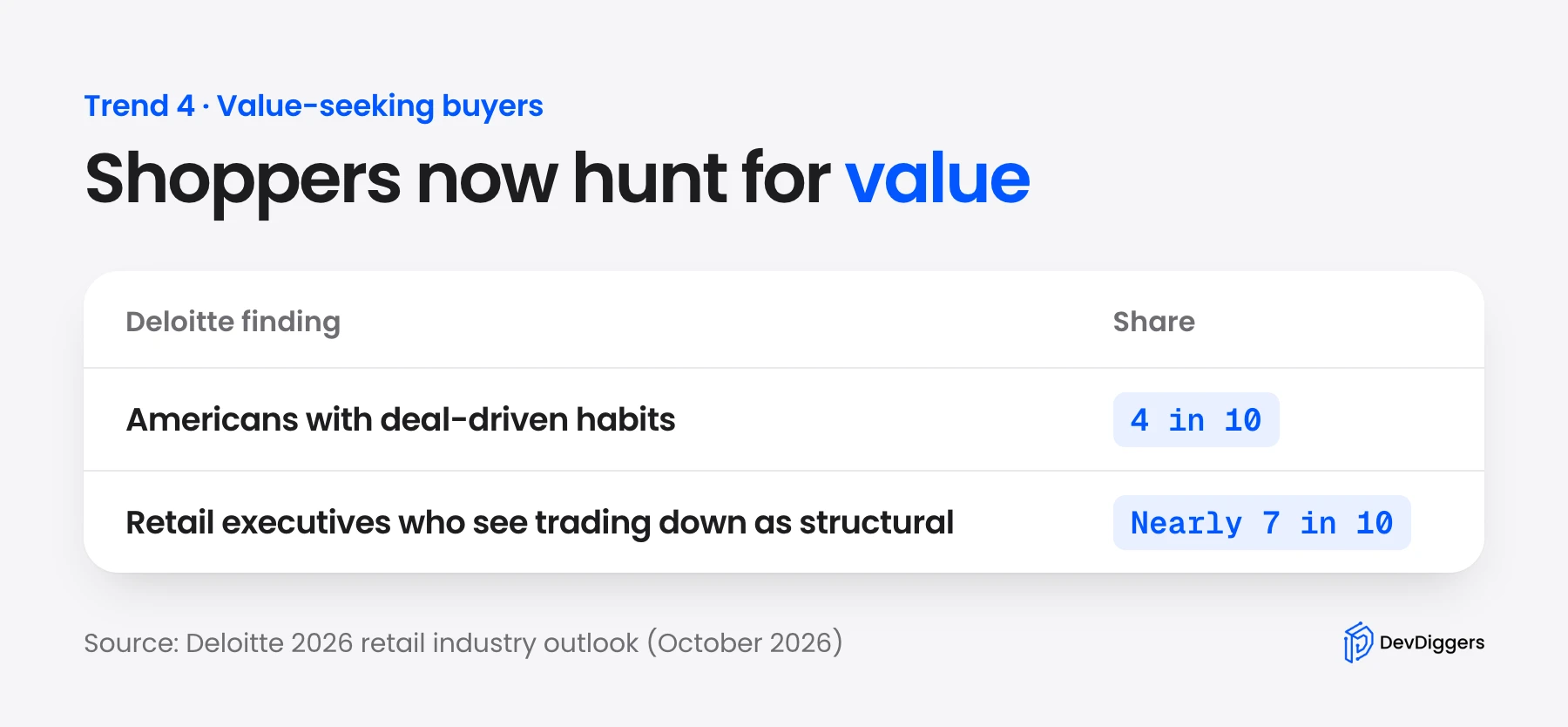
Deloitte’s 2026 retail industry outlook reports that four in 10 Americans now show deal-driven or cost-conscious habits. Nearly 70% of the 330 retail executives Deloitte surveyed see trading down as a structural change. They do not expect it to fade as inflation cools.
Buyers now check prices on purchases they used to make without thinking.
The trap is responding to this by cutting prices. That’s a race you can’t win against larger competitors. The smarter response is competing on perceived value: loyalty rewards, cashback, exclusive member benefits, and post-purchase experiences that make customers feel they got more than they paid for.
If you already use LoyaltyX, our WooCommerce Points and Rewards plugin built by DevDiggers, this is the year to review your reward rates. Show customers their points balance and make redemption easy to find.
- Who this applies to: Every store. But especially stores in commodity-adjacent categories (supplements, pet products, home goods) where switching costs are low.
- What to do now: If you don’t have a loyalty program, set one up. If you do, check your redemption rate. Low redemption means your reward value isn’t high enough, or customers don’t know their balance.
5. The Return Crisis and the Retention Opportunity Inside It
Returns are no longer just a logistics problem. They’re a retention lever most stores are using badly.
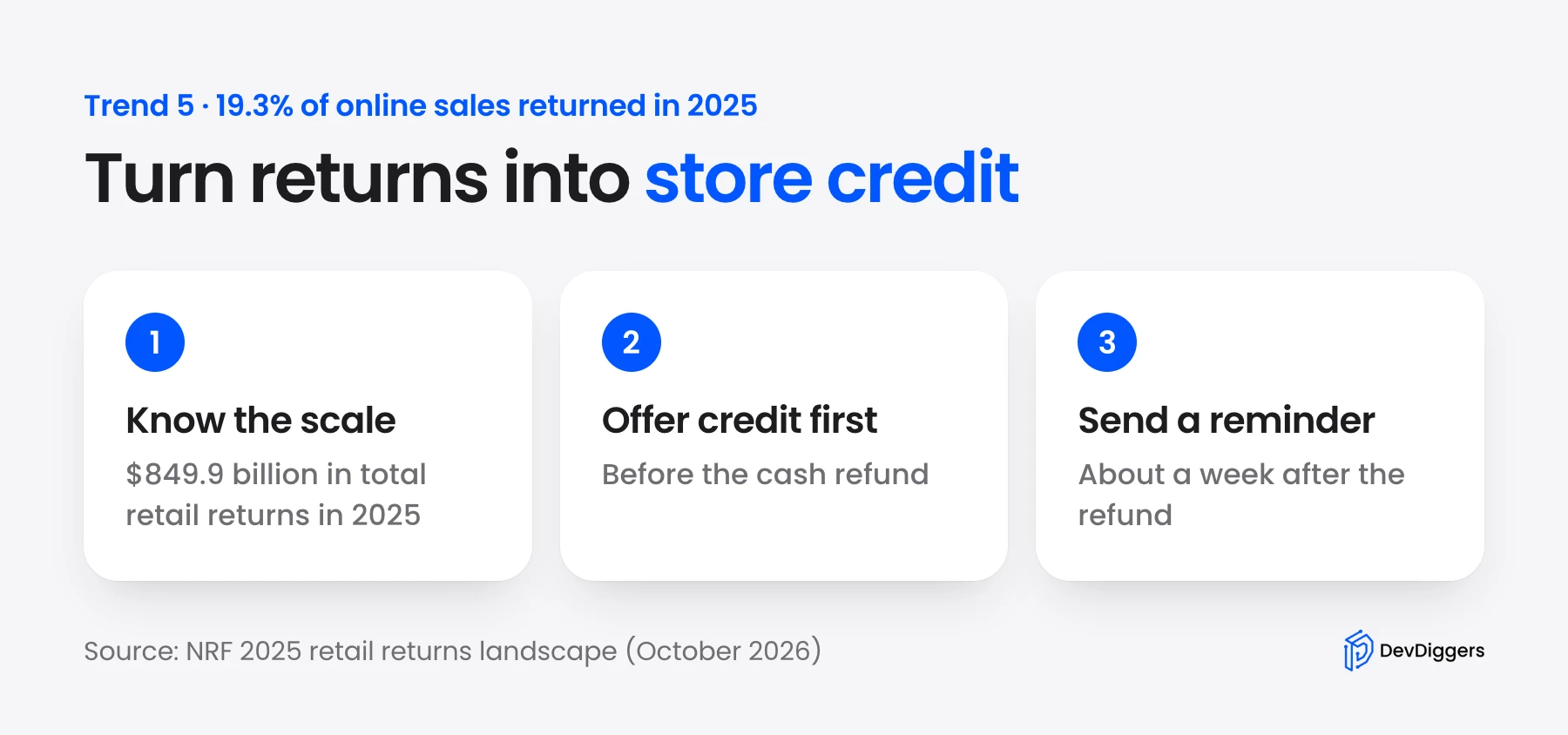
The NRF 2025 retail returns report estimated that 19.3% of online sales would be returned in 2025. Across all US retail, returns were forecast at $849.9 billion, or 15.8% of sales.
Many merchants now charge return fees to cover that cost. A better play for retention is to steer customers toward an exchange or store credit instead of a cash refund.
Store credit and digital wallets are the bridge here. When a customer chooses store credit over a cash refund, you keep the revenue, they keep the relationship, and the next purchase is already funded. Our WooCommerce Wallet plugin, built by DevDiggers, credits order refunds back to the customer’s wallet. Customers can then spend that balance at checkout, including as a partial payment.
Wallet credit only works if customers remember it. Send a reminder email about the unused balance about a week after the refund.
- Who this applies to: Any store with a high return rate, mostly apparel, home goods and electronics.
- What to do now: Present store credit as the first option in your returns flow, before the cash refund. Add an automated reminder email for unused wallet balances.
6. Digital Wallets and Flexible Payments
Checkout friction is still one of the largest revenue leaks in eCommerce. The fix isn’t complicated.
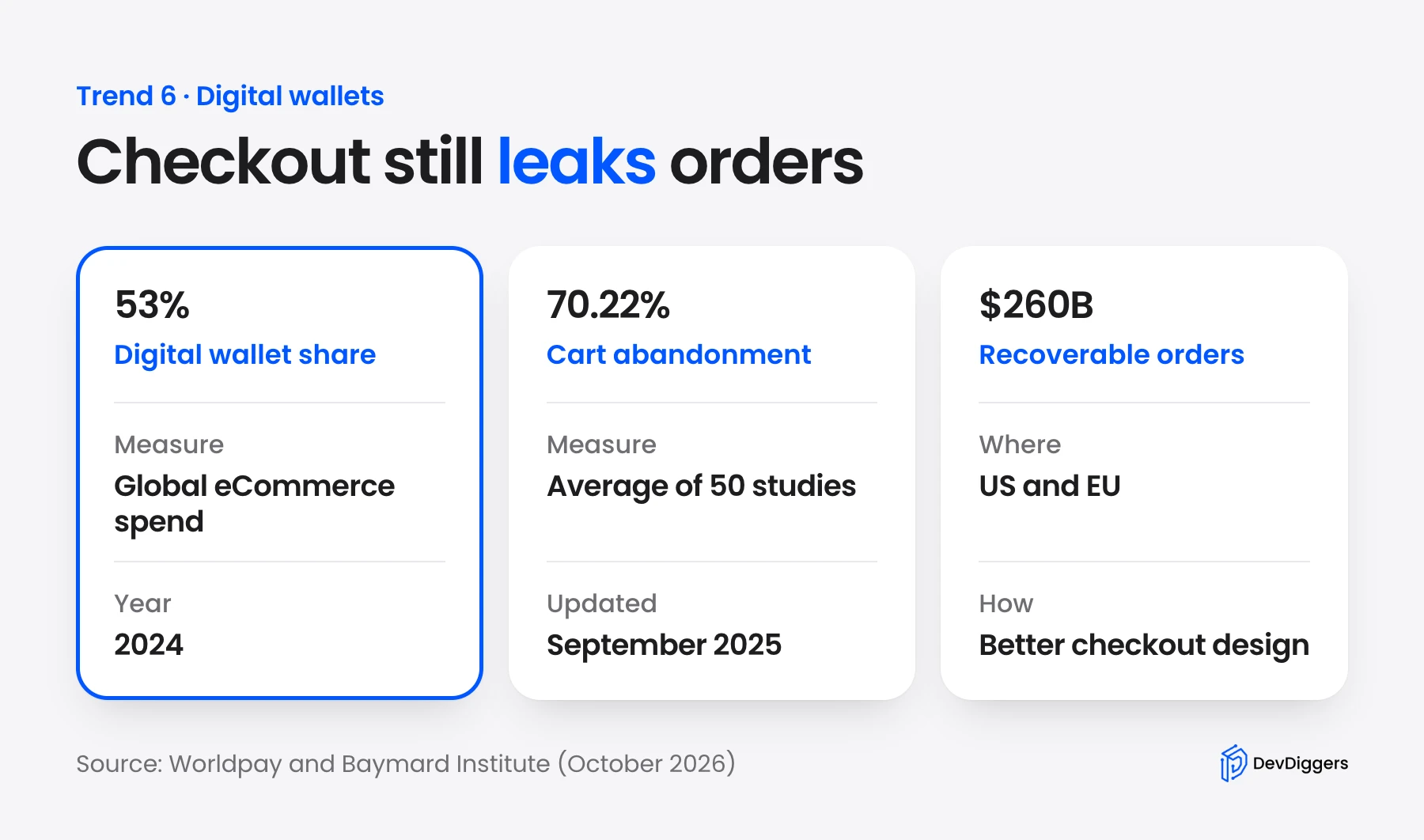
The Worldpay Global Payments Report 2025 puts digital wallets at 53% of global eCommerce spend in 2024. Shoppers expect Apple Pay, Google Pay and regional options at checkout. Buy now pay later (BNPL) is now a common option in most consumer categories.
Baymard Institute’s average of 50 studies puts cart abandonment at 70.22% as of its September 2025 update. Baymard estimates that $260 billion of lost orders in the US and EU can be recovered through better checkout design.
Wallet checkout cuts the steps between wanting a product and a confirmed order. For higher-ticket items, BNPL can win customers who would otherwise wait or compare prices.
- Who this applies to: All stores. This is table stakes for 2026 and not a differentiator.
- What to do now: Check that your WooCommerce checkout offers at least Apple Pay or Google Pay alongside your standard payment gateway. If your average order value is above $100, add a BNPL option.
7. Re-Commerce and the Secondhand Economy
This one is moving faster than most Western store owners realize.
Resale apps such as Vinted and ThredUp have taught shoppers to buy secondhand. B2C brands that run their own trade-in or resale programs are the next step.
Re-commerce also works as a loyalty driver. A trade-in program keeps customers with your brand when they sell used items on third-party platforms. Patagonia’s Worn Wear program is the reference case. But smaller brands in outdoor gear, fashion, and electronics are running versions of this at a modest scale.
This trend is early enough that getting ahead of it now creates a real advantage. The mechanics aren’t complicated: accept trade-ins, certify condition, list for resale at a discount, issue store credit for the trade-in value.
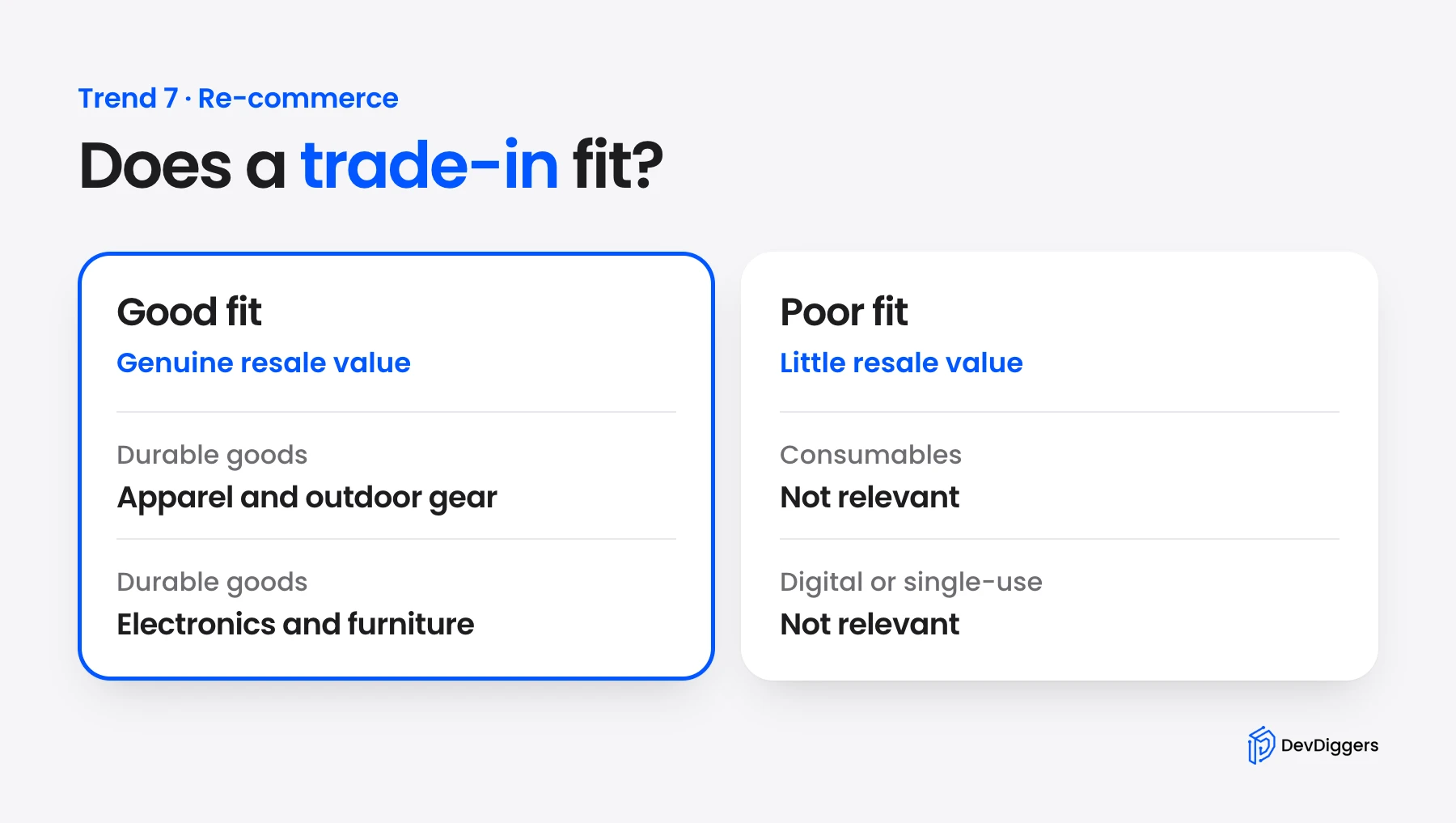
- Who this applies to: Stores selling durable goods with genuine resale value: apparel, outdoor gear, electronics, furniture. Not relevant for consumables, digital products, or single-use items.
- What to do now: If your category has resale value, sketch a basic trade-in model. A manual process with a form and a store credit voucher is enough to validate demand before investing in dedicated software.
8. Omnichannel Is Now the Default
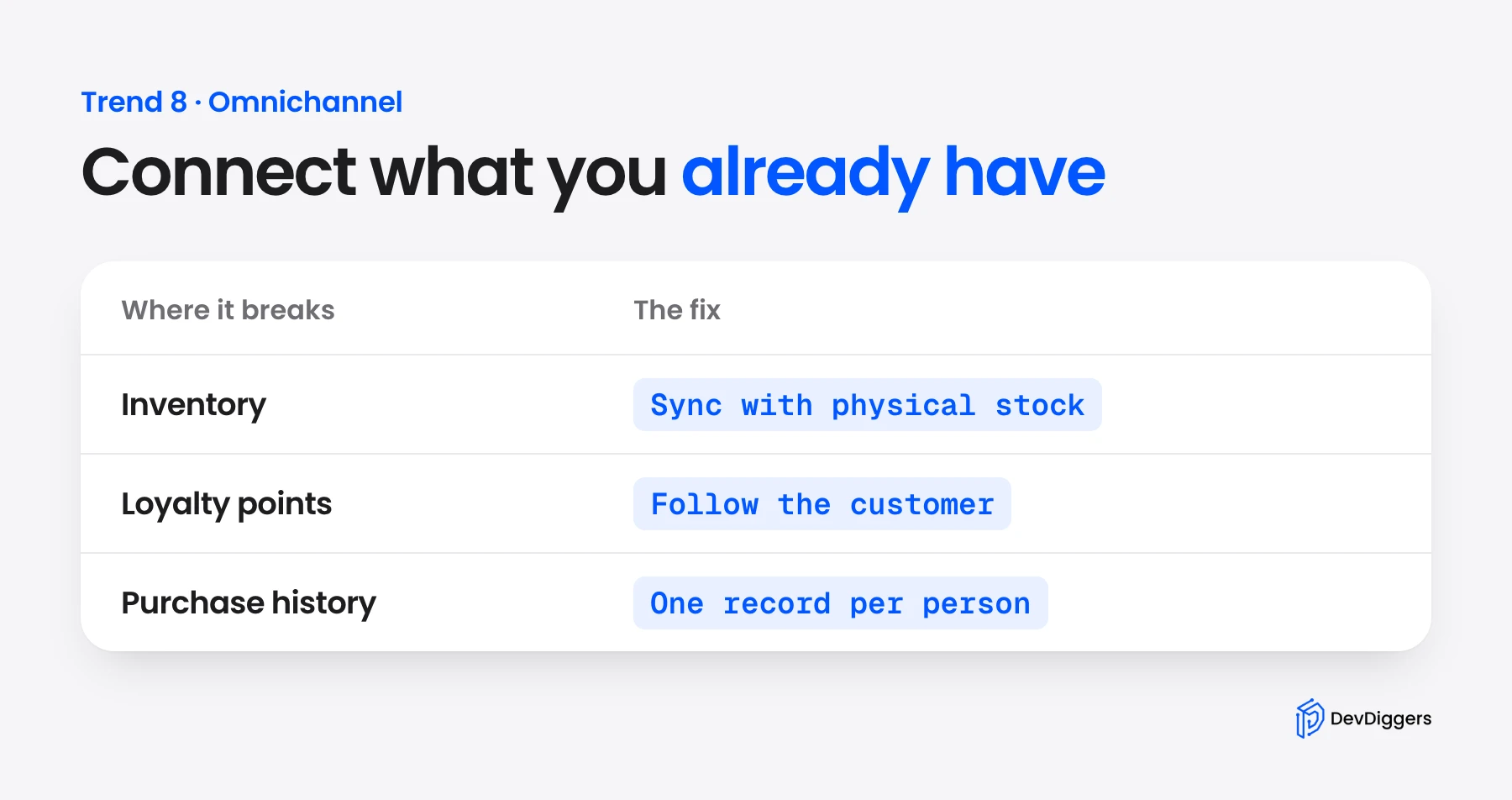
A few years ago, “omnichannel” sounded like an enterprise goal. In 2026, it’s the baseline expectation for any store selling in more than one place.
The problem is that many WooCommerce stores are siloed: online inventory doesn’t talk to in-person stock, loyalty points earned in one channel don’t apply in another, and customer purchase history is fragmented across systems.
The fix doesn’t require an enterprise platform. It requires connecting what you already have: syncing WooCommerce inventory with any physical or pop-up sales channel, and making sure loyalty data follows the customer regardless of where they buy.
- Who this applies to: Any store selling across more than one channel. If you sell in one place only, skip this for now.
- What to do now: Map where your customer data lives. If a customer buys at a market event and then visits your WooCommerce store, do you know it’s the same person? If not, that’s the gap to close first.
9. Zero-Party Data and Privacy-First Retention
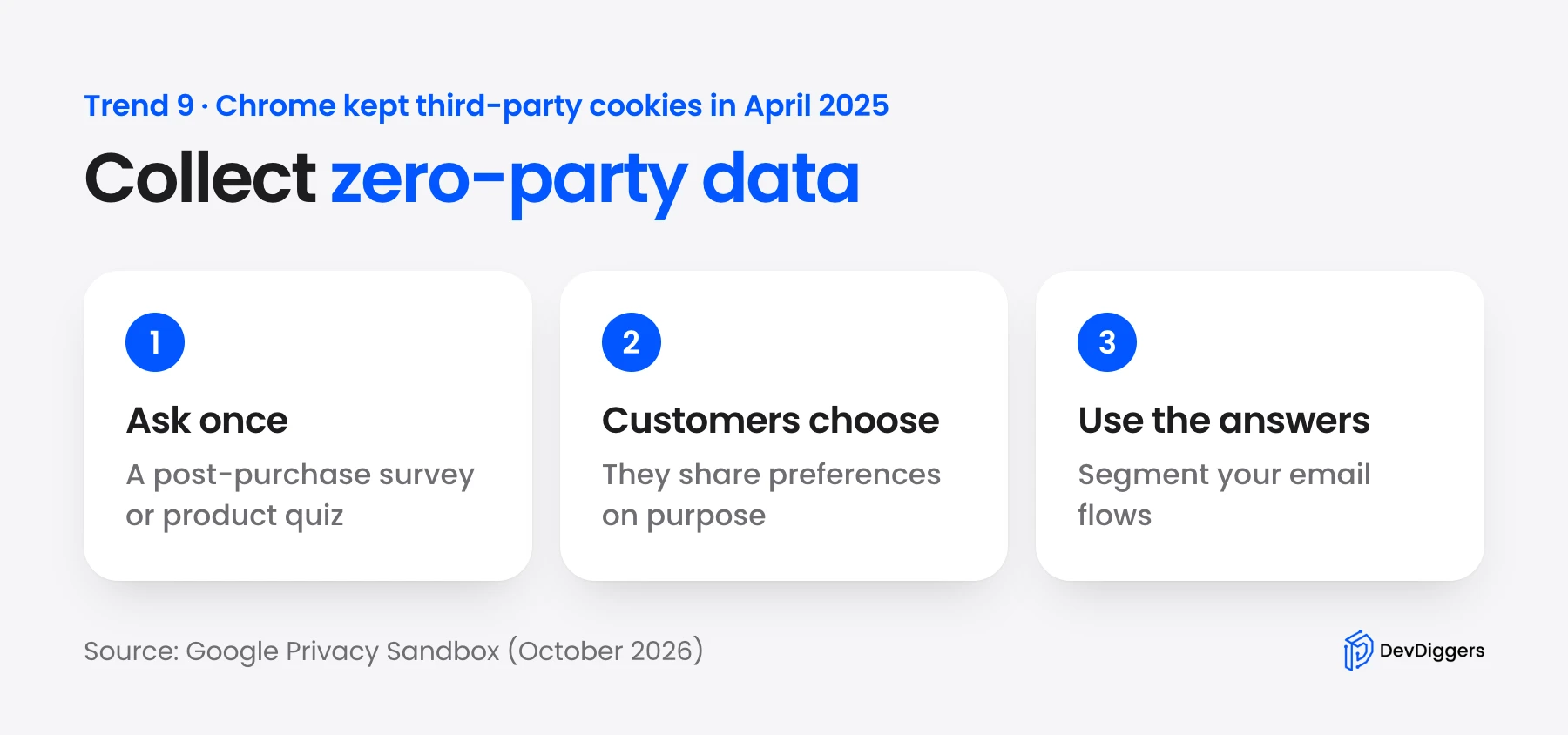
Google decided in April 2025 to keep third-party cookies in Chrome, per its Privacy Sandbox update. Privacy rules and browser blocking in Safari and Firefox still shrink third-party data. Brands that built retention on retargeting ads feel that loss.
The replacement is zero-party data: information customers actively choose to share with you. Preferences, product interests, purchase motivations, sizing. This is more valuable than tracking data anyway, because it’s accurate and consensual.
Loyalty programs, post-purchase surveys, quizzes, and onboarding flows are your collection mechanisms. The trade is simple: give customers a useful experience, such as personalized recommendations, relevant rewards, and useful content, and they’ll share the data that makes it possible.
- Who this applies to: Every store. Especially urgent for stores that have leaned heavily on Facebook or Google retargeting and are seeing customer acquisition costs climb.
- What to do now: Add one zero-party data collection moment to your customer journey, a post-purchase survey asking about preferences or a product finder quiz. Use that data to segment your email flows.
For a deeper look at setting up loyalty systems that collect and use this data well, our guide on how to set up a loyalty program in WooCommerce covers the mechanics in detail.
10. Sustainability as a Purchase Filter and Not Just Branding
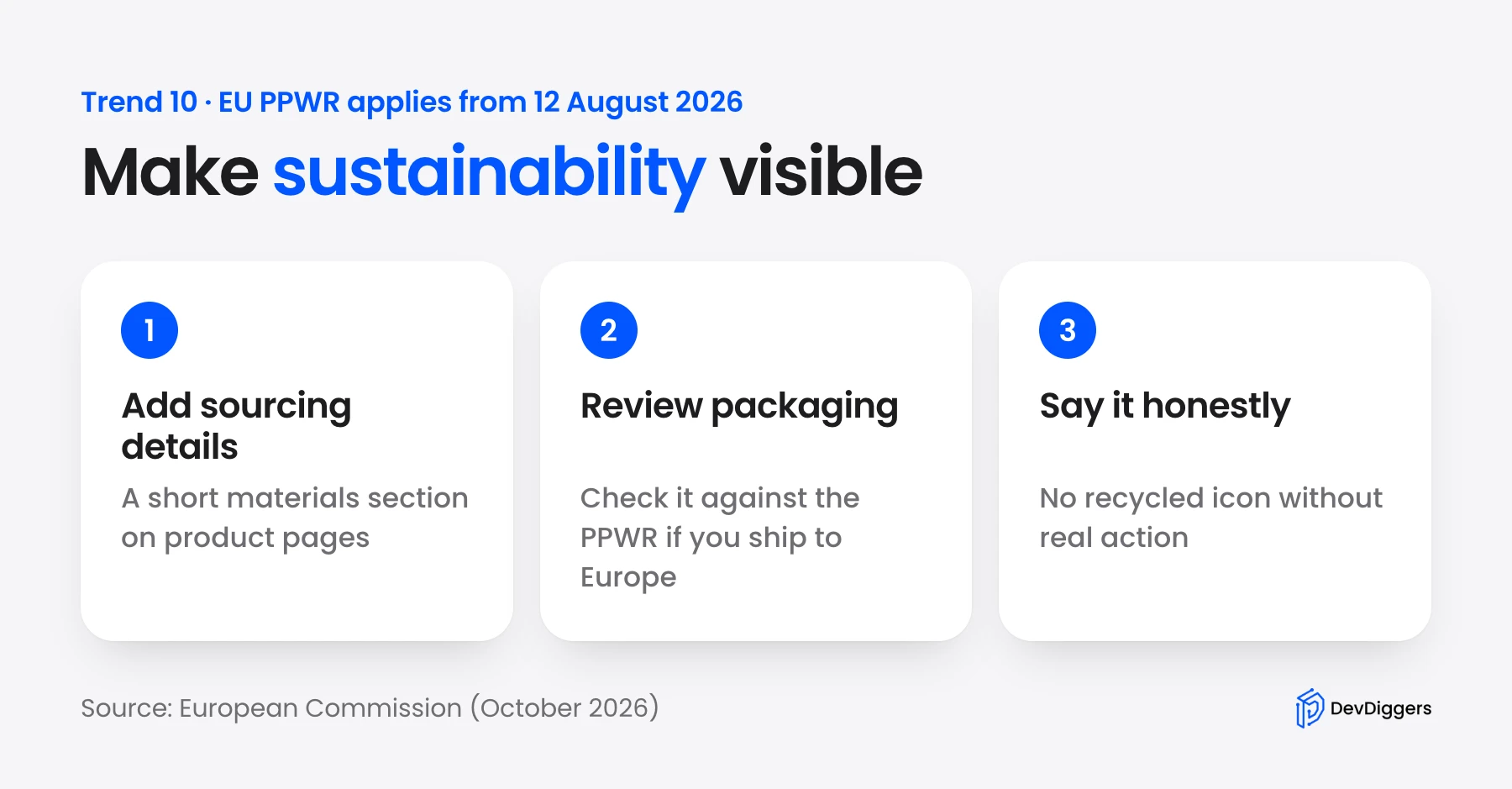
For some buyers, how a product is made and shipped now shapes what they buy.
Regulation is arriving too. The EU’s Packaging and Packaging Waste Regulation (PPWR) applies from 12 August 2026. Its 50% maximum empty-space ratio for e-commerce packaging starts later, from 1 January 2030 at the earliest. If you ship to European customers, these rules apply to you.
The practical version of this trend isn’t about greenwashing. It’s about adding sourcing transparency to product pages, tightening up packaging, and communicating what you’re doing honestly. Buyers are smart enough to tell the difference between genuine commitment and a recycled icon on a checkout page.
- Who this applies to: All stores, but especially those selling to European customers or targeting Gen Z and Millennial demographics who apply higher sustainability scrutiny.
- What to do now: Add a short sourcing or materials section to your product pages. Review your packaging against the PPWR rules if you ship to Europe. You can do both this month.
The Two Trends That Pay Off Fastest for WooCommerce Stores
Ten trends are a lot. If you’re a solo operator or a small team, you can’t chase all of them at once. So here’s the honest prioritization.
The two trends with the best return-on-effort for most WooCommerce stores right now are AI-powered personalization and loyalty/wallet-based retention. Both connect directly to the value-seeker trend (Trend 4), both address the return crisis (Trend 5), and both use data you already have.
Why Loyalty Programs Work Differently in a Value-Seeking Economy
A loyalty program in 2022 was a nice-to-have. In 2026, it’s how you compete on value without cutting price.
Rewarding customers only for spending is now the bare minimum. Many programs also reward engagement, such as reviews, referrals, sign-ups and birthdays. Those actions build long-term value even when they bring no revenue that day.
The detail most guides skip is that your reward rate has to be a real incentive. Take a store that gives 1 point per $1 spent, where 1,000 points earn $1 off. That is a 0.1% cashback rate, and few customers will bother to redeem it.
At 100 points per $1 off, the same spend returns 1%. That is a reward customers notice, and people who redeem tend to come back.
Our WooCommerce loyalty program plugin lets you set loyalty levels, points expiry and bonus points for reviews, referrals and sign-ups. If you’re setting it up for the first time, start with a rate your customers can understand. “Earn $1 for every $100 spent” is clearer than any points math.
How a Digital Wallet Turns Returns Into Repeat Purchases
Here’s the return crisis reframe most store owners miss: a customer who requests a refund hasn’t decided to leave yet. They’re still deciding.
If your returns flow offers cash back by default, they take the cash and leave. If it offers store credit first, with a clear, easy wallet balance they can see and spend instantly, a meaningful percentage stays. The purchase is already funded. The friction to buy again drops to near zero.
You can learn more about the specific mechanics in our post on maximizing sales with a WooCommerce wallet, including how to set up cashback rules and automate balance reminders.
What Agentic Commerce Means for Your Store Right Now
Most eCommerce content treats agentic commerce as a future event. It’s already happening.
Google started rolling out agentic checkout in AI Mode in November 2025. Google Pay completes the order on an eligible merchant’s site once the shopper confirms. OpenAI launched Instant Checkout in ChatGPT in September 2025, starting with US Etsy sellers.
This is the practical implication for a WooCommerce store owner: an AI agent searching for “best collagen supplement for joint pain under $40 with fast shipping” will only include your product if it can read and understand your product page. That means clear product titles, detailed use-case descriptions, accurate pricing and availability data, and schema markup. Check your own product pages for all four. On a small catalog the audit takes an afternoon.
The AI may suggest a product, but the shopper still decides. Reviews, clear content and brand trust help them confirm the pick before they buy.
That means your product pages, your reviews, and your brand story still matter. The AI gets the shopper to your door. Your page closes the sale.
The eCommerce Trends That May Not Apply to Your Store
This section exists because no honest trend guide should pretend every trend applies to every store. Some of these are enterprise-first developments dressed up as universal advice.
- Live shopping: High conversion rates when done well. Requires a charismatic presenter, a structured content calendar, real-time inventory management, and consistent execution. For a solo operator without a content team, the setup cost is high. Test it once before committing to a strategy.
- AR/VR product visualization: Meaningful return-rate reduction for fashion and furniture. Near-zero impact for consumables, digital products, or anything where fit and physical appearance aren’t the purchase driver. Don’t add AR to a supplement store.
- Full agentic autonomy: Criteo’s CEO writing on the future of agentic commerce argues that decisions in agentic commerce remain mostly human-led. The realistic picture is assistive AI that enhances research and reduces checkout friction and not AI that replaces human decision-making. Plan for the assistive version now. Plan for the autonomous version later.
- Re-commerce: Only applies if your product has genuine resale value and your margin supports a trade-in discount. A store selling $12 candles doesn’t need a resale program. A store selling $200 outdoor jackets does.
Simple idea. Hard to execute uniformly across every trend. Worth knowing before you plan your quarter.
Your 2026 eCommerce Action Plan: Where to Start
Here’s the prioritization framework based on effort vs. impact for most independent WooCommerce stores.
High impact and low effort: do these first:
- Set up or audit your loyalty program. Check the redemption rate. Fix the reward math if it’s too low.
- Add store credit as the first option in your returns flow, powered by a wallet system.
- Audit your WooCommerce product pages for structured data and schema markup.
High impact and medium effort: do these this quarter:
- Add behavioral product recommendations to your store.
- Set up at least one zero-party data collection point (survey or quiz) in your customer journey.
- Add Apple Pay or Google Pay to your WooCommerce checkout if it’s not already there.
Medium impact and medium effort: plan these for the next six months:
- Run a pilot live selling session on Instagram or TikTok.
- Build basic first-party data segmentation into your email flows.
- Check EU PPWR packaging compliance if you ship to Europe.
Longer-term plays: worth monitoring and not building yet:
- Re-commerce and trade-in programs (if your category supports it).
- Full omnichannel inventory and loyalty sync across channels.
- Deeper AR/VR product experiences (fashion and furniture stores only).
Conclusion
The eCommerce trends shaping 2026 come down to a few central shifts: consumers are more value-conscious than ever, AI is reshaping how products get discovered, and the gap between stores with strong retention systems and those without is widening fast.
For most WooCommerce entrepreneurs, the highest-leverage moves are the least glamorous: tighten your product data, build or improve your loyalty program, and make your returns flow work for retention instead of against it. Those three changes address the value-seeker trend, the agentic commerce trend, and the return crisis in one coordinated effort.
The flashier eCommerce trends, such as live shopping, AR and full agentic autonomy, are real. They reward execution skill more than early adoption. Get the foundation right first.
If you’re ready to build the retention layer, our WooCommerce Points and Rewards plugin is a practical starting point. Questions about setup or strategy? Drop them in the comments below.
Frequently Asked Questions (FAQs)
Q1. What is the biggest eCommerce trend in 2026?
AI personalization and agentic commerce get the most attention. For most store owners, the shift with the widest daily impact is the rise of value-seeking buyers. Deloitte reports that four in 10 Americans now show deal-driven habits.
Q2. How big is the eCommerce market in 2026?
Global retail eCommerce sales are forecast to reach $6.88 trillion in 2026, or 21.1% of all retail sales, per EMARKETER. Digital wallets made up 53% of global eCommerce spend in 2024, per the Worldpay Global Payments Report.
Q3. What is agentic commerce and how does it affect small stores?
Agentic commerce refers to AI tools like ChatGPT’s shopping feature and Google’s AI Mode that browse, compare, and sometimes complete purchases on behalf of consumers. For small stores, the immediate implication is practical: if your product data is incomplete or your schema markup is missing, AI agents won’t include your products in their results. Clean product titles, detailed descriptions, and structured data are the foundation.
Q4. Are loyalty programs still worth investing in for smaller WooCommerce stores?
Yes. For smaller stores competing against larger brands on price, loyalty rewards give buyers a reason to come back without a bigger ad budget. The key is a reward rate high enough that customers bother to redeem it.
Q5. How should WooCommerce store owners respond to rising return rates?
Treat returns as a chance to keep the customer. Offer store credit as the first option, ahead of a cash refund. Then send a reminder email about unused wallet balances about 7 days after the refund.