
DeepSeek vs ChatGPT in 2026 comes down to one question. Do you need to own the model, or do you need the strongest assistant you can buy?
DeepSeek publishes its weights free under an MIT license. You can run it on your own servers. ChatGPT does not, and its top model, GPT-6 Astra, is the most capable of the two on almost every public test. We have run both in real projects, and we rechecked every price and release date against each vendor’s own docs in October 2026, including the OpenAI pricing page and the DeepSeek pricing page.
This guide covers what each one costs, where each one wins, and the trade-off that decides it for most teams before a single benchmark matters.
The Short Answer
Pick ChatGPT if you want the best general assistant with no setup, and you are fine sending your data to OpenAI. Pick DeepSeek if cost matters, if your data cannot leave your own servers, or if you want to fine-tune a model on your own work.
For most people writing, coding, or researching day to day, ChatGPT is the stronger tool. For teams running AI at volume, or under strict data rules, DeepSeek wins on cost and control by a wide margin. Both answers are correct. They are answers to different questions.
What Changed in 2026
Both companies shipped a lot this year. A comparison written even six months ago is out of date. Here is where each side stands now.
ChatGPT model timeline
| Model | Released | What it added |
|---|---|---|
| GPT-4o | May 2024 | One model for text, images and audio. |
| GPT-4.5 | February 2025 | Better conversation. Left ChatGPT on 26 June 2026. |
| GPT-5 | August 2025 | A router that picks a fast or a slow answer for you. |
| GPT-5.1 | November 2025 | Warmer tone and better at following instructions. |
| GPT-5.2 | December 2025 | Stronger writing and data work. |
| GPT-5.3 Instant | 3 March 2026 | More accurate answers and fewer dead ends. |
| GPT-5.4 Thinking | 5 March 2026 | Best coding scores of the GPT-5 line at the time. |
| GPT-5.5 | 23 April 2026 | Wider rollout across paid plans. |
| GPT-5.6 | 9 July 2026 | Shipped in three sizes: Luna, Terra and Sol. |
| GPT-6 Astra | 3 September 2026 | Top model with a new architecture and a one million token context. |
| GPT-6 Sol and Luna | 22 September 2026 | Cheaper GPT-6 models for everyday and high-volume work. |
| GPT-6.1 Sol | 29 September 2026 | Near-Astra coding at one fifth of Astra’s API price. |
| GPT-6 in ChatGPT | 7 October 2026 | Default for every ChatGPT user and comes with Intelligent UI. |
DeepSeek model timeline
| Model | Released | What it added |
|---|---|---|
| DeepSeek-V3 | December 2024 | 671B parameters with about 37B active per question. MIT license. |
| DeepSeek-R1 | January 2025 | The reasoning model that made DeepSeek famous. |
| DeepSeek-V3.1 | August 2025 | A cleaner and faster V3. |
| DeepSeek-V3.2 | December 2025 | Last of the V3 line. |
| DeepSeek-V4 | April 2026 | First look at the new thinking and non-thinking modes. |
| DeepSeek-V4-Flash | 31 July 2026 | The cheap and fast half of the V4 release. |
| DeepSeek-V4-Pro | 13 August 2026 | Top model that is now out of preview. 1.6T parameters with 49B active and a one million token context. |
| DeepSeek-V4.1-Flash | 10 September 2026 | Newest model. Reads images natively and cut API prices again. |
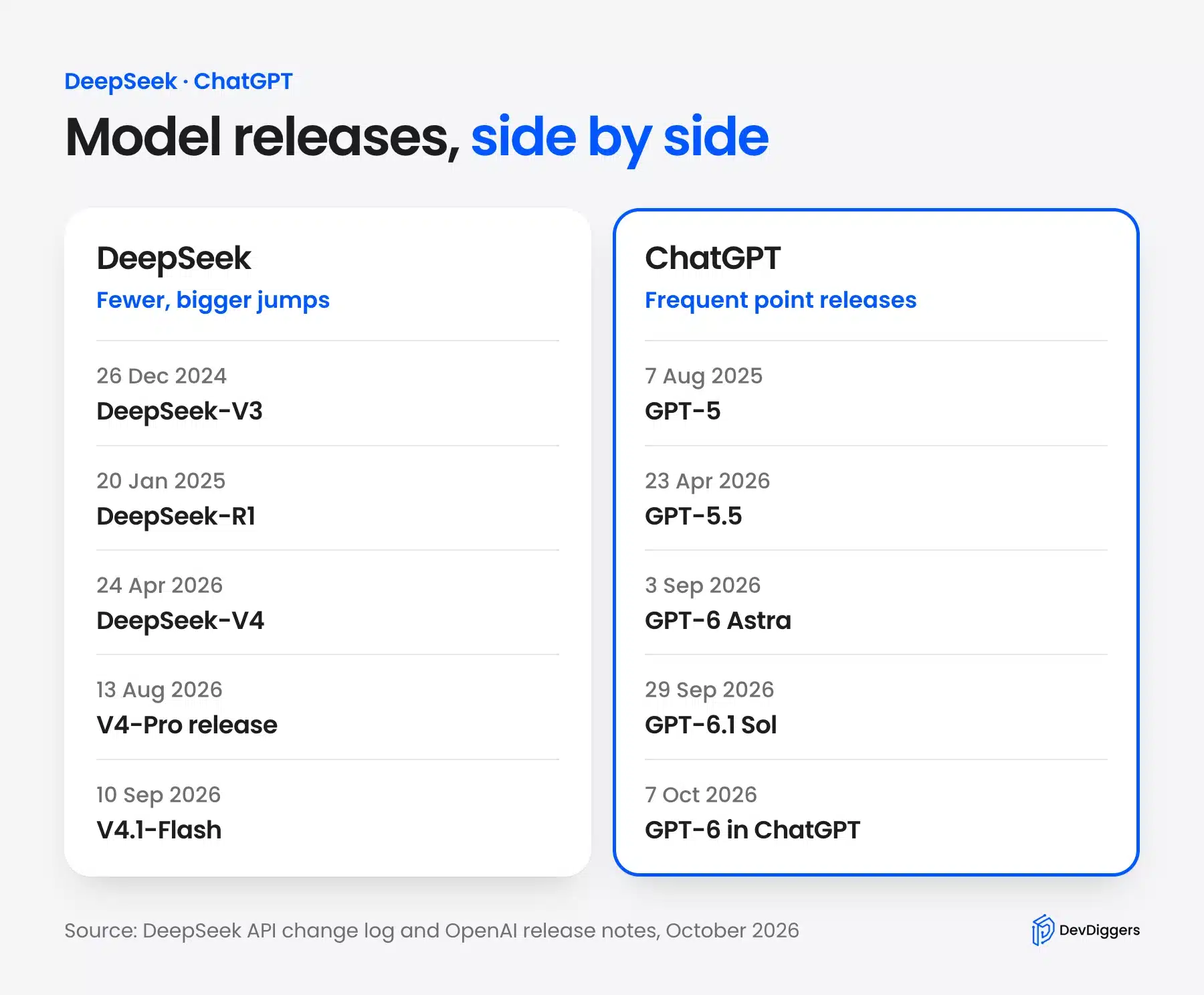
Notice the shape of both lists. DeepSeek ships fewer, bigger jumps. OpenAI ships small point releases every few weeks (OpenAI release notes). DeepSeek lists its releases in its API change log. That difference matters if you build on top of either one, and we come back to it below.
DeepSeek vs ChatGPT: Side by Side
| DeepSeek V4-Pro | ChatGPT (GPT-6 Astra) | |
|---|---|---|
| License | MIT license with open weights | Closed. Weights not published |
| Run it yourself | Yes, on your own hardware | No |
| Fine-tune the base model | Yes | No |
| Context window | About 1 million tokens | About 1.05 million tokens |
| API input price | $1.32 per million tokens (half off-peak) | $10 per million tokens |
| API output price | $3.96 per million tokens (half off-peak) | $50 per million tokens |
| Free tier | Yes, on the web | Yes, with limits |
| Image input | Only on V4.1-Flash and missing on V4-Pro | Yes |
| Best at | Cost, privacy, control | Reasoning, coding, general use |
The Price Gap Is Wider Than Most Comparisons Admit
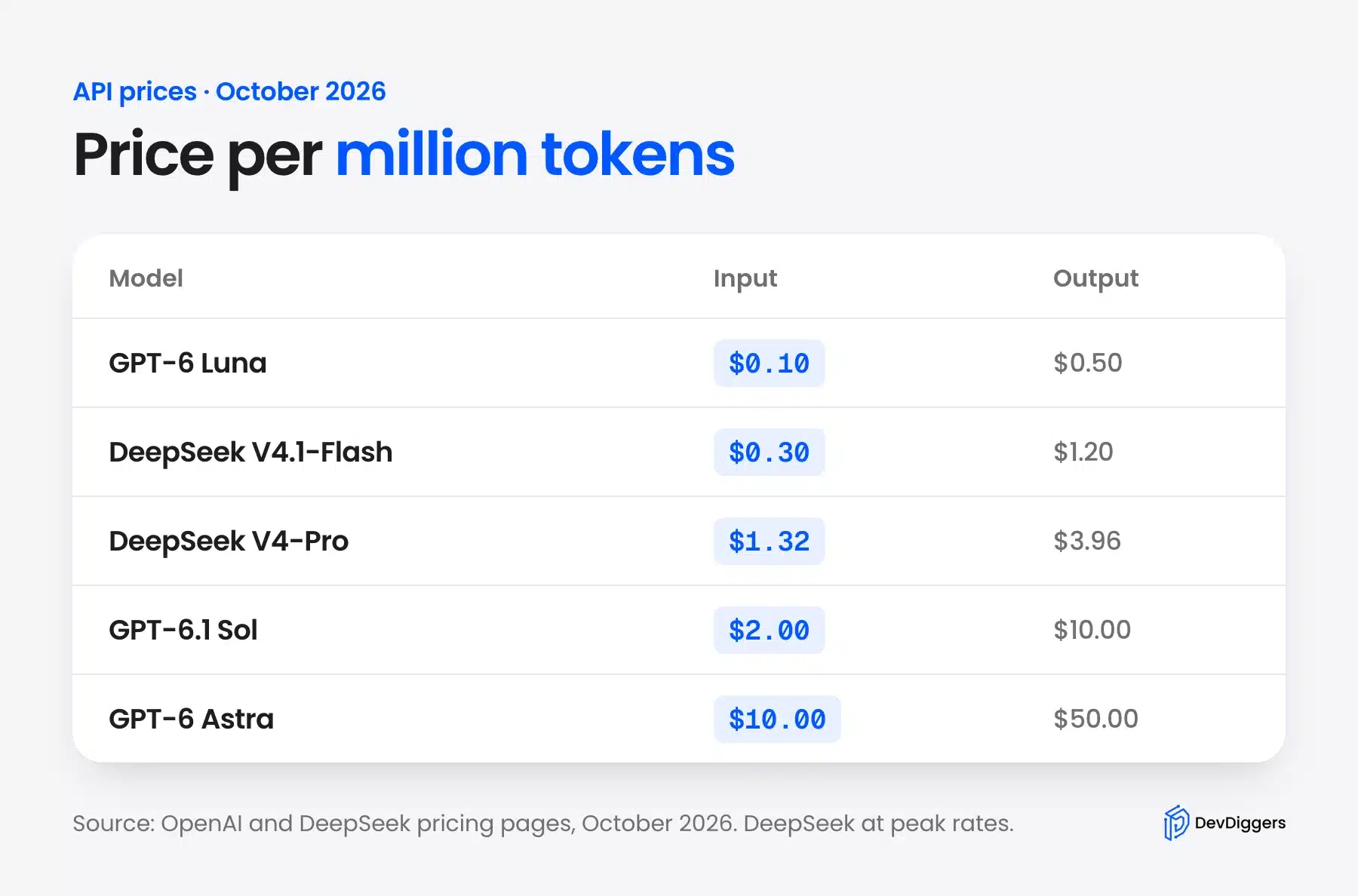
This is where the two stop being comparable products. DeepSeek V4-Pro charges $1.32 per million input tokens at peak hours, and half that off-peak. GPT-6 Astra charges $10. On output, the gap is bigger: $3.96 against $50, according to the DeepSeek pricing page and the OpenAI pricing page in October 2026.
Run the numbers on real work. A job that processes 50 million input tokens and writes 5 million tokens costs about $86 on DeepSeek V4-Pro at peak rates, or $43 off-peak. The same job on GPT-6 Astra costs about $750. On V4.1-Flash, it drops to about $21.
That is not a rounding difference. It changes which projects are worth building at all.
OpenAI’s own budget model is cheaper still. GPT-6 Luna costs $0.10 per million input tokens and $0.50 for output, and DeepSeek V4.1-Flash costs $0.30 and $1.20 at peak hours. OpenAI also lists a higher long-context rate for Astra: $20 input and $75 output.
The training cost tells the same story from the other end. DeepSeek trained V3 on about 2,000 GPUs for around $5.58 million. OpenAI pretrained GPT-6 Astra on more than 100,000 GPUs at its Stargate site in Texas. You are looking at two different bets on how to build a model, and the price you pay reflects which bet you are buying into.
Worth saying plainly: you get what you pay for in quality. GPT-6 Astra is ahead on hard reasoning. The question is whether your work needs that edge enough to pay about 7 times more for input and 12 times more for output.
Open Weights or Closed: The Question That Decides It First
For a lot of teams, the comparison ends here, before any test result is opened.
DeepSeek releases its models under the MIT license, one of the most open licenses there is. You can download the weights, run them on a machine you control, train them on private data, and ship them inside a paid product. No fee, no permission needed.
OpenAI does not publish weights for the GPT-6 line. You cannot host it, inspect it, or fine-tune the base model. You send your prompt to OpenAI and get an answer back.
Work in healthcare, law, or finance? Handle customer records under rules that say data stays in your country? That single line settles it. No benchmark score changes a legal requirement.
- Data cannot leave your servers: DeepSeek self-hosted is the only answer. There is no other.
- You want to train on private data: DeepSeek. Fine-tuning the base model is not on offer from OpenAI.
- You want the best answer with no infrastructure: ChatGPT.
- You are unsure and moving fast: Start on ChatGPT. Moving to DeepSeek later is easier than the reverse.
Where Each One Wins
ChatGPT is ahead on hard reasoning
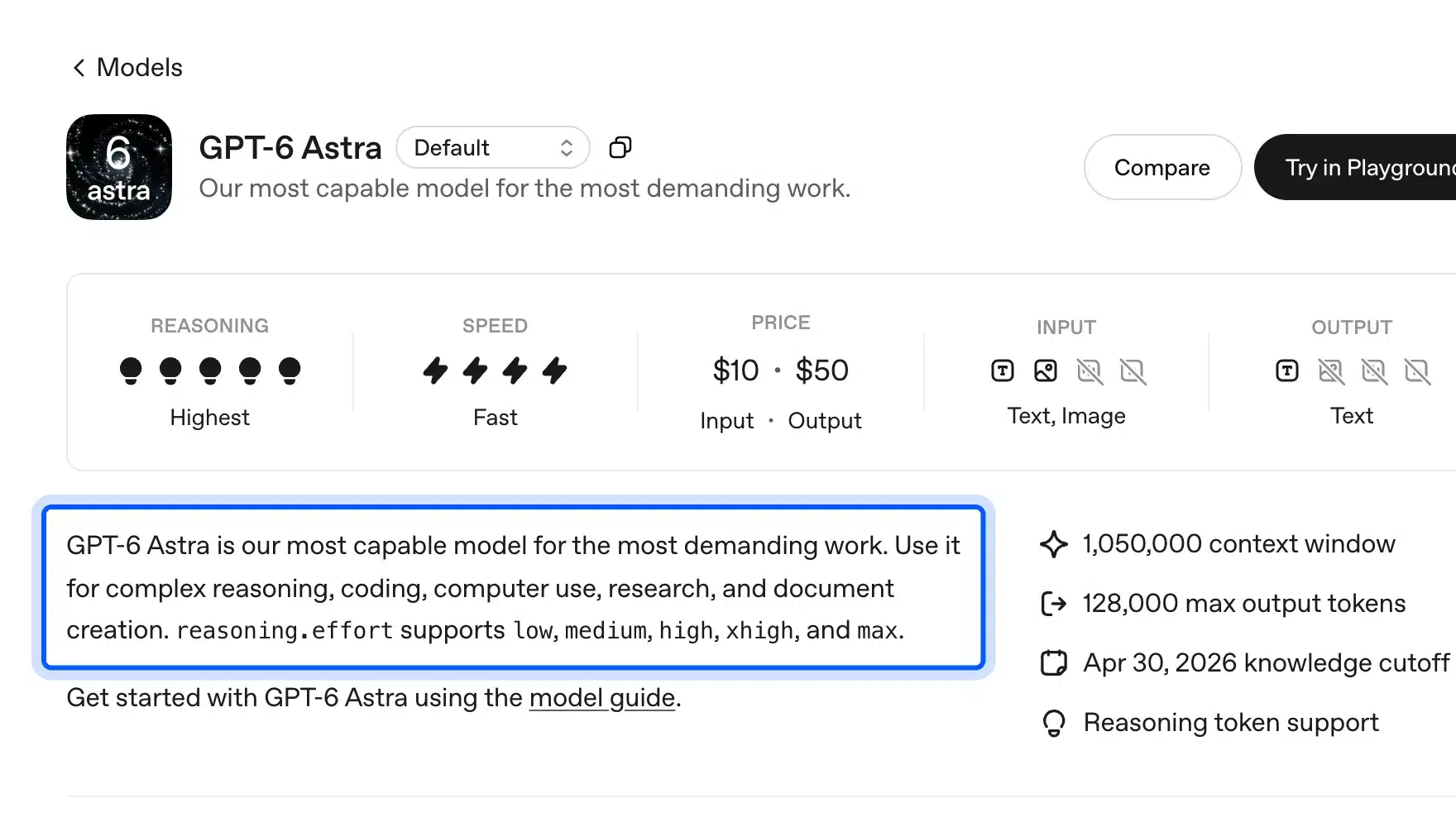
GPT-6 Astra posts the stronger numbers on the difficult public tests. OpenAI reports 97.6% on FrontierMath Tier 4 and 96.0% on GPQA Diamond. On computer and browser tasks it scores 72.6% on OSWorld 2.0, and does it in about 47% less time per task than GPT-5.6 Sol.
Here is one fair caution. Some of those headline scores come from OpenAI’s own test setup. The 99.9% on ARC-AGI-3 depends on a stateful test setup that is expensive to run. A plain API call scores a lot lower. Treat vendor benchmarks as a ceiling. They do not show what you will see on Monday morning.
DeepSeek is ahead on cost, control and volume
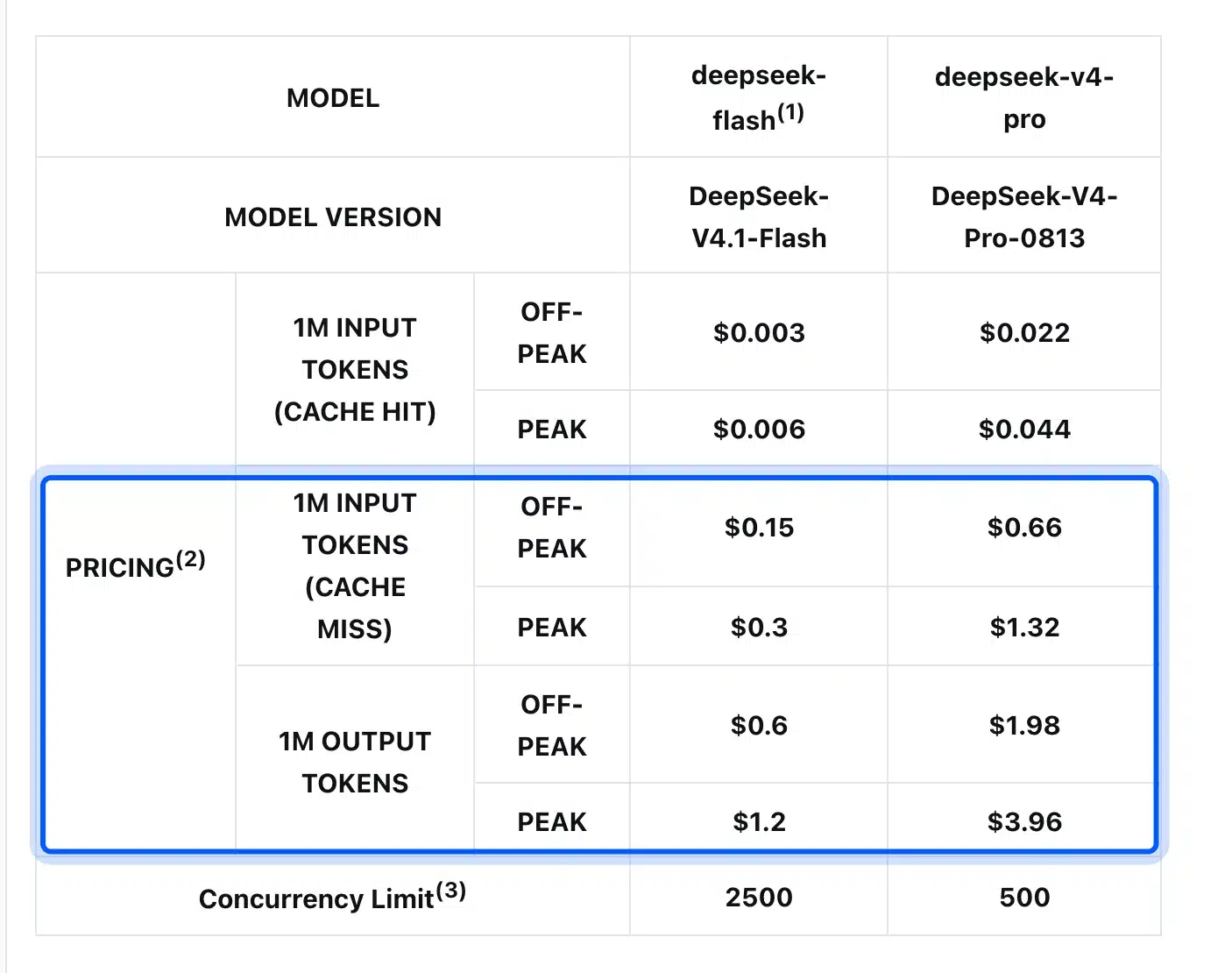
Say you are classifying a million support tickets or running an agent that makes thousands of calls a day. DeepSeek is the only one of the two whose bill stays sane. Its V4 models use a hybrid design with thinking and non-thinking modes. You pay for slow and careful reasoning only when you ask for it.
The parameter design helps too. V4-Pro has 1.6 trillion parameters in total but activates about 49 billion for any one question. You get the knowledge of a huge model at the running cost of a much smaller one.
ChatGPT is ahead on everything around the model
This gets skipped in most comparisons and it matters more than a benchmark. ChatGPT has the apps, the voice mode, the file handling, the image input, the memory, and a huge library of integrations. DeepSeek gives you a very good model and a plain chat window.
If you want a finished tool instead of a component, that gap is the real one.
DeepSeek vs ChatGPT for Coding
For coding, GPT-6 Astra and DeepSeek V4.1-Flash score almost the same on DeepSWE v1.1: 74.1% from OpenAI and 74.2 from DeepSeek. Each company ran its own test setup. Read the tie loosely. The clear gap is price: $10 per million input tokens for Astra against $0.30 for Flash.
DeepSeek also reports 87.9 on Terminal Bench 2.1 for V4-Pro. OpenAI lists 88.8 for GPT-5.6 Sol on the same test in its July launch post. Those are different generations and different harnesses. They show a close race and not a winner.
Setup matters too. DeepSeek’s API accepts the OpenAI Responses API format and has a Codex setup guide. You can run Codex on DeepSeek models. ChatGPT includes Codex already.
All of these numbers come from each vendor’s own announcement. Run both models on a slice of your own codebase before you commit.
What Nobody Tells You Before You Switch
Three things we learned the hard way running both.
- Self-hosting is not free: The license costs nothing. The hardware does. Running a V4-class model well needs serious GPU capacity, and someone to keep it running. Below a certain volume, paying an API bill is cheaper than paying for machines and the person who looks after them.
- Prompts do not transfer cleanly: A prompt tuned over months for GPT-5 will not behave the same on DeepSeek. Budget real time for reworking prompts and re-testing outputs. Teams underestimate this every time.
- OpenAI’s release pace is a hidden cost: Small point releases land every few weeks, and behavior shifts with them. That is fine in a chat window and painful in production. Pin a model version in the API. Test before you move.
There is a fourth thing, and it is the one people ask about last. GPT-6 Astra uses a design OpenAI calls recurrent depth, or looped transformers. It is faster, and OpenAI has said it hides some of the model’s reasoning steps. If you need to show your working to an auditor, that is worth knowing before you build on it.
So Which One Should You Use?
Most readers should start with ChatGPT and move only if they hit a wall. The wall is usually one of three: the bill, a data rule, or a need to fine-tune.
Teams already running AI at volume should price DeepSeek seriously. A 7 times cheaper input rate is not a detail you optimize later. It decides what you can afford to build.
And if you are choosing for a company and not just yourself, do not pick on benchmarks. Pick based on where your data is allowed to go. That question has one right answer, and it is usually already written down somewhere in your contracts. Whichever you pick, check whether AI tools cite your site.
If you want the full picture on how OpenAI’s models got here, our ChatGPT version history walks through every release. For other options beyond these two, see our roundup of the best ChatGPT alternatives.
Conclusion
The DeepSeek vs ChatGPT choice is not really about which model is smarter. GPT-6 Astra is, on most public tests. DeepSeek is far cheaper; you can run it yourself, and you can train it on your own data.
Ask three questions in this order. Where is your data allowed to live? What is your monthly volume? Do you need to change the model itself? The answers point to one of them without you having to read another benchmark table. Both are good. They are built for different jobs.
Frequently Asked Questions (FAQs)
Q1. Is DeepSeek better than ChatGPT in 2026?
Not on raw ability. GPT-6 Astra scores higher on most public reasoning and coding tests. DeepSeek is better when cost, privacy, or the ability to run the model yourself matter more than the last few points of accuracy.
Q2. How much cheaper is DeepSeek than ChatGPT?
DeepSeek V4-Pro charges $1.32 per million input tokens and $3.96 per million output tokens at peak hours, and half that off-peak. GPT-6 Astra charges $10 and $50. That makes DeepSeek about 7 times cheaper on input and 12 times cheaper on output.
Q3. Can I run DeepSeek on my own servers?
Yes. DeepSeek publishes its model weights under the MIT license. You can download them and run them on your own hardware. You will need serious GPU capacity for the larger models. ChatGPT cannot be self-hosted at all.
Q4. What is GPT-6 Astra and when did it come out?
GPT-6 Astra is OpenAI’s current flagship model, released on 3 September 2026. It has a context window of about one million tokens and uses a design OpenAI calls recurrent depth. Its advanced cybersecurity abilities are limited to approved testers.
Q5. Is DeepSeek safe to use for business data?
It depends on how you run it. The hosted DeepSeek app sends your data to DeepSeek’s servers, the same trade-off as any hosted assistant. Self-hosting the open weights keeps everything on your own infrastructure, which is the reason regulated teams choose it.
Q6. Do prompts written for ChatGPT work on DeepSeek?
Not reliably. The two models respond differently to the same instructions. Prompts tuned for one usually need reworking for the other. Plan for testing time if you are moving an existing system across.