
ChatGPT version history runs from a research paper in 2018 to GPT-6 Astra, the model OpenAI released on 3 September 2026.
Nineteen named models sit between those two points, and the gap between them keeps shrinking. Most version lists you find are a year out of date, which is a problem when the current flagship is five days old.
This guide gives you every model, its release date, and what it changed, starting with the full table. Then it explains each generation and shows you how to tell which version you are on right now.
ChatGPT Version History at a Glance
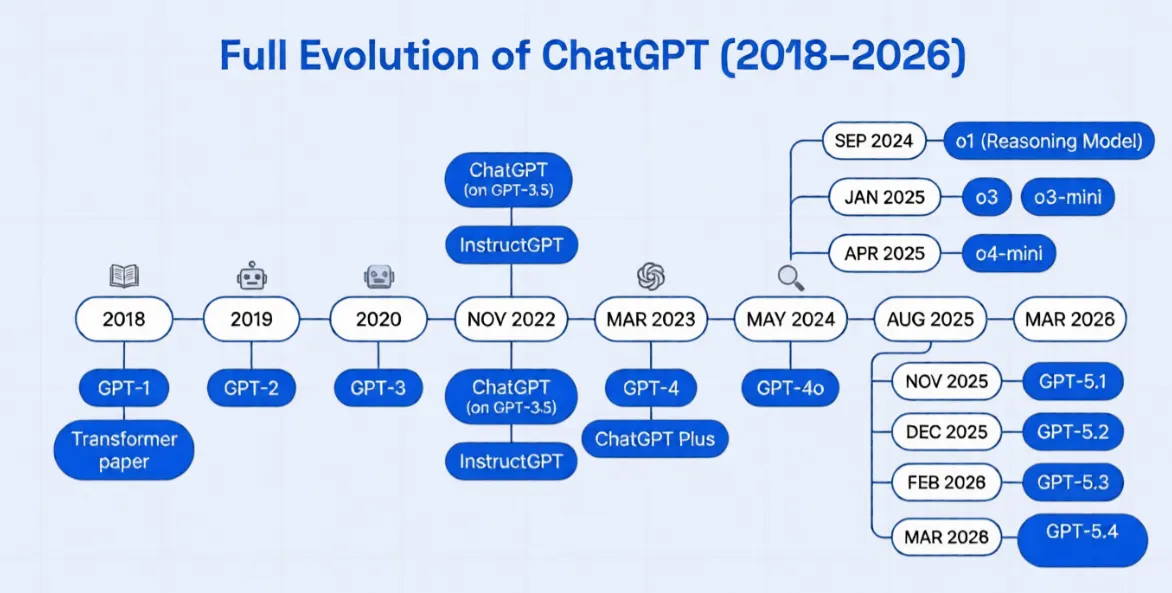
Every ChatGPT and GPT model, in order, with its release date.
| Model | Released | What changed |
|---|---|---|
| GPT-1 | June 2018 | The first generative pre-trained transformer. A research paper, not a product. |
| GPT-2 | February 2019 | Bigger and far more coherent. OpenAI staged the release over misuse worries. |
| GPT-3 | June 2020 | 175 billion parameters. The first model that wrote usable long-form text. |
| GPT-3.5 | November 2022 | The model ChatGPT launched on, and how most people met AI. |
| GPT-4 | 14 March 2023 | Took images as well as text. Passed exams GPT-3.5 failed. |
| GPT-4o | 13 May 2024 | One model for text, vision and audio, with much faster replies. |
| o1 | 12 September 2024 | First reasoning model. It thought before answering. |
| o3-mini | January to March 2025 | Cheaper reasoning, aimed at maths and code. |
| o4-mini | April 2025 | Last of the separate o-series line. |
| GPT-4.5 | 27 February 2025 | Codenamed Orion. Better conversation, no reasoning jump. |
| GPT-5 | 7 August 2025 | A router that picks a fast or a slow answer for you. |
| GPT-5.1 | November 2025 | Warmer tone, better at following instructions. |
| GPT-5.2 | 11 December 2025 | Stronger writing and data analysis. |
| GPT-5.3 | February 2026 | More reliable reasoning on simple prompts. |
| GPT-5.4 | 5 March 2026 | Best coding scores of the GPT-5 line at the time. |
| GPT-5.5 | April 2026 | Wider rollout across the paid plans. |
| GPT-5.6 | June 2026 | Shipped in three sizes: Luna, Terra and Sol. |
| GPT-6 Astra | 3 September 2026 | Current flagship. New architecture and a one million token context. |
Two things stand out in that list. The gap between big releases keeps shrinking, from years down to weeks. And since GPT-5, the point releases carry most of the real change. A version list that stops at GPT-5 tells you almost nothing about what you are using today.
The Early Models: GPT-1 to GPT-3
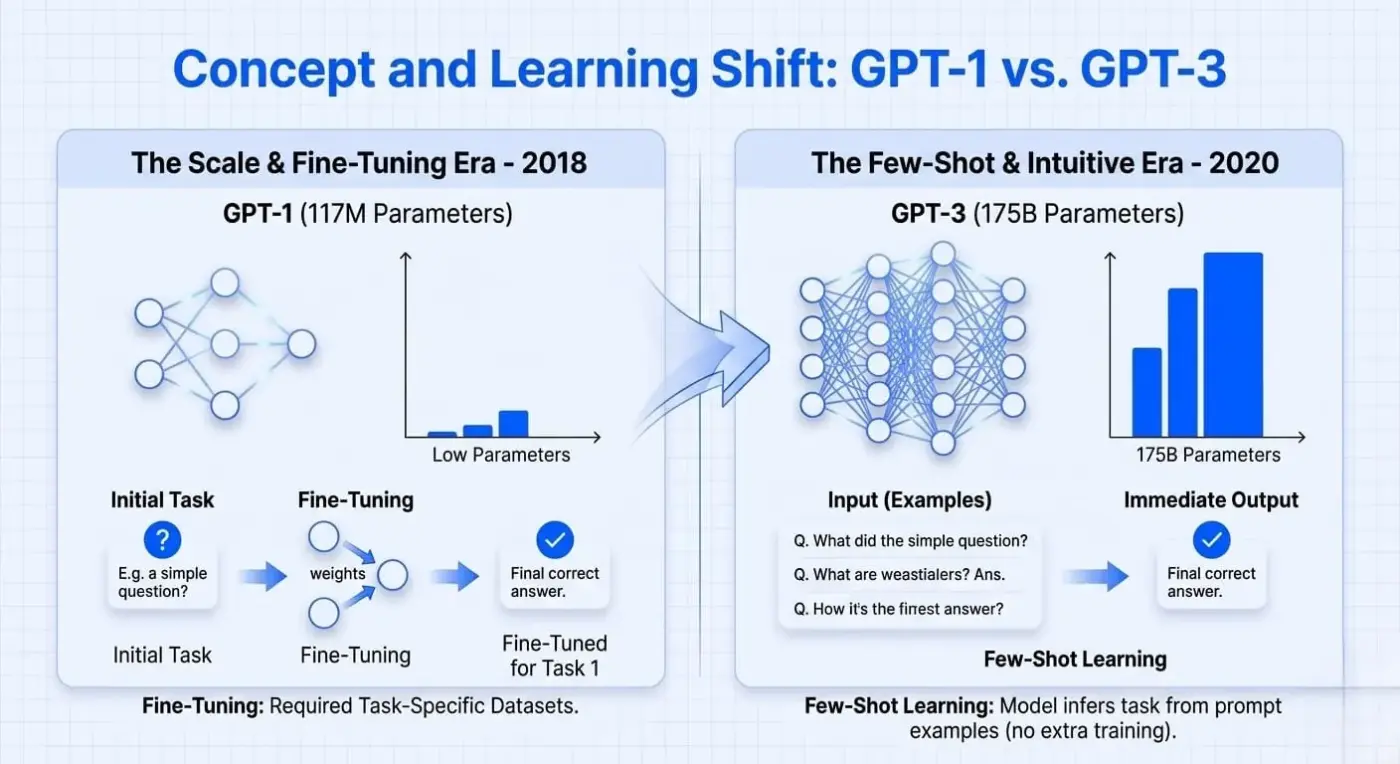
None of these were products. They were papers with model weights attached, and almost nobody outside research used them.
GPT-1 arrived in June 2018 and proved the idea: train a model on a lot of text, then adapt it to specific jobs. GPT-2 followed in February 2019 and wrote well enough that OpenAI held back the full version for months, worried about misuse. That decision looks quaint now and was taken seriously at the time.
GPT-3 landed in June 2020 with 175 billion parameters. It was the first one that could write a page of text you might not spot as machine-written. Developers built demos on it for two years before the public caught on.
GPT-3.5 and the Launch That Changed Everything
ChatGPT launched in November 2022 on GPT-3.5. The model was not much better than GPT-3. The chat window was the change.
A text box instead of an API key took the user count from a few thousand developers to a hundred million people. That took two months. Worth remembering when you read about model releases: the interface did more here than the weights did.
GPT-4 and the Move to Multimodal
GPT-4 shipped on 14 March 2023 and was the first real jump in ability since GPT-3. It accepted images, held far longer conversations, and passed professional exams that GPT-3.5 failed outright.
GPT-4o followed on 13 May 2024. The o stands for omni. One model now handled text, vision and audio together instead of stitching separate systems, and it replied fast enough for live voice conversation. For a lot of people GPT-4o is still the version they picture when they think of ChatGPT.
GPT-4.5, codenamed Orion, arrived on 27 February 2025. It was the best conversational model OpenAI had made and not a reasoning step forward. It was retired in August 2025 when GPT-5 launched, one of the shortest lives of any model on this list.
The o-Series: A Separate Line for Reasoning

For about seven months, OpenAI ran two model lines at once, and this is the part of the version history that confuses people most.
o1 arrived on 12 September 2024 and worked differently from every GPT model before it. Instead of predicting an answer straight through, it worked through steps first, then answered. Slower, more expensive, and much better at maths and logic.
o3-mini and o4-mini followed through early 2025 as cheaper versions aimed at maths and code. Then the line ended. GPT-5 folded that step-by-step approach into the main model. There was no longer a reason to choose between a fast model and a thinking one.
The GPT-5 Line: 2025 to 2026
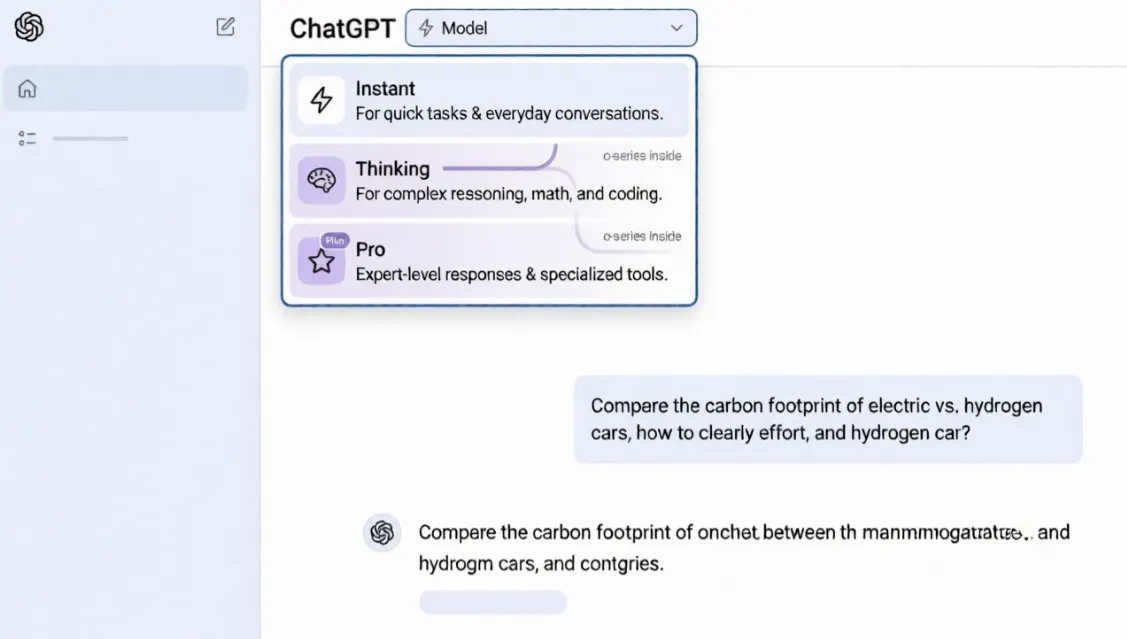
GPT-5 launched on 7 August 2025 and fixed the problem every regular user had: choosing which model to use. GPT-5 is a system of models with a router that reads your question and picks a quick answer or a longer thought.
The launch was rocky. People reported odd results and disliked losing GPT-4o, which OpenAI had retired the same day. Access to the older models came back for paid users within weeks.
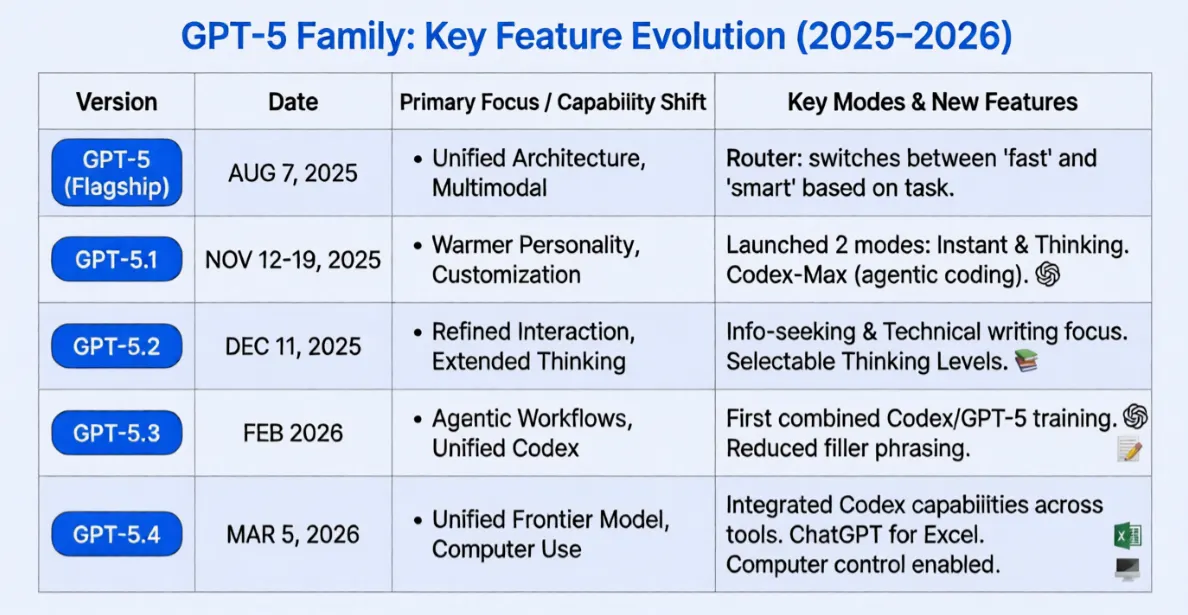
After that came point releases roughly every six to eight weeks. GPT-5.1 in November 2025 softened the tone. GPT-5.2 on 11 December 2025 improved writing and data work. GPT-5.3 in February 2026 made reasoning steadier. GPT-5.4 on 5 March 2026 brought the best coding scores of the line.
GPT-5.5 in April 2026 pushed the line across the paid plans. GPT-5.6 arrived in June 2026 in three sizes named Luna, Terra and Sol, from cheapest to most capable. That naming carried into the next generation.
GPT-6 Astra: The Current Flagship
OpenAI released GPT-6 Astra on 3 September 2026, first as a limited preview and then to paid users the next day. It is available to ChatGPT Plus, Pro, Business and Enterprise users, through the OpenAI API as gpt-6-astra, and on Amazon Bedrock.
What is new
- Context window: about 1,050,000 tokens, with up to 128,000 tokens of output. Long enough to hold a small codebase or a stack of contracts at once.
- Knowledge cutoff: 30 April 2026.
- Architecture: a design OpenAI calls recurrent depth, or looped transformers. It is more efficient, and OpenAI has said it hides some of the model’s reasoning steps.
- Training scale: pretrained on more than 100,000 GPUs at OpenAI’s Stargate site in Texas.
- Price: $10 per million input tokens and $50 per million output. Cached input drops to $1, batch runs at half price, and a Fast mode costs double.
How it scores
OpenAI reports 97.6% on FrontierMath Tier 4 and 96.0% on GPQA Diamond. On computer and browser tasks, it scores 72.6% on OSWorld 2.0, at roughly 47% less time per task than GPT-5.6 Sol.
Read those with care. The headline 99.9% on ARC-AGI-3 relies on a stateful and costly test setup, and plain API calls score much lower. Vendor benchmarks show what a model can do under ideal conditions, not what you get by default.
The part that got the most attention
OpenAI is releasing GPT-6 Astra in stages, and its advanced cybersecurity abilities are held back behind an approved-tester programme. The public version refuses certain security prompts. This is the first time OpenAI has gated a whole capability class at launch. It says more about where these models have got to than any score does.
Which ChatGPT Version Are You Using?
Most people cannot answer this, and it is the question that matters more than the history.
- Open the model picker: In the ChatGPT web app or mobile app, the model name sits at the top of the conversation. Tap it to see what is available on your plan.
- Check your plan, not the news: A launch announcement does not mean the model is on your account yet. OpenAI rolls new models out in stages, and free accounts get them last, if at all.
- Do not ask the model: Ask ChatGPT which version it is and it will often get it wrong. A model’s knowledge cutoff sits before its own release, so it cannot know its own name.
- In the API, pin the version: Use the exact model ID, such as
gpt-6-astra, instead of an alias that moves. Behaviour shifts between point releases, and a moving alias will change your output with no warning.
That last one catches teams out constantly. A prompt tuned on GPT-5.3 can behave differently on GPT-5.4, and nothing in your code changed. Pin the version and test before you move.
Conclusion
The ChatGPT version history is nineteen models in eight years, and the pace is still rising. GPT-1 to GPT-3 took two years each. GPT-5 to GPT-6 Astra took thirteen months, with seven point releases in between.
Two practical takeaways. Check which version your account is on before you judge ChatGPT, because free and paid accounts often sit a generation apart. And if you build on the API, pin your model version, or a quiet update will change your results for you.
For how the current flagship stacks up against the leading open-weight model, see our comparison of DeepSeek vs ChatGPT.
Frequently Asked Questions (FAQs)
Q1. What is the latest ChatGPT version?
GPT-6 Astra, released on 3 September 2026. It is available to ChatGPT Plus, Pro, Business and Enterprise users, and through the OpenAI API as gpt-6-astra. Free accounts usually get new models later, or not at all.
Q2. How is GPT-6 Astra different from GPT-5.6?
It uses a different architecture that OpenAI calls recurrent depth, and its context window is about one million tokens. It also scores higher on reasoning and computer-use tests. It also costs more: $10 per million input tokens against GPT-5.6’s lower rate.
Q3. What happened to the o1, o3 and o4 models?
They were a separate reasoning line that ran alongside the GPT models from September 2024 to April 2025. GPT-5 absorbed their step-by-step approach into the main model, so the o-series was retired instead of continued.
Q4. Why does ChatGPT tell me the wrong version number?
Because a model’s training data ends before the model itself is released, so it has no reliable information about its own name or release date. Check the model picker in the app instead of asking the model itself.
Q5. How many ChatGPT versions are there in total?
Nineteen named models between GPT-1 in June 2018 and GPT-6 Astra in September 2026, counting the o-series reasoning models and every GPT-5 point release.
Q6. Is GPT-4o still available?
OpenAI retired GPT-4o when GPT-5 launched in August 2025, then restored access for paid users after complaints. Availability of older models changes with each release, so check the model picker on your own plan.
Q7. Does a newer ChatGPT version always give better answers?
No. Newer models score higher on tests, but tone and formatting change between releases. A prompt tuned for an older model can perform worse on a newer one. Test your own prompts instead of assuming an upgrade helps.