
Learning WordPress takes anywhere from a few days to two years, depending on what you actually want to do with it. That’s not a cop-out answer. It’s the honest reality, and understanding why makes the whole journey a lot less intimidating.
Having built over 25 WooCommerce plugins and worked with store owners across dozens of industries, we’ve seen every type of WordPress learner. The ones who struggle most aren’t the slowest learners. They’re the ones who started without a clear goal.
Here’s the thing most guides don’t tell you: the WordPress learning curve is not one curve. It’s several, stacked on top of each other. A blogger, a WooCommerce store owner, and a freelance developer all “learn WordPress,” but they’re learning very different things.
In this guide, you’ll get realistic timelines broken down by skill level and goal, a straight answer on the self-taught vs. structured course debate, and a frank take on when learning WordPress yourself actually makes sense versus when you should just hand it off.
The Short Answer: It Depends on Your Goal
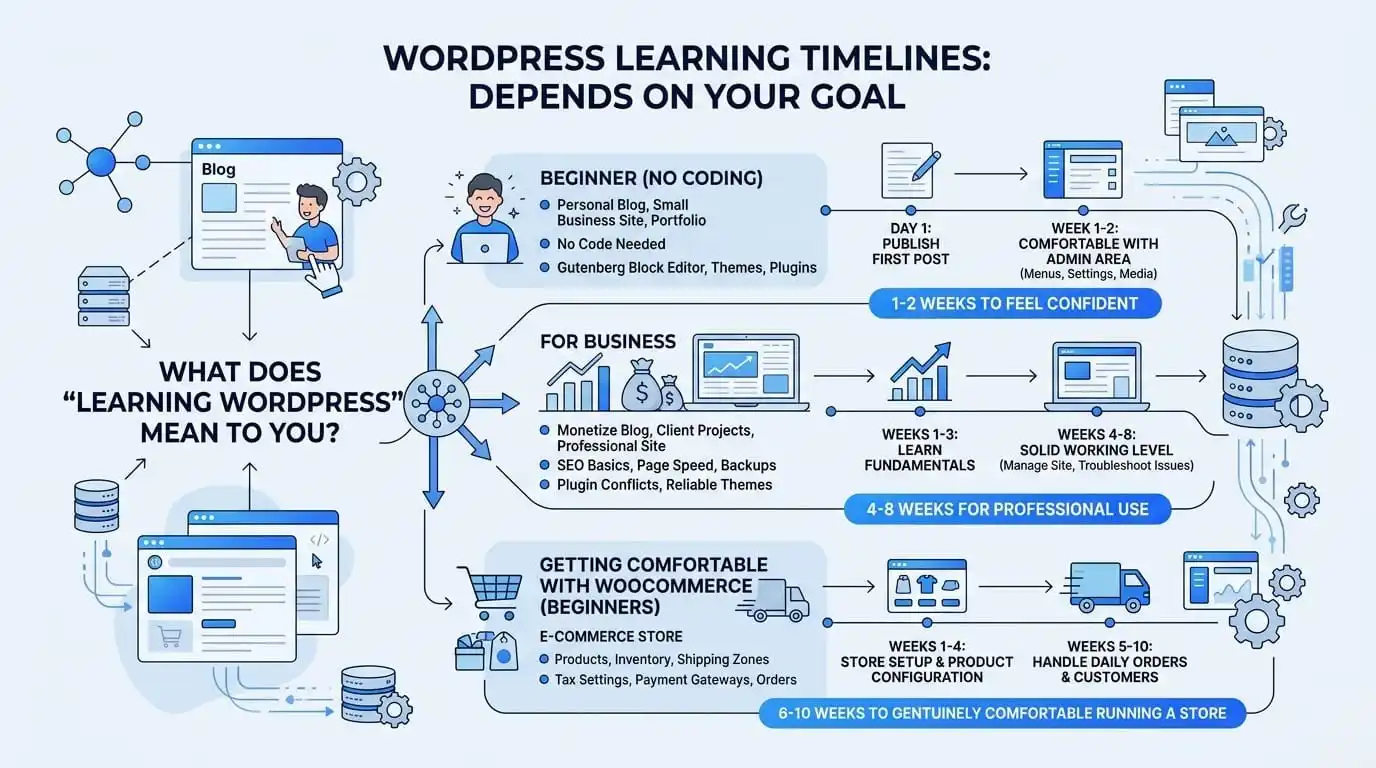
How long does it take to learn WordPress comes down to one question first: what does “learning WordPress” mean to you? The answer shapes everything.
WordPress powers over 42.2% of all websites on the internet. It runs simple hobby blogs and multi-million-dollar ecommerce stores. Those two use cases require very different skill sets, and pretending they share the same learning timeline is where most guides go wrong. Check out the range of websites you can build with WordPress to understand just how wide the platform’s scope actually is.
Learning WordPress as a Beginner (No Coding Needed)
If you want to run a personal blog, a small business site, or a portfolio, you don’t need to touch a single line of code. The Gutenberg block editor handles layouts visually. Themes handle design. Plugins handle features.
Most complete beginners can publish their first post within a few hours. Getting comfortable with the full admin area, including menus, settings, media uploads, and plugin management, typically takes one to two weeks of regular use.
That’s two weeks to feel confident, not two weeks of studying. The fastest learners build something real on day one and figure things out as they go.
Learning WordPress for Business or Blogging
If you’re using WordPress professionally, whether for a business website, a blog you want to monetize, or a client project, the bar is higher. You’ll need to understand SEO basics, page speed, backups, plugin conflicts, and how to pick a reliable theme.
Expect four to eight weeks to reach a solid working level for this use case. At that point, you can manage the site confidently, add new content without breaking things, and troubleshoot common issues on your own.
How Long to Get Comfortable with WooCommerce for Beginners
WooCommerce adds a meaningful layer on top of WordPress. You’re not just managing content anymore. You’re managing products, inventory, shipping zones, tax settings, payment gateways, and order workflows.
Most store owners with no prior WordPress experience take six to ten weeks to get genuinely comfortable running a WooCommerce store. That includes setting up the store, configuring products, and handling the day-to-day of orders and customer management. WooCommerce’s official getting started guide is the cleanest starting point.
We’ll cover the WooCommerce learning path in more depth later in this guide.
WordPress Learning Curve by Skill Level
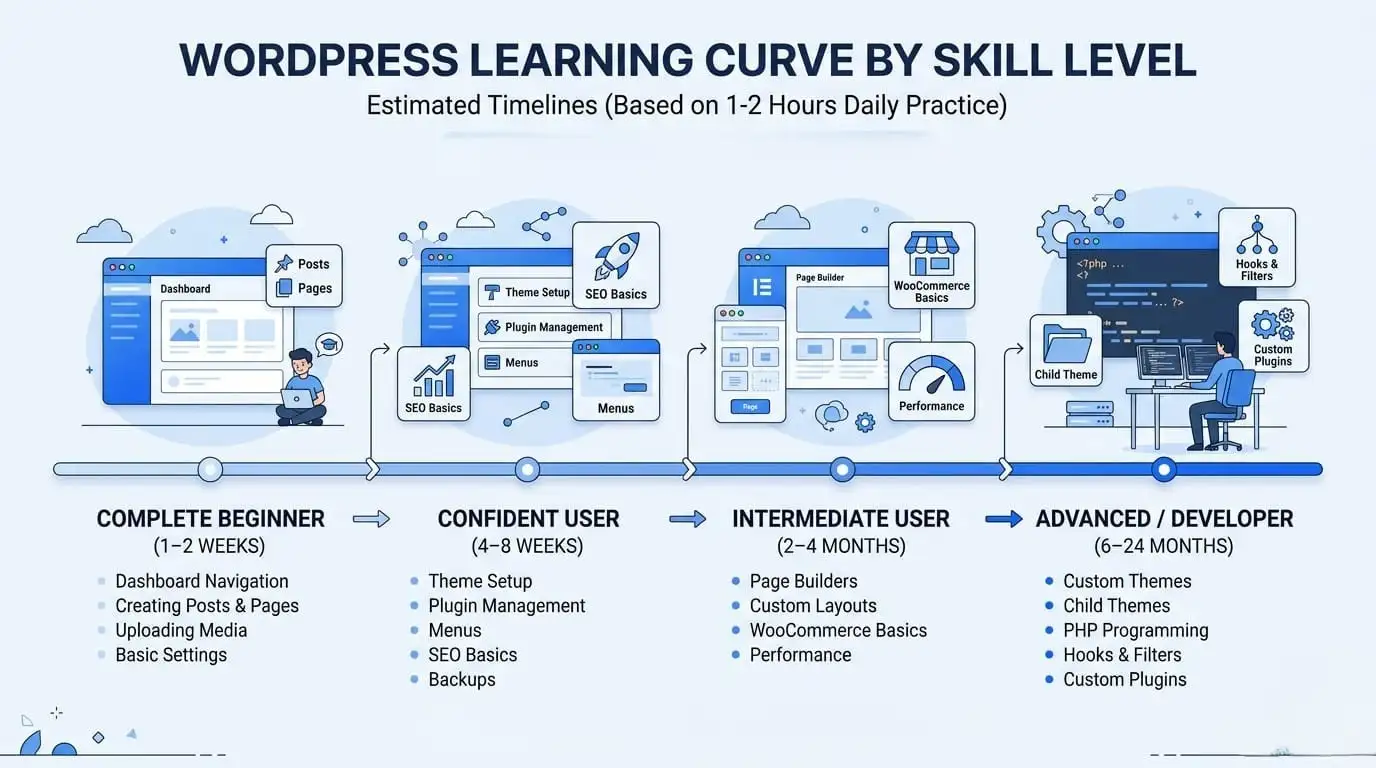
Here’s a clean breakdown of realistic timelines by skill level. These are based on consistent practice of one to two hours per day. Occasional learners should roughly double the timeframes.
| Skill Level | Timeline | What You Can Do |
|---|---|---|
| Complete Beginner | 1–2 weeks | Dashboard navigation, posts, pages, media, basic settings |
| Confident User | 4–8 weeks | Theme setup, plugin management, menus, SEO basics, backups |
| Intermediate | 2–4 months | Page builders, custom layouts, WooCommerce basics, performance |
| Advanced / Developer | 6–24 months | Custom themes, child themes, PHP, hooks, custom plugins |
Level 1 — Basic User (Days to 2 Weeks)
At this level, you’re learning the WordPress admin interface. That means logging in, creating posts and pages, uploading images, installing a theme, and changing basic settings.
This is genuinely not hard. Most people overestimate how technical it feels. If you can use Google Docs, you can learn the WordPress editor in a single afternoon. The menus are logical. The interface is mostly visual.
What slows beginners down at this stage is overthinking. Don’t worry about finding the “perfect” theme before you start. Pick a clean free theme, install WordPress on a live or staging site, and start creating content. You’ll learn twice as fast by doing as by watching tutorials.
Level 2 — Intermediate User (1–3 Months)
At the intermediate level, you’re working with page builders like Elementor or using the full power of Gutenberg’s block system, managing plugins more carefully, understanding how themes affect your layout, and handling basic WordPress SEO.
You’re also making smarter decisions. Which plugins are actually worth installing? How do you keep your site fast? How do backups work, and why do they matter?
One month of daily, hands-on use is usually enough to reach this level. Three months puts you firmly here if you’re learning more casually.
Level 3 — Professional / Developer (6 Months to 2 Years)
This is where WordPress development begins. You’re writing PHP. You understand hooks and filters. You can build a child theme, modify template files, and create custom plugins from scratch.
Most plugins don’t handle edge cases well. That’s something we run into regularly when working on WooCommerce extensions. Custom development unlocks the ability to solve problems that off-the-shelf plugins can’t. But getting to this level takes real time. Six months gets you to functional. Two years get you confident. And even then, you’re still learning.
Check out WooCommerce’s developer documentation if the development path is where you’re headed.
What Actually Slows You Down (and How to Fix It)
Most people don’t fail to learn WordPress because it’s too hard. They get stuck because of specific, avoidable mistakes. Here’s what actually causes delays.
- Choosing the wrong theme from the start: A bloated premium theme with 200 options feels powerful until you realise it’s slowing your site down and making simple changes confusing. Start with a lightweight, well-documented theme. Astra, GeneratePress, and Kadence are good choices. You’ll learn faster with a simple foundation.
- Installing too many plugins too quickly: A common beginner trap is installing 15 plugins in the first week because each one promises something useful. Plugin conflicts are one of the most common sources of WordPress issues, and they’re hard to diagnose when you don’t know which plugin caused the problem. Add plugins one at a time. Test after each one.
- Watching tutorials without building anything: Video courses feel productive. Passive learning feels like progress. But watching someone else build a site does not build your skill. You need to create something real. Set up your own test site. Make mistakes. Break things. Fix them. That process is where the actual learning happens.
- Skipping the WordPress.org documentation: WordPress’s own free learning library is underused. It’s organised, regularly updated, and free. Most beginners skip it in favour of YouTube. Both have value, but the official docs are the closest thing to a structured curriculum WordPress has.
- Trying to learn everything at once: WordPress is deep. There’s always another plugin to explore, another feature to configure. Pick a specific goal, learn what you need for that goal, and stop. You don’t need to know everything to build a good site.
Self-Taught vs. Structured Course — Does It Change the Timeline?
Short answer: Yes, a structured course gets most people to a confident working level faster. But it’s not the only path, and it’s not for everyone.
Self-taught WordPress learners tend to go wider and slower. They explore areas that interest them, skip things that don’t, and often miss foundational concepts that would have saved them hours later. That’s not a criticism. It’s how curiosity-based learning works. The trade-off is that the path is less efficient.
Structured courses force you through a logical sequence. You learn hosting before themes, themes before plugins, and so on. That sequence matters more than most people realise. The result is that structured learners often hit an intermediate level in four to six weeks rather than eight to twelve.
The catch is that not all courses are equal. A good course will have you building a real site within the first module. A bad one will have you watching 90 minutes of theory before you ever log into a dashboard. If the course doesn’t involve hands-on tasks from day one, skip it.
For WooCommerce specifically, a structured learning path is worth the investment. The number of moving parts (products, shipping, payments, taxes, order management) makes self-directed learning slower than usual. Starting with our guide to setting up WooCommerce on WordPress gives you a practical foundation before you go broader.
Should You Learn WordPress or Hire a Developer?
This question doesn’t get asked enough in guides on this topic. The honest answer is: it depends on what you’re trying to build and how much your time is worth.
Learn it yourself if:
- You’re building a personal blog, portfolio, or small informational site
- You want long-term control over your content without depending on an agency for every update
- You have the time to invest two to eight weeks and enjoy learning new tools
- Your site doesn’t require custom functionality beyond what standard plugins can provide
Hire a developer if:
- You need a WooCommerce store with custom checkout flows, integrations, or specialised features
- You’re launching something commercially important and can’t afford months of trial and error
- You need the site done in weeks, not months
- The cost of your time learning is higher than the cost of professional help
There’s also a middle ground: learning enough WordPress to work confidently with a developer. Store owners and business owners who come to our team for our WooCommerce development services, with four to eight weeks of WordPress experience under their belt, make the whole collaboration smoother. They can brief us clearly, review work accurately, and manage their own content once the project is done.
You don’t need to become a developer to work effectively with one. But knowing the basics makes every conversation faster and every revision cheaper.
Adding WooCommerce to the Mix — What Store Owners Need to Know
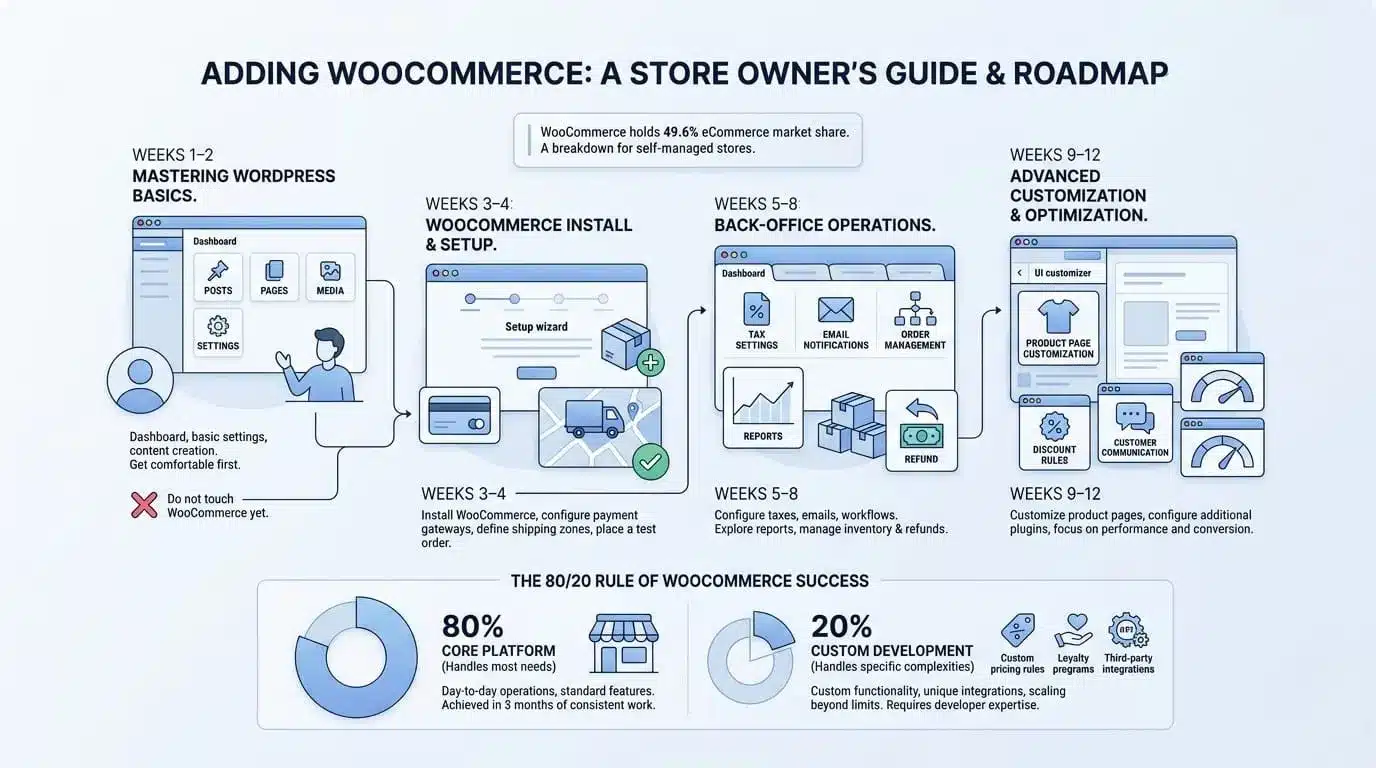
WooCommerce holds 49.4% of the eCommerce platform market worldwide. That says a lot about its reach. But it’s a more involved system than most first-time store owners expect.
Here’s the honest breakdown for someone who wants to run a WooCommerce store and manage it themselves.
- Weeks 1–2: Learn WordPress basics. Dashboard, posts, pages, media, settings. Don’t touch WooCommerce yet. Get comfortable with the platform first.
- Weeks 3–4: Install WooCommerce and run through the setup wizard. Add a few products. Configure your payment gateway. Set up at least one shipping zone. Place a test order and see it come through.
- Weeks 5–8: Configure tax settings, email notifications, and order management workflows. Explore the WooCommerce reports. Learn how to manage inventory and handle refunds.
- Weeks 9–12: Customise your product pages, configure any additional plugins (discount rules, upsells, customer communication), and start focusing on performance and conversion.
After three months of consistent work, most store owners without a development background feel genuinely comfortable running day-to-day store operations. They’re not developers. But they’re not dependent on one for every small task either.
Where things get complicated is when custom functionality is needed. Custom pricing rules, loyalty programs, or integrations with third-party tools are where standard WooCommerce hits its limits.
Having built 20+ WooCommerce plugins across a wide range of industries, we see this frequently. The core platform handles 80% of what most stores need. The remaining 20% often requires custom development. Knowing that in advance helps you plan.
Final Thoughts
What is the time it takes to master WordPress? If you only want to learn the basics, probably take two weeks. If you’re looking to create your own WooCommerce Store, you will most likely need anywhere from two months to three months to do so. If you’re looking to develop professionally, you would most likely require a year or more.
In summary, match your learning goal to your timeline and do not try to learn everything at once. From day one, create a real-world project. Learn exactly what is necessary to accomplish your goals. Be honest with yourself about whether it is the right time to hire a professional rather than spending weeks trying to determine something that the professional would complete in a matter of minutes.
If you’re at the point where you need custom WordPress or WooCommerce functionality, our WordPress development services are built for exactly that. What questions do you have about where to start?
Frequently Asked Questions
Q1. How long does it take to learn to use WordPress?
The basics. It may take you about 1 week to learn how to create posts and pages in and how to get around inside WordPress through the dashboard. This is enough for you to get started with sharing some content online. However, it may take several weeks to become proficient and comfortable with operating a complete website including the use of plugins for enhancing various site functions, performing data backups, and have some understanding of how search engine optimisation works for your website.
Q2. Is WordPress easy to learn for people without technology experience?
Yes. It is very straightforward for typical use in today’s environment. WordPress has its own ‘editor’ which is similar to working with Google Docs, and nearly all the basic administration settings in WordPress are self-explanatory. You will find it more challenging to customise themes and plugins; however, working through these challenges does not require any programming skills.
Q3. Are technical skills required? Do you need to know PHP to use WordPress?
Not on a daily basis. The majority of WordPress-related tasks do not require technical skills, including any creation of content, setup of theme layout and setup/configuration of plugins. We highly suggest that, when you start changing the way that themes function and start creating plugins or modifying how WordPress runs internally, you become familiar with PHP programming.
Q4. What’s the average time it takes to become familiar with WooCommerce?
The average time it takes for a store owner who has no WordPress experience to become comfortable using WooCommerce is between 6 and 10 weeks. This period is enough time to cover product configuration, payment processing, shipping setup and basic order management (fulfillment). Advanced levels of customisation (custom pricing, external integration) may require greater time commitments and typically require additional professional support during this process.
Q5. What is the fastest way to learn WordPress?
The fastest way to learn how to use WordPress is by building an actual website right away and do not wait until you complete a course or finish watching enough tutorial videos before you get started. Create a test environment with WordPress installed, select a simple free theme to use for your project, and start building your website. Hands-on learning is always more productive than passive learning, so pairing a beginner’s level courses with an actual test project builds your productivity.