

You can start blogging to earn money with no technical background, no existing audience, and less than $50 at the beginning. The setup takes an afternoon. Getting to your first income takes longer, usually 6-24 months, but the bloggers who get there fastest all share one thing: they had a monetisation plan before they published their first post.
Most beginners do it backwards. They spend weeks picking fonts and spending too much time on their theme, then wonder why nobody’s reading six months in. The platform doesn’t make you money. The strategy does.
Here’s what this guide covers: how to pick a niche that can pay, how to set up a WordPress blog the right way, how to write content that gets found, and which monetisation methods to pursue first when you’re starting from scratch.
Can You Still Make Money Blogging in 2026?
Yes. Blogging is not dead. But the honest answer is more useful than that.
According to survey data from Productive Blogging, it takes an average of 22 months to start making money from a blog. About 30% of bloggers start earning within 6 months, and 28% reach a full-time income within 2 years of starting. Those numbers are real, not picked from a guru’s income report.
What the averages don’t show is why the gap is so wide. Bloggers who started with no monetisation plan, no niche focus, and no SEO strategy took much longer. Bloggers who treated it like a business from day one got there faster.
Blogging income research from InBound Blogging shows that blogs active for 5-10 years earn the most on average, about $5,450/month. But blogs with 100-500 published articles earn between $10-$15/post on average. That second number matters more for beginners. You don’t need a thousand posts. You need the right posts.
The blogging income timeline isn’t linear either. Most blogs earn close to nothing for the first 3-6 months, then grow quickly once Google starts trusting the domain. Expect a slow start. Plan for it. Don’t quit at post 12.
One thing worth knowing: According to Elementor’s blogging statistics report, driving traffic from search engines remains the number one challenge for bloggers, which signals a shift from a content-first to a distribution-first approach. Writing good posts is not enough. You need a reason for people to find them.
How to Start Blogging to Earn Money: Steps
Here is how one should start blogging to earn money.
Step 1: Choose a Niche That Can Actually Pay

Your niche is the topic your blog covers. Pick it before you buy a domain. Before you install anything.
Most advice here is useless. “Write about your passion” sounds nice until you’re 40 posts deep into knitting wall hangings and wondering why nobody’s buying anything.
Here are three questions that filter a niche idea properly:
- Do people spend money in this space? People spend on personal finance, health, software tools, online business, and home improvement. Poetry analysis, local history, and film theory are much harder to monetise. That’s not a reason to quit a passion project, but it is a reason to understand what you’re getting into.
- Can you write 50 posts on this topic without running out of things to say? A niche that feels “too narrow” is usually fine. A niche that’s too broad, such as “lifestyle,” “wellness,” “everything I find interesting”, gives you no SEO strength position and no clear audience.
- Are there affiliate products or digital products that fit naturally? If you can name three products your future readers already buy, you have a monetizable niche. If you can’t, the blog niche selection process isn’t done yet.
Once you’ve shortlisted a niche idea, don’t guess; validate it. Open a free tool like Google Trends or Ubersuggest, type in your niche topic, and check two things: search volume (are people actually searching for this?) and trend direction (is interest growing or shrinking?). A niche with steady or rising search volume and low-to-medium competition is a strong signal to move forward.
The trade-off is real. A niche you know well will produce better content faster. A niche with higher affiliate commissions (software, finance, hosting) will make money faster. The best combination is knowing enough about a profitable topic to write about it credibly.
Step 2: Set Up Your WordPress Blog the Right Way
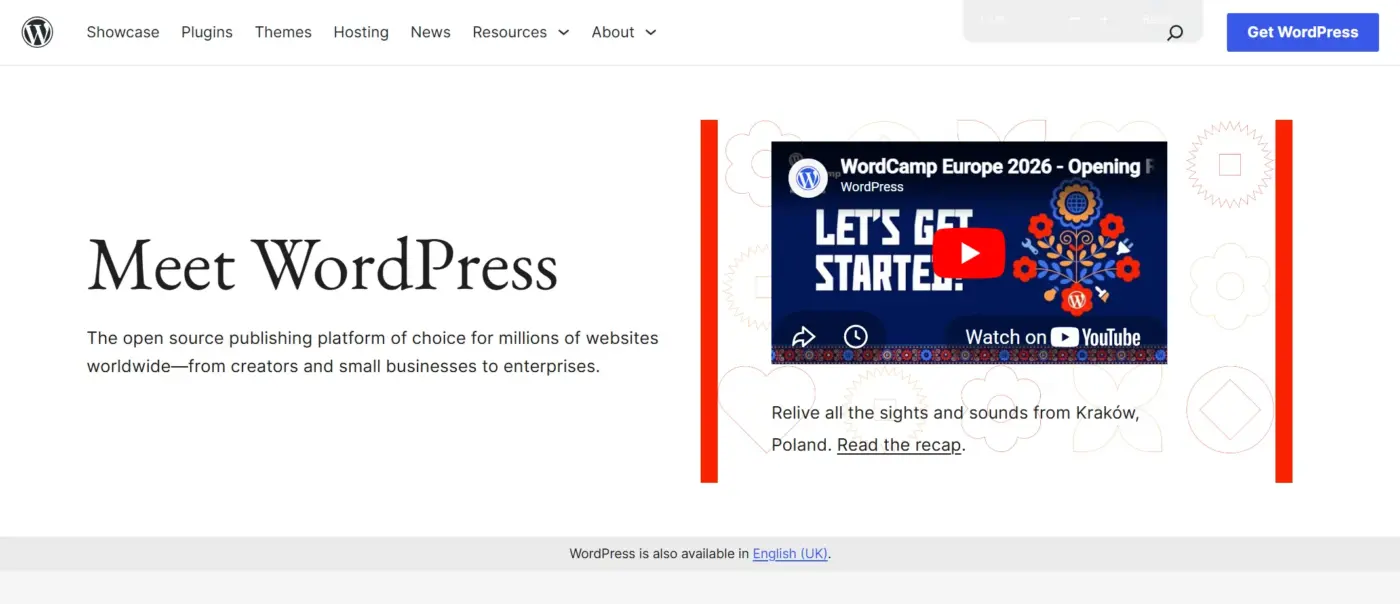
Setting up a WordPress blog takes about 30-60 minutes if you follow a clear path. According to WPZOOM’s beginner guide, the total cost runs roughly $3-$10/month for hosting plus about $10-$15/year for a domain name. WordPress itself is free.
Before the steps: understand one thing that most beginner guides skip.
WordPress.org vs. WordPress.com (Why It Matters for Monetisation)
WordPress.org is the free, open-source software you install on your own hosting. You own everything. You can run ads, add any plugin, sell products, connect WooCommerce, and monetise however you want.
WordPress.com is a hosted platform. The free and cheaper plans restrict monetisation. You can’t install third-party plugins. You don’t fully own your content in the same way.
If your goal is to earn money from your blog, use WordPress.org. Full stop.
Step 3: Write Content That Gets Found
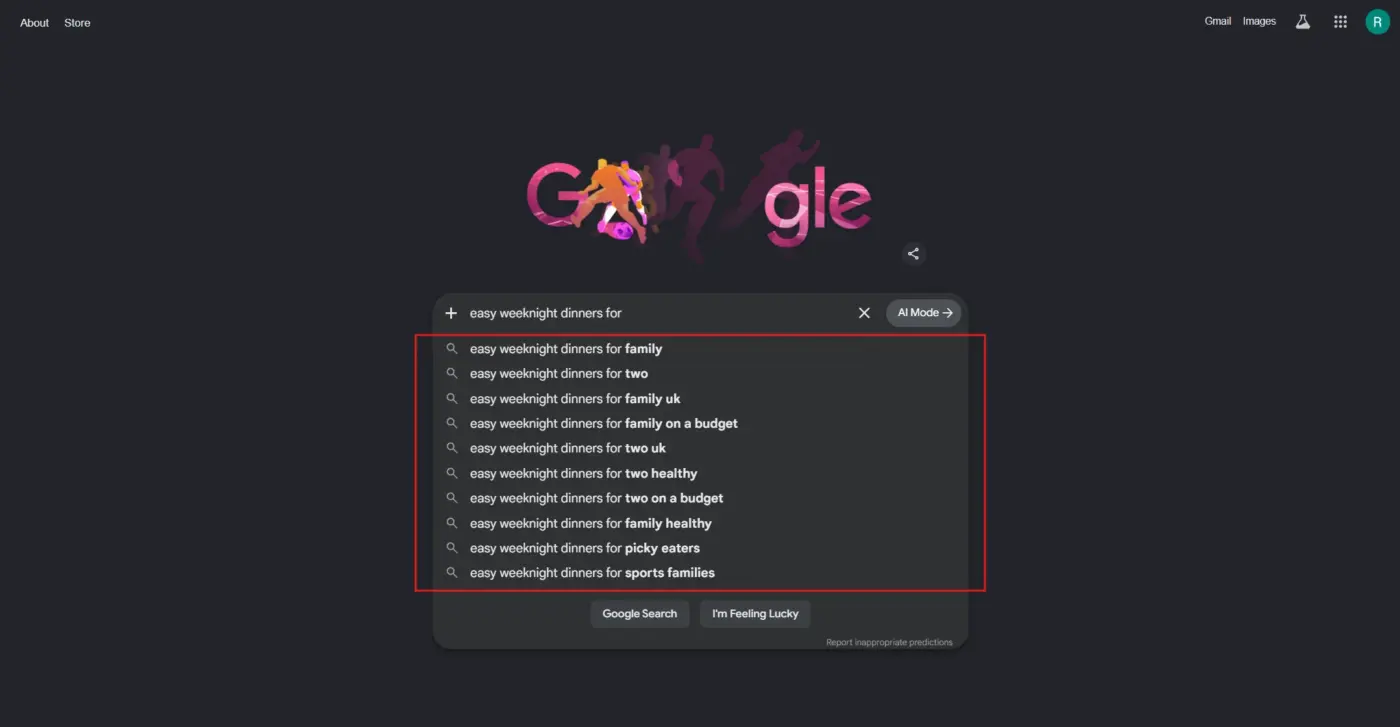
Every post needs a reason to exist from a search perspective. That means targeting a specific phrase people actually type into Google. Not “cooking tips” as it is too broad, too competitive. Something like “easy weeknight dinners for two people with no oven” is specific, searchable, and much easier to rank for as a new blog.
This is called researching specific search phrases. You don’t need expensive tools to start. Google’s autocomplete, the “People Also Ask” box, and free tools like Ubersuggest or Google Search Console give you enough to work with.
Here’s the thing most tutorials skip: not all posts make you money equally. There are two types you need.
- Informational posts answer questions. They drive traffic. They build trust. “How to fix a leaking pipe” is an example. These rank well but convert slowly.
- Buyer-intent posts target people already looking to spend. “Best pipe repair kits under $30” or “Roto-Rooter vs. DrainX comparison”: these convert readers into income. Someone reading a comparison post is usually close to buying.
Beginners make money blogging faster when they mix both. Write informational posts to build traffic and authority. Write buyer-intent posts to turn that traffic into income. Aim for roughly one buyer-intent post for every two informational ones.
How often should you publish? Consistency beats frequency. Two well-researched posts per month that rank do better than five rushed ones that don’t. Elementor’s analysis of blogging data shows posts over 2,000 words are far more likely to produce strong results, even though search engines reward length while most readers say they prefer shorter posts. The practical answer: write as long as the topic needs. Cut everything that doesn’t serve the reader.
Build Your Email List From Post One
This is the step that the most profitable bloggers do from day one, and most beginners skip entirely.
As Matt Giaro notes in his blogging guide, your blog is not your business; it’s a lead generation tool. The real money is in your email list, which protects you against algorithm changes and platform shifts. A specific free resource that solves a real problem converts about five times better than a generic newsletter signup.
Add an email sign-in to your site before you publish your first post. Offer something specific: a checklist, a short guide, a template. Not “join my newsletter.” Something with a clear reason to say yes.
A reader who joins your list is worth far more than one who clicks away and never comes back. This is true whether you plan to sell affiliate products, your own ebooks, or an online course. The list is where the income actually happens.
How to Monetise Your Blog (Ranked by Speed for Beginners)
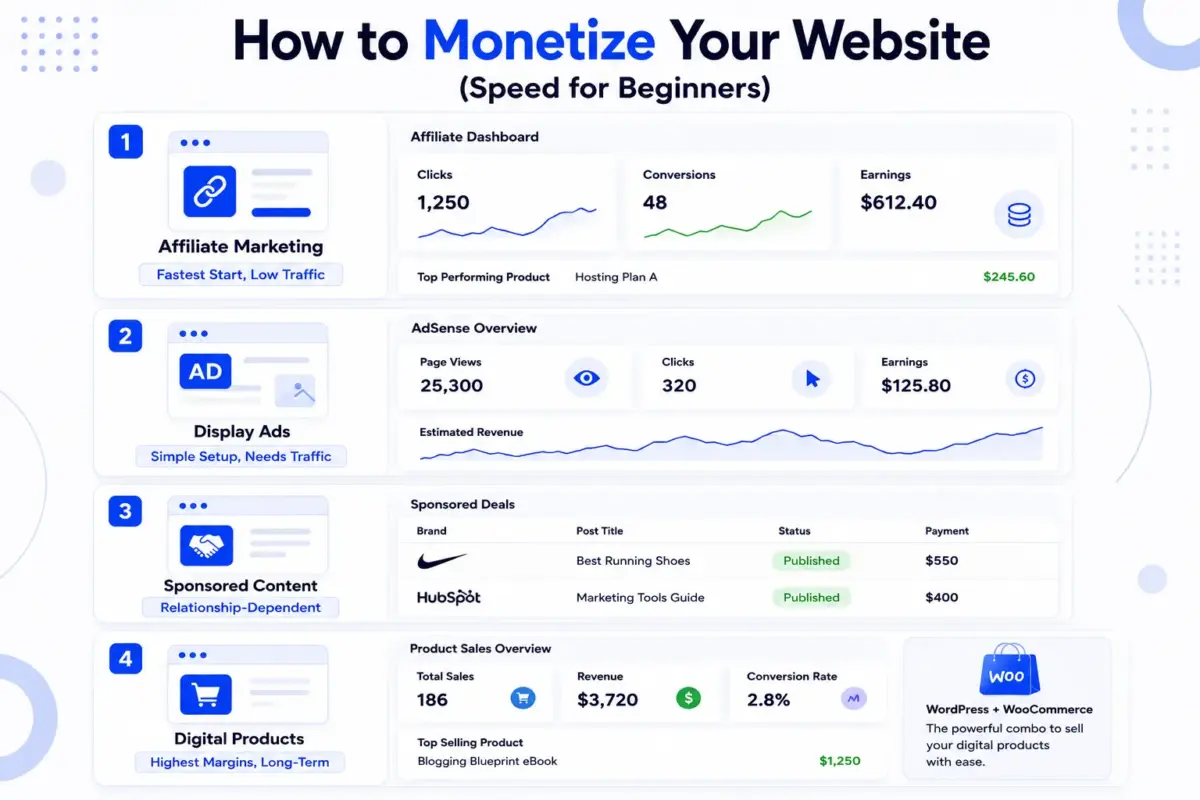
Here’s the honest version of this list. Not “11 ways to make money blogging.” Just the ones that work fastest for someone starting from zero, ranked by how quickly you can see real income.
1. Affiliate Marketing (Fastest Start, Low Traffic required)
Affiliate marketing means recommending a product or service using a unique link. When someone buys through your link, you earn a commission. According to Gillian Perkins’ breakdown of how bloggers make money, affiliate commissions range from about 2%-90% of the sale price, depending on the product, and companies (large or small) have affiliate programs bloggers can join.
This is the best first monetisation method for beginners because you don’t need to create a product, manage inventory, or wait for a traffic threshold. You can add affiliate links to your second or third post. Amazon Associates is the most common starting point. Software affiliate programs (hosting, SEO tools, email platforms) often pay more per sale.
The rule that matters most: only recommend things you’d use yourself. Readers notice when a recommendation is genuine, and affiliate marketing on your blog depends entirely on that trust.
2. Display Ads (Simple Setup, needs Traffic first)
Display ads work by placing code on your site. An ad network fills that space and pays you based on views or clicks. Google AdSense is the most common starting point for new blogs.
The honest trade-off: According to Fiverr’s blogging income guide, blog owners with 10,000-100,000/monthly page views typically earn between 2 and 10 cents per page view from advertising, working out to $200-$10,000/month depending on traffic and niche. At low traffic levels, ad income is small. Use it as a passive layer alongside affiliate links, not as your primary income source.
Once your traffic reaches around 50,000 monthly sessions, premium ad networks like Mediavine pay higher rates than AdSense. That’s a future milestone, not a day-one concern.
3. Sponsored Content (Relationship-Dependent, not Beginner-First)
Brands pay bloggers to write posts that feature their products. Sponsored articles range from about $250-$750/post, depending on audience size, niche, and the individual deal.
This path requires an established audience and a niche that brands want to reach. It’s a real income stream, just not the one to prioritise in month one.
4. Selling Your Own Digital Products (Highest Margins, best Long-Term)
This is where bloggers with an audience make the most money per reader. An ebook, template, checklist, or short online course can sell for $15-$200 with almost no overhead. No inventory, no shipping, no platform cut beyond payment processing fees.
Productive Blogging’s 2026 monetisation guide makes the case clearly: if you had to pick one income method, digital products are the best choice in 2026 because they are passive, fully within your control, and not dependent on an algorithm or third-party platform.
Worth knowing before you go further: This is where the combination of WordPress and WooCommerce becomes your strongest tool.
Selling Digital Products With WooCommerce (The Upgrade Most Bloggers Miss)
Once your blog has readers, selling your own digital products is the highest-margin step you can take. Most bloggers either skip it entirely or build a separate store on a third-party platform, which splits their audience and takes a larger cut of every sale.
There’s a simpler path. If your blog runs on WordPress, which it should, for the reasons covered in Step 2, you can add WooCommerce to your existing site and sell digital downloads directly. No separate platform. No extra subscriptions. Your readers stay on your site, and you keep far more of each sale.
As WooCommerce’s own documentation confirms, WooCommerce has built-in digital product support, including product listings, checkout, payment gateways, and download delivery, all for free. You set up a downloadable product, connect to Stripe or PayPal, and your ebook or template is for sale in about 30 minutes.
For readers who want a full walkthrough, our guide on how to set up WooCommerce on WordPress covers the complete process. And if you’re planning to offer cashback, wallet credit, or store credit as part of your product setup, our Wallet for WooCommerce plugin handles that without any custom code.
If you’re exploring the broader picture of making money with WordPress beyond just blogging, that post covers the adjacent paths worth knowing about.
Most bloggers discover this combination too late. Setting it up early means your first $50 in digital product sales can happen before you ever qualify for a premium ad network.
What Kills Most Blogs Before Month 6
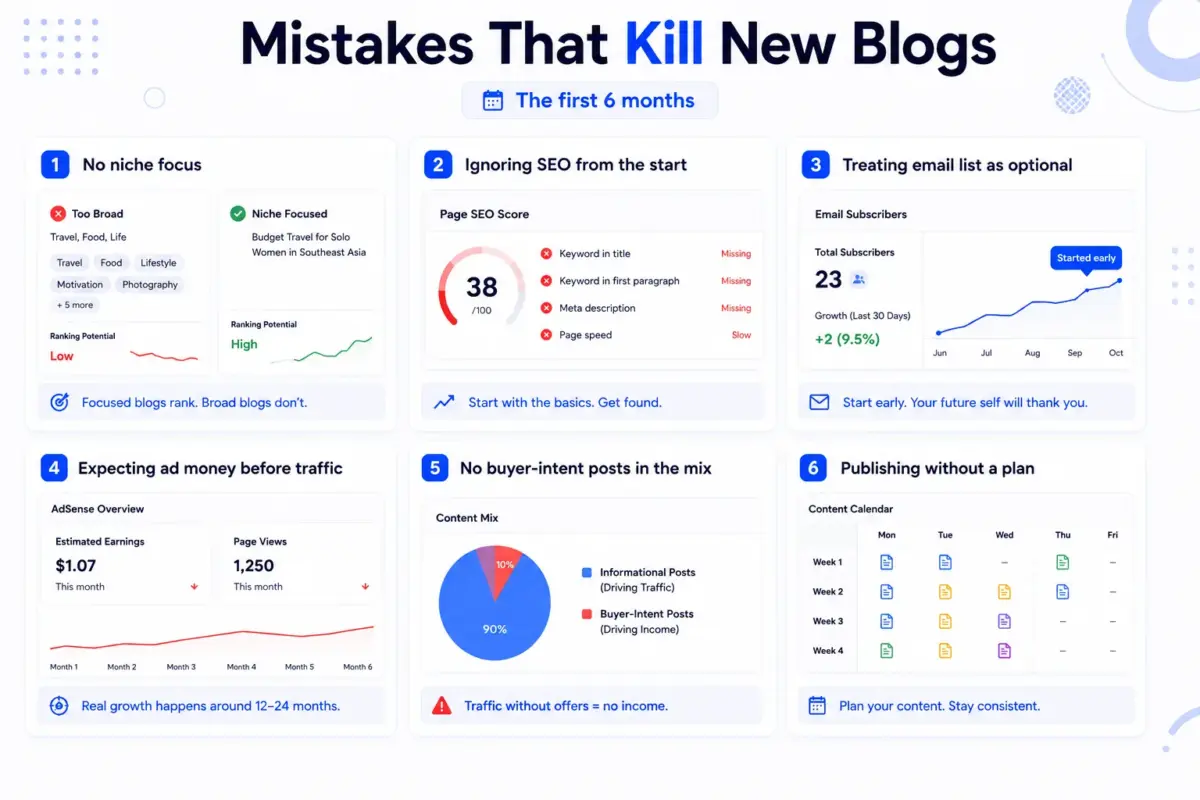
This is the section most guides skip because it isn’t motivating. It is the most useful thing a new blogger can read.
- No niche focus: Blogging about five different topics confuses Google and confuses your readers. A blog about budget travel for solo women in Southeast Asia ranks. A blog about “travel, food, and life stuff” does not.
- Ignoring SEO from the start: You don’t need to be an SEO expert on day one. But you do need to understand the basics: write about topics people search for, use your target phrase in your title and first paragraph, and make sure your site loads quickly. Skipping this means writing posts that nobody ever finds. For a deeper look at how SEO works for content-driven sites, our WooCommerce SEO guide covers the core principles that apply across WordPress blogs.
- Treating the email list as optional: The bloggers who make money fastest all have email lists. The ones who wait until they “have enough traffic” to start one almost always wish they’d started earlier.
- Expecting ad money before you have traffic: InBound Blogging’s data shows that on average, active blogs under a year old earn about $1.07/month. That’s not a discouraging number; it’s a realistic one. The income curve bends sharply upward around the 12-24 month mark when SEO traction builds. Giving up at month 5 because your AdSense is paying pennies means quitting right before the growth starts.
- Publishing without a buyer-intent post in the mix: Informational posts build traffic. Buyer-intent posts build income. A blog with only one type will either get traffic with nothing to sell or have products with no readers to buy them.
None of these mistakes is fatal. They’re all fixable. The blogs that fail usually stop before they get the chance to fix them.
Conclusion
Starting a blog to earn money is a real, achievable goal. The path is straightforward: pick a niche that pays, build your blog on WordPress, write content that gets found, and layer in monetisation starting with affiliate marketing and building toward your own products.
The blogging income timeline requires patience. Most blogs take 12-24 months to produce meaningful income. The ones that get there fastest treat their blog like a business from the first post with a niche, a content strategy, and an email list that starts growing on day one.
When you’re ready to move beyond affiliate links and start selling your own digital products, WordPress and WooCommerce give you everything you need without leaving your own site. That’s the step that separates a blog with traffic from one that actually earns, and it’s exactly what how to start blogging to earn money looks like in practice.
Frequently Asked Questions
Q1. How much does it cost to start a blog from scratch?
The minimum to launch a serious blog is about $50-$100 for your first year. That covers a domain name ($10-$15/year) and entry-level shared hosting ($3-$10/month). WordPress is free. A basic theme is free. You can add premium tools later as your income grows, but none of them is required to start.
Q2. Do I need to know how to code to start a blog?
No. WordPress is designed for non-developers. Installing plugins, adding pages, writing posts, and basic customisation all happen through a visual dashboard. You may hit a moment where a small CSS tweak helps, but that’s entirely optional and easy to learn as you go.
Q3. What is the best niche to start a blog for making money?
The highest-earning niches are personal finance, software and technology, online business, health and fitness, and home improvement. These work because readers spend money in these areas, and strong affiliate programs exist for all of them. A moderately profitable niche you know well will outperform a high-earning niche you find boring to write about. The best niche is specific, sustainable, and has some commercial intent behind it.
Q4. Can I make money blogging without social media?
Yes. Organic search traffic from Google is the primary income driver for most profitable blogs, and it has nothing to do with social media follower counts. An email list is more valuable than any social platform; it’s the one distribution channel you fully control. Build that first.
Q5. What is the difference between WordPress.com and WordPress.org for bloggers who want to earn money?
WordPress.org is the self-hosted version, where you install WordPress on your own hosting. You can run ads, add any plugin, and sell products through WooCommerce. WordPress.com is a hosted service that restricts monetisation on cheaper plans and limits plugin access. For anyone serious about making money from a blog, WordPress.org is the right choice.



2 responses
I’ve been trying to figure out how to make money blogging, and this post offers some great starting points. The section on optimizing your blog for SEO is particularly helpful – driving organic traffic is crucial for monetization.
Thank you for your feedback! I’m glad you found the post helpful, especially the section on SEO. Optimizing for search engines is indeed a critical step in driving organic traffic and ultimately monetizing your blog. If you have any specific questions or need further tips on SEO or other aspects of blogging, feel free to ask. Happy blogging!