
SEO copywriting is writing page copy that answers what searchers want and still moves them to buy, sign up or call. It works when the same words fit the search result, the reader and the sale.
We tested that with a real rewrite in October 2026. We took keyword-stuffed copy for an example leather wallet category page and measured it in two free tools, the Mangools SERP Simulator and Hemingway Editor. Then we rewrote it and measured again: the title shrank from 836 to 474 pixels and the reading grade fell from post-graduate to grade 5.
This guide walks through that process step by step, with the before and after copy you can reuse. It also covers how SEO copywriting differs from SEO content writing and how to learn the skill.
What Is SEO Copywriting?
SEO copywriting is the craft of writing titles, descriptions and page copy that rank for a search and persuade the person who clicks. The copy has two jobs. It has to match the words and intent behind a query, and it has to turn a visit into a sale or a lead.
Plain copywriting only has the second job. SEO writing alone often stops at the first. The overlap is where most product pages, category pages and service pages live, because they need traffic and they need it to convert.
Google’s own guide to helpful, people-first content frames the test from the reader’s side. It asks whether your content shows first-hand expertise and whether a reader leaves having learned enough to reach their goal.
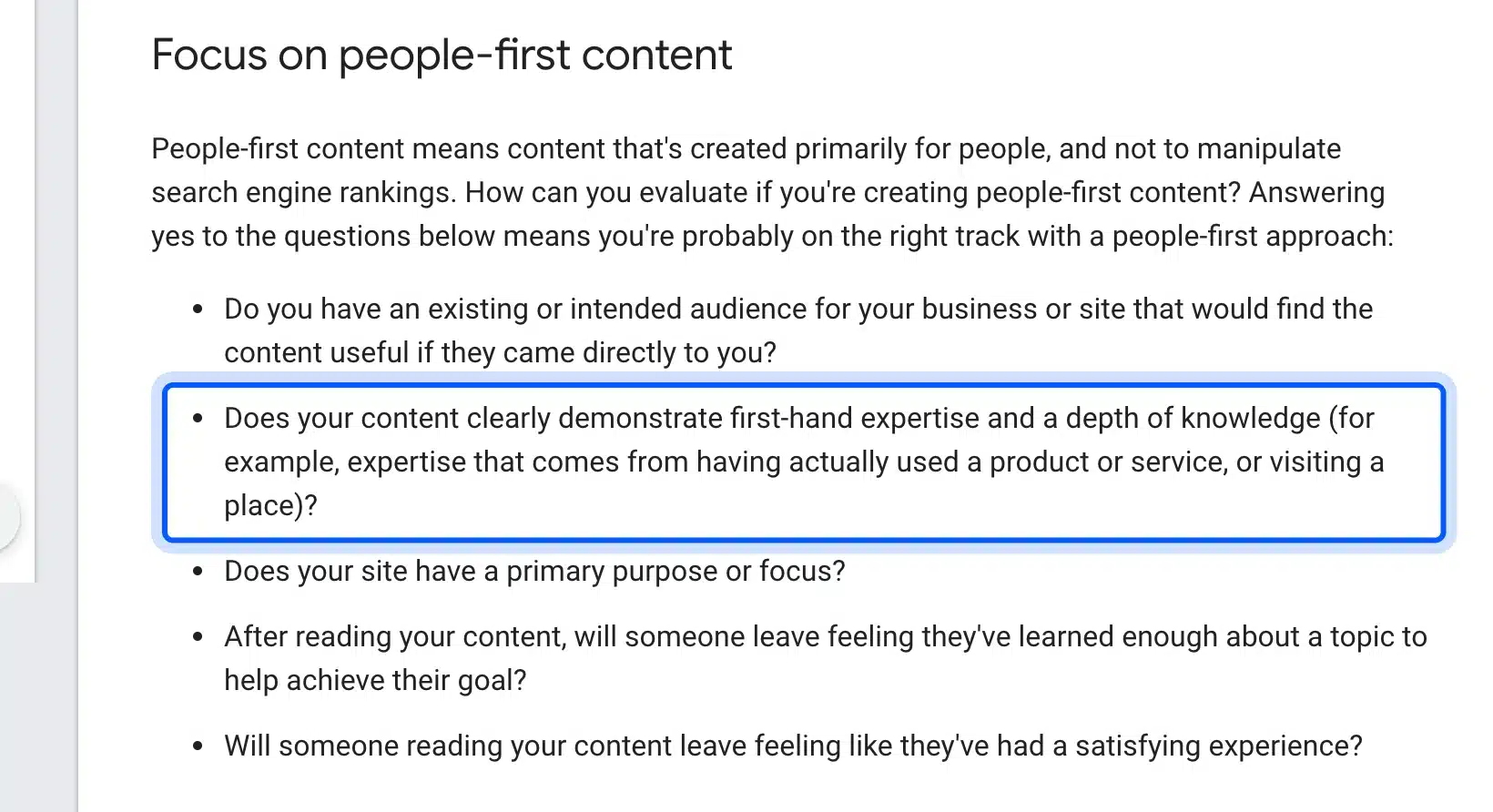
So what does SEO copywriting mean in practice? It means every line earns its place twice: once for the search result and once for the person reading it.
SEO Copywriting vs SEO Content Writing
SEO copywriting and SEO content writing share the same research but aim at different results. Copywriting sells on product, category, landing and service pages. SEO content writing teaches on blog posts and guides, where the reader wants an answer and the sale comes later.
The split matters because the measure of success changes. A blog post wins when it answers the question better than the other results. A category page wins when the visitor picks a product and checks out.
The research step is the same for both. You read the search results, list the questions people ask and note the words they use.
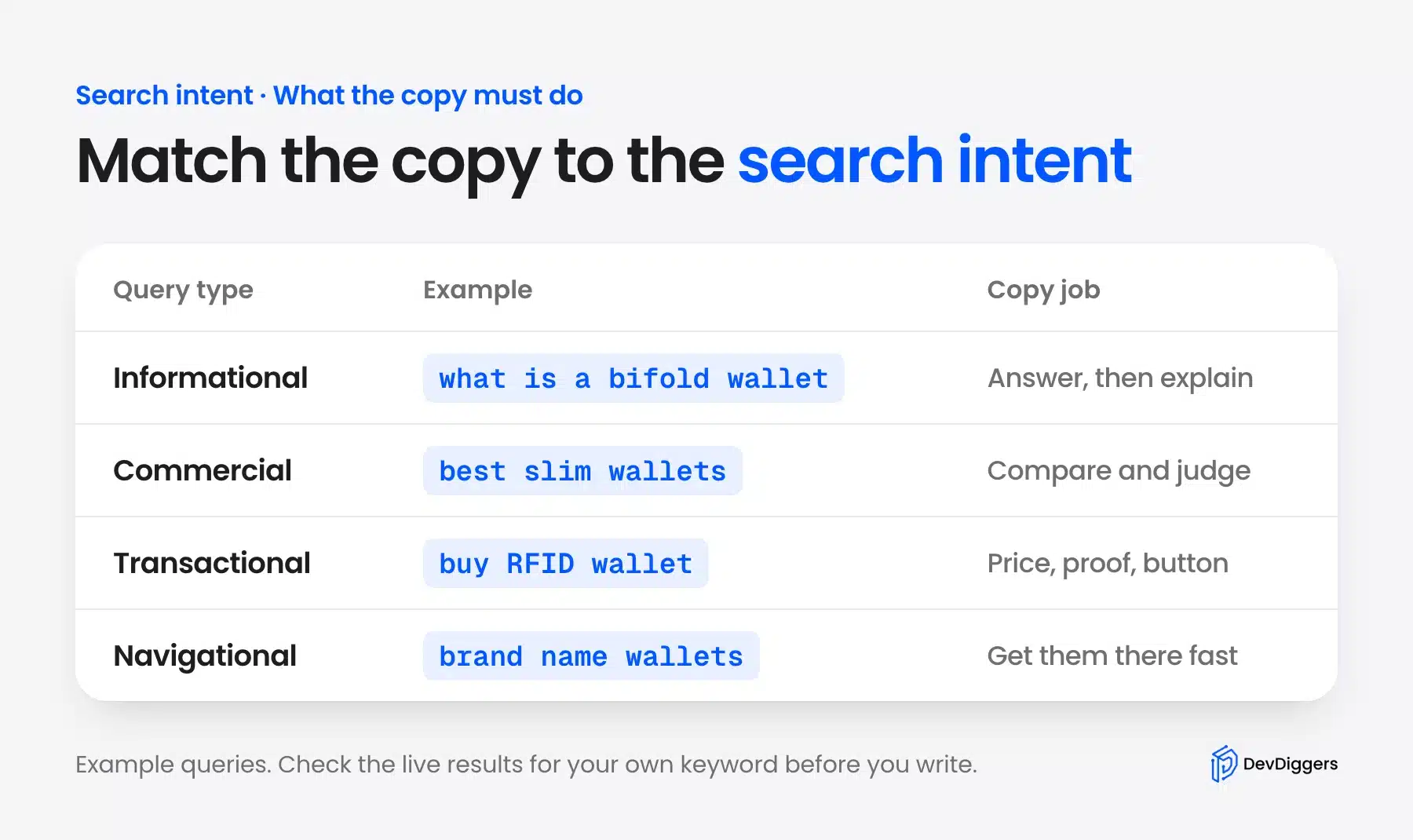
The writing step is where they split, and it starts with search intent. The four intent types each set a different job for the copy:
- Informational intent: The copy answers first and explains after. This is SEO content writing.
- Commercial intent: The copy compares options and makes a call. A “best” list sits here.
- Transactional intent: The copy states the price, the proof and the next step. This is pure SEO copywriting.
- Navigational intent: The searcher wants a brand page. Get them there in one click.
Most pages that sell sit in the last two rows. That is why a store’s category page needs different copy from its blog.
How to Write for SEO in 6 Steps
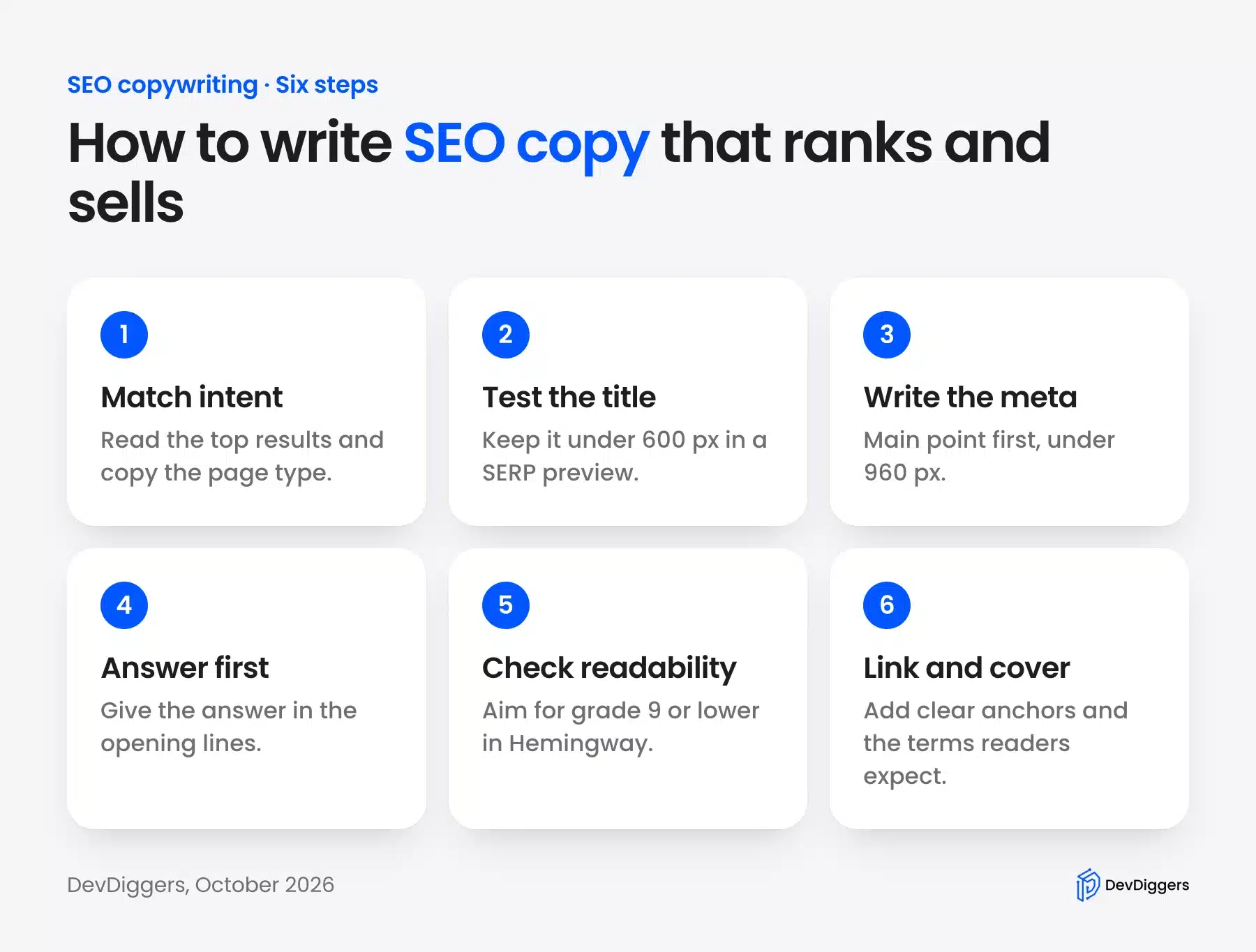
You can write for SEO in six steps, from matching search intent to title testing and a readability check. The last step adds internal anchors and entity coverage. Each step below shows the free tool we used and the numbers our example copy produced in October 2026.
The example is a category page for men’s leather wallets on a made-up store at example.com. The “before” copy is the keyword-first style many stores still run. The “after” copy is the rewrite.
Step 1: Match the Search Intent
Search intent is the reason behind a query, and the copy has to serve that reason before anything else. Search the keyword, look at the top five results, and copy their page type. If Google shows product grids, a blog post will not rank there.
For “leather wallets for men”, the results are category pages with filters and prices, so the page we rewrote is a category page too. A query like “what is a bifold wallet” shows guides instead, and needs SEO content writing.
Step 2: Write the Title and Test Its Pixel Width
The title is the first piece of copy a searcher reads, so it has to fit and it has to promise something. Write the keyword near the start, add one concrete detail, and test the width in a free SERP preview tool. The Mangools SERP Simulator flags titles over 600 pixels.
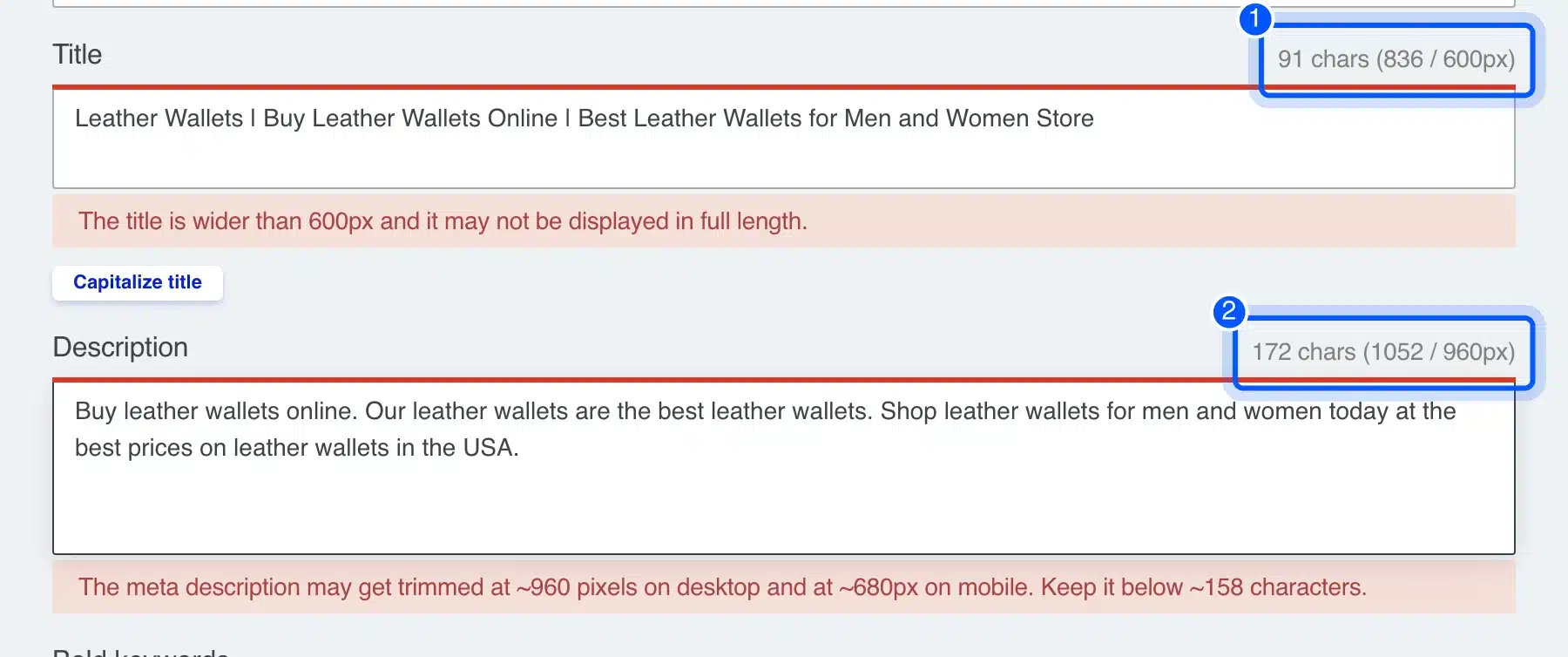
Our before title repeated the keyword three times: “Leather Wallets | Buy Leather Wallets Online | Best Leather Wallets for Men and Women Store”. The simulator measured it at 91 characters and 836 pixels, and showed both warnings in red.
Google’s title link documentation says long titles get cut to fit the device width. It also says there is no reason to repeat the same words in a title. Our rewrite says it once: “Leather Wallets for Men: Slim, RFID and Bifold Styles” came in at 53 characters and 474 pixels.
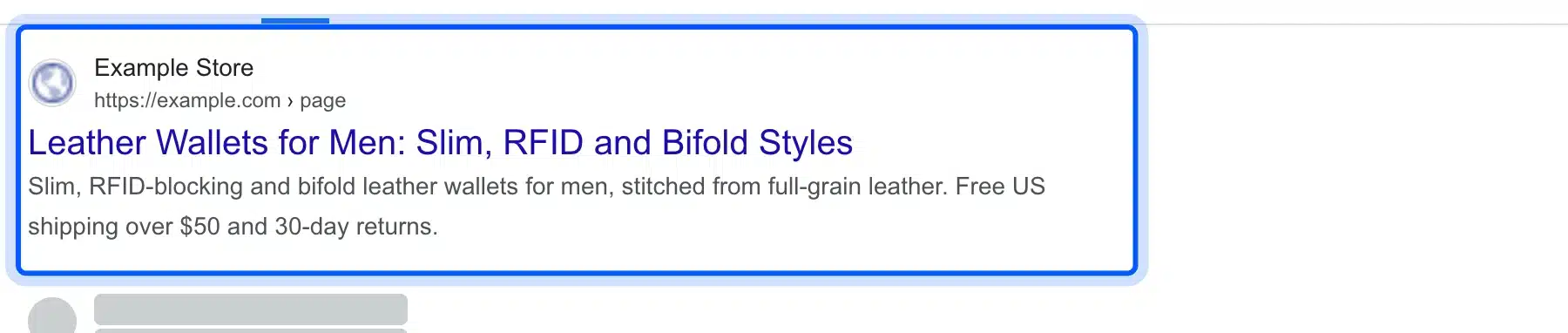
Tip: Character counts lie. A title full of W and M runs wider than one full of i and l, so always test the pixel width.
Step 3: Write the Meta Description
The meta description is ad copy for the search result, and its first 120 characters do the selling. Put the main benefit first, add one proof point, and keep it under about 960 pixels. Google may still rewrite it, but a clear one gives it a reason not to.
The before description said “leather wallets” five times in 172 characters. It ran to 1,052 pixels, and the preview cut it off mid-phrase.
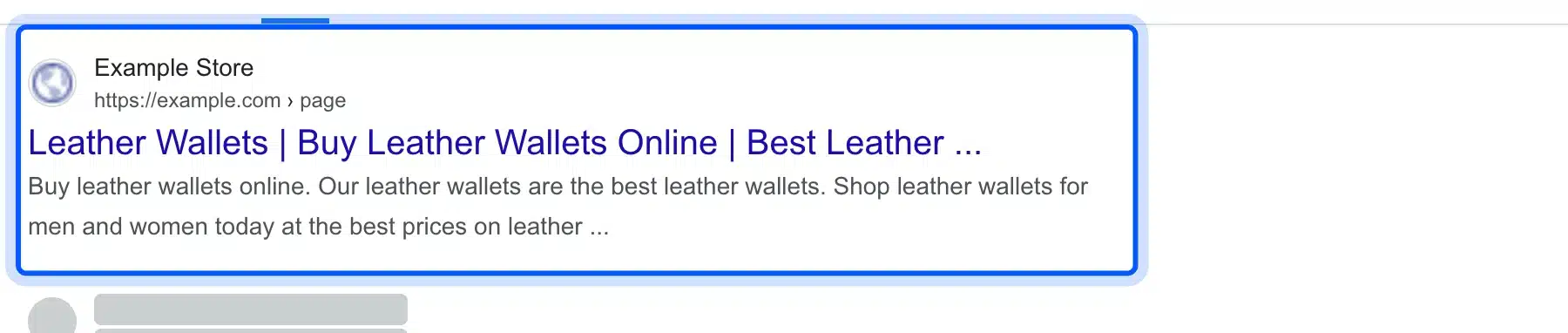
Google’s snippet documentation says it sometimes uses the meta description when it describes the page better than the page text. Our rewrite named the three styles, the leather and the shipping offer in 135 characters and 824 pixels. That is a reason to click, which repeating the keyword never was.
Step 4: Answer the Reader in the First Lines
The opening lines of a page decide whether a visitor scrolls or leaves. Say what the page offers and who it is for in the first two sentences. Then give the details a buyer needs to choose, in the order they ask for them.
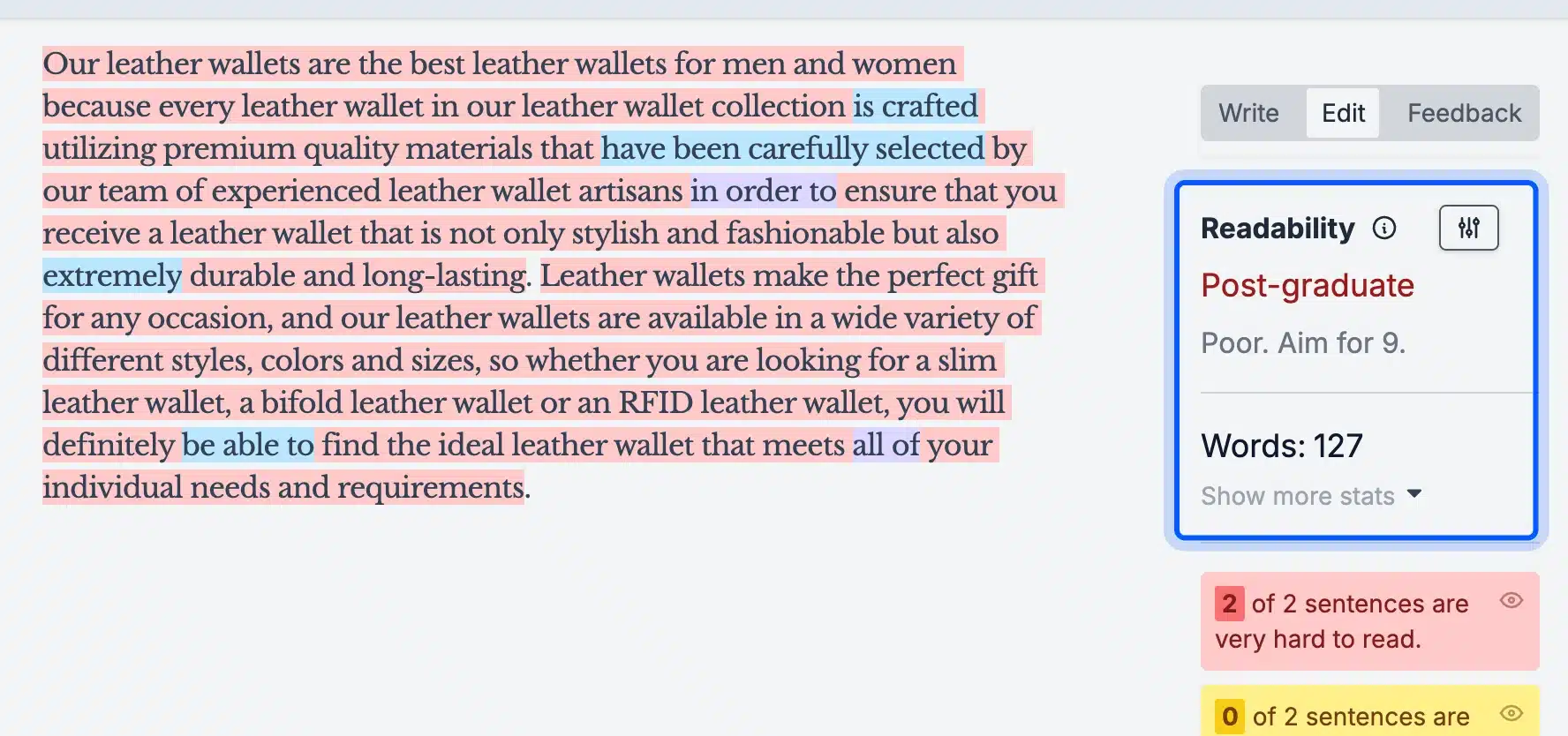
Our before paragraph opened with “Our leather wallets are the best leather wallets for men and women because”. That says nothing a buyer can check. The rewrite opens with the material and the stitching, then explains each style in one sentence.
Here is the after copy in full:
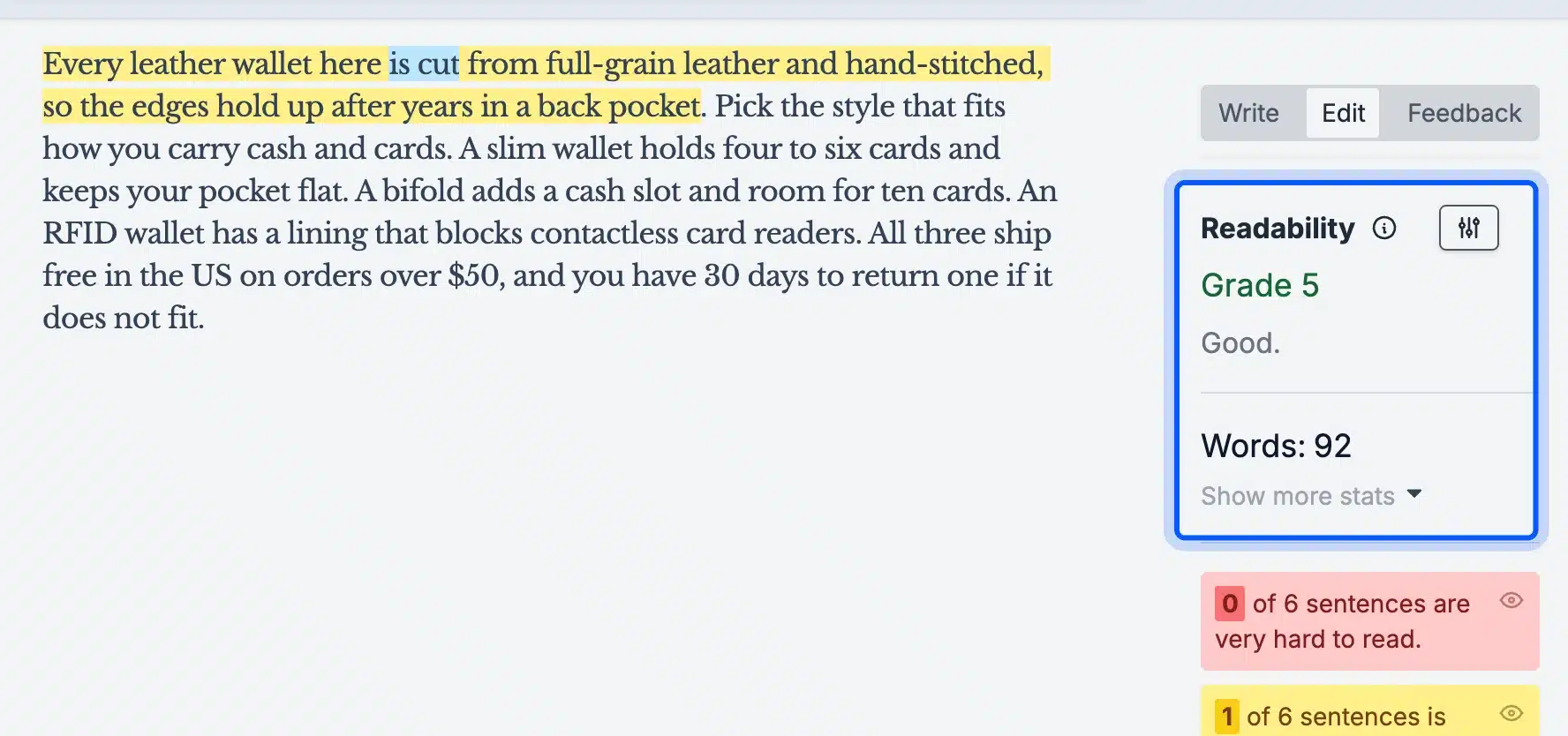
> Every leather wallet here is cut from full-grain leather and hand-stitched, so the edges hold up after years in a back pocket. Pick the style that fits how you carry cash and cards. A slim wallet holds four to six cards and keeps your pocket flat.
Step 5: Check Readability With a Free Tool
Readability decides whether a visitor understands the copy before they lose interest. Paste the copy into the free Hemingway Editor, read the grade, and fix every red sentence first. The tool itself says to aim for grade 9.
Our before paragraph was 127 words in two sentences. Hemingway graded it post-graduate, marked both sentences as very hard to read, and found five weakeners, among them “extremely” and a wordy “in order” phrase.
The rewrite came to 92 words in six sentences. Hemingway graded it grade 5, with one hard sentence and no very hard ones. Shorter sentences did most of the work, and cutting the repeated keyword did the rest.
Note: A low grade is not the goal in itself. Technical buyers can handle longer words, so treat grade 9 as a ceiling for store copy and judge by whether the facts are clear.
Step 6: Add Internal Anchors and Entity Coverage
Internal anchors and entity coverage tell readers and search engines what the page is about without repeating the keyword. Link to related pages with anchor text that names the destination. Then mention the things a buyer expects on the topic, such as materials, sizes and card counts.
Google’s link best practices say good anchor text is descriptive, concise and relevant to both pages. “Click here” and “read more” fail that test.
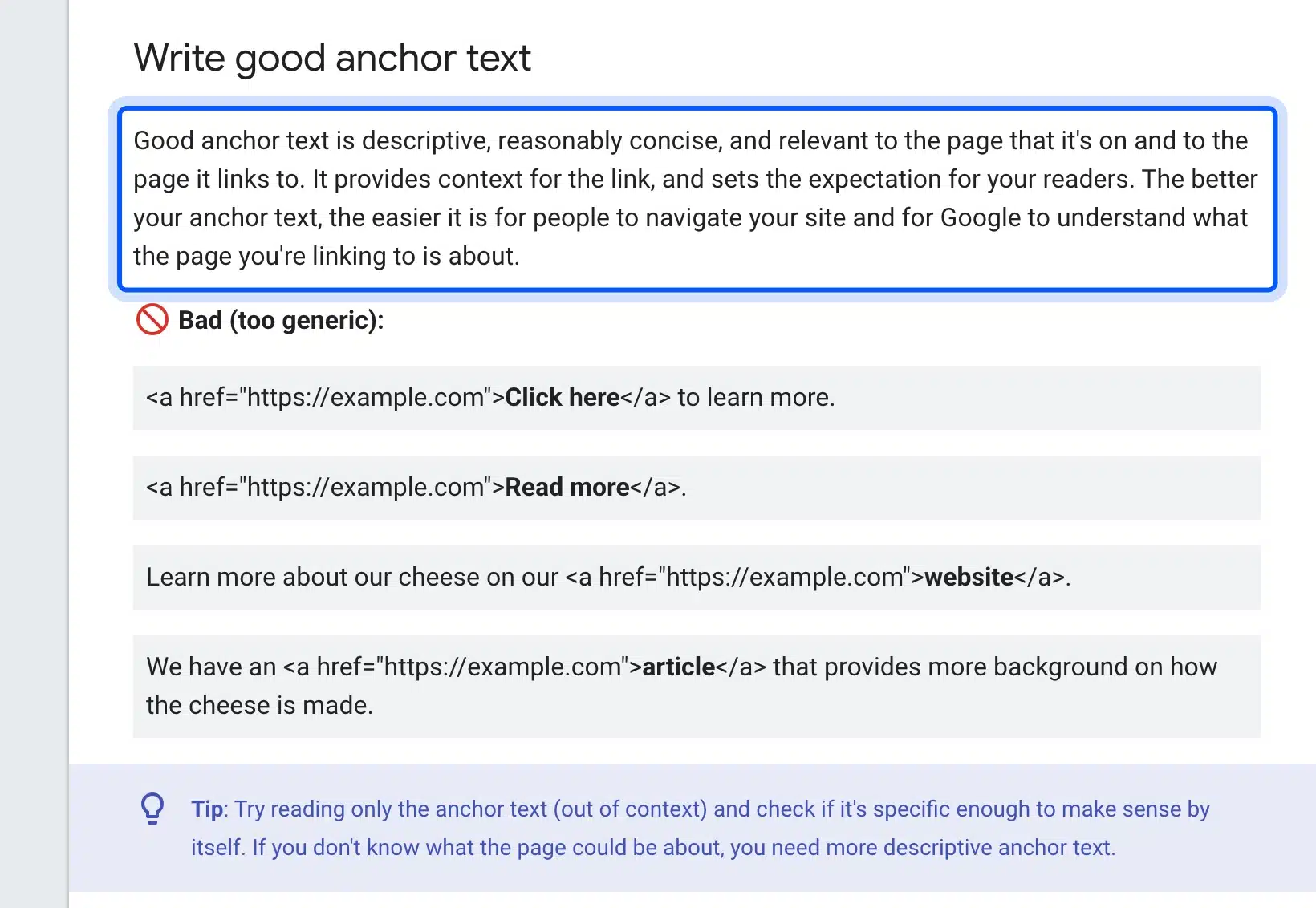
Entity coverage is the same idea for words on the page. Our rewrite named full-grain leather, RFID, bifold, card counts, the $50 free shipping line and the 30-day return window. Each one answers a buyer question, and none of them is the keyword.
For a deeper check of on-page elements, our on-page SEO checklist lists every item.
Before and After: A Category Page Rewrite
Our before and after test showed what each fix changed on the same example page. The title width fell from 836 to 474 pixels, the description from 1,052 to 824 pixels, and the Hemingway grade from post-graduate to grade 5. The keyword went from 12 repeats to one.
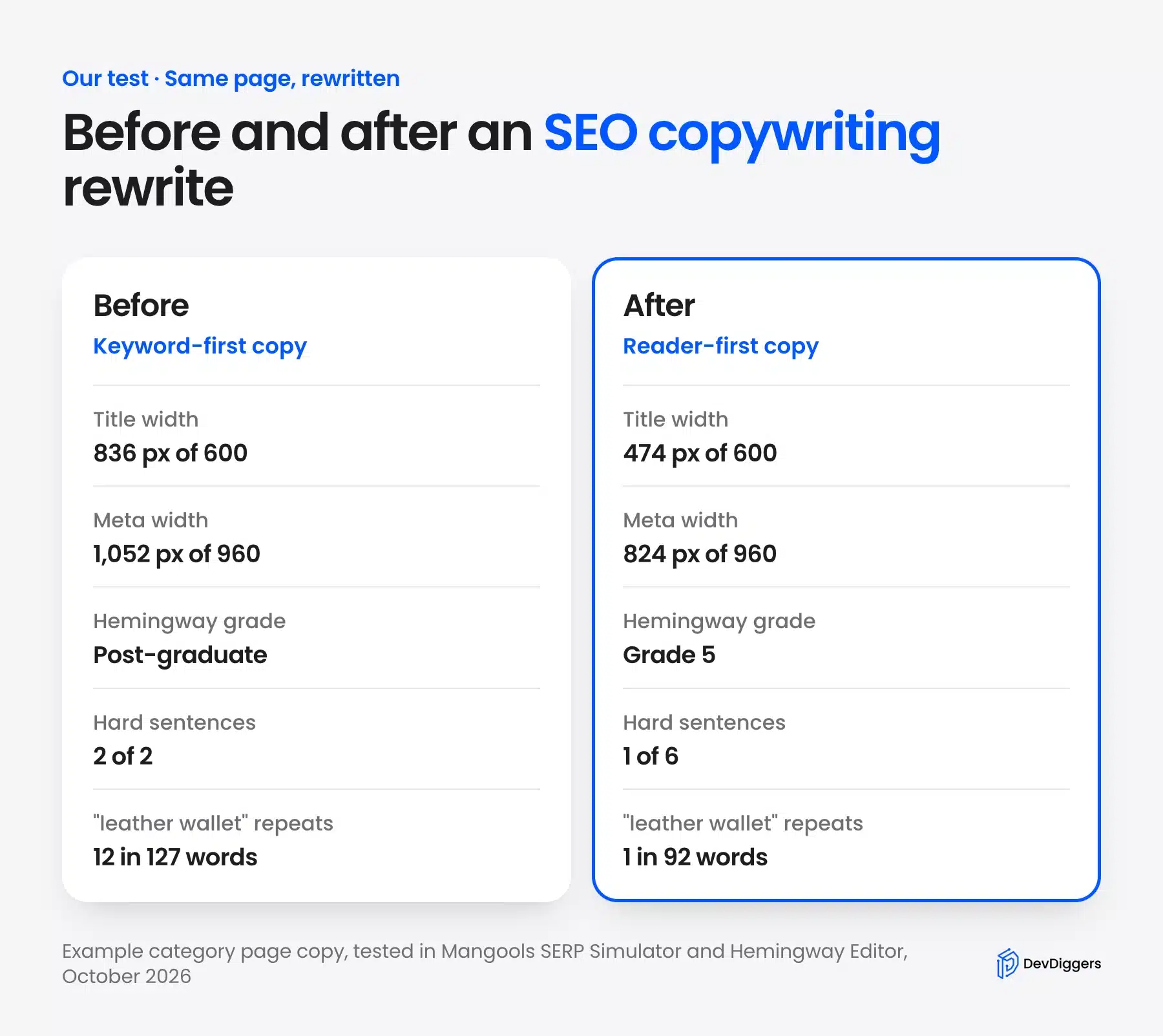
The before version is not a straw man. Copy like it still sits on many store category pages, written when people believed a keyword needed to appear again and again. Our post on how many keywords to use for SEO covers why that stopped working.
What we could not measure is ranking or sales. The page is an example, not a live store, so these numbers show fit and clarity only. A real rewrite should be judged in Search Console after a few weeks, on clicks and click-through rate for the target query.
Worth checking: Keep the old copy in a note before you publish a rewrite. If clicks drop, you can compare the two versions line by line.
What Google’s Helpful Content Guidance Means for Copy
Google’s helpful content guidance tells writers to make content for people first and treat search as a second reader. For copy, that means writing for the buyer’s real question, showing first-hand knowledge of the product, and never padding to a word count. Google states it has no preferred word count for pages.
The guide lists warning signs of search engine-first content. One of them asks whether you write to a set word count because you heard Google likes one. Google answers it directly: “No, we don’t.”
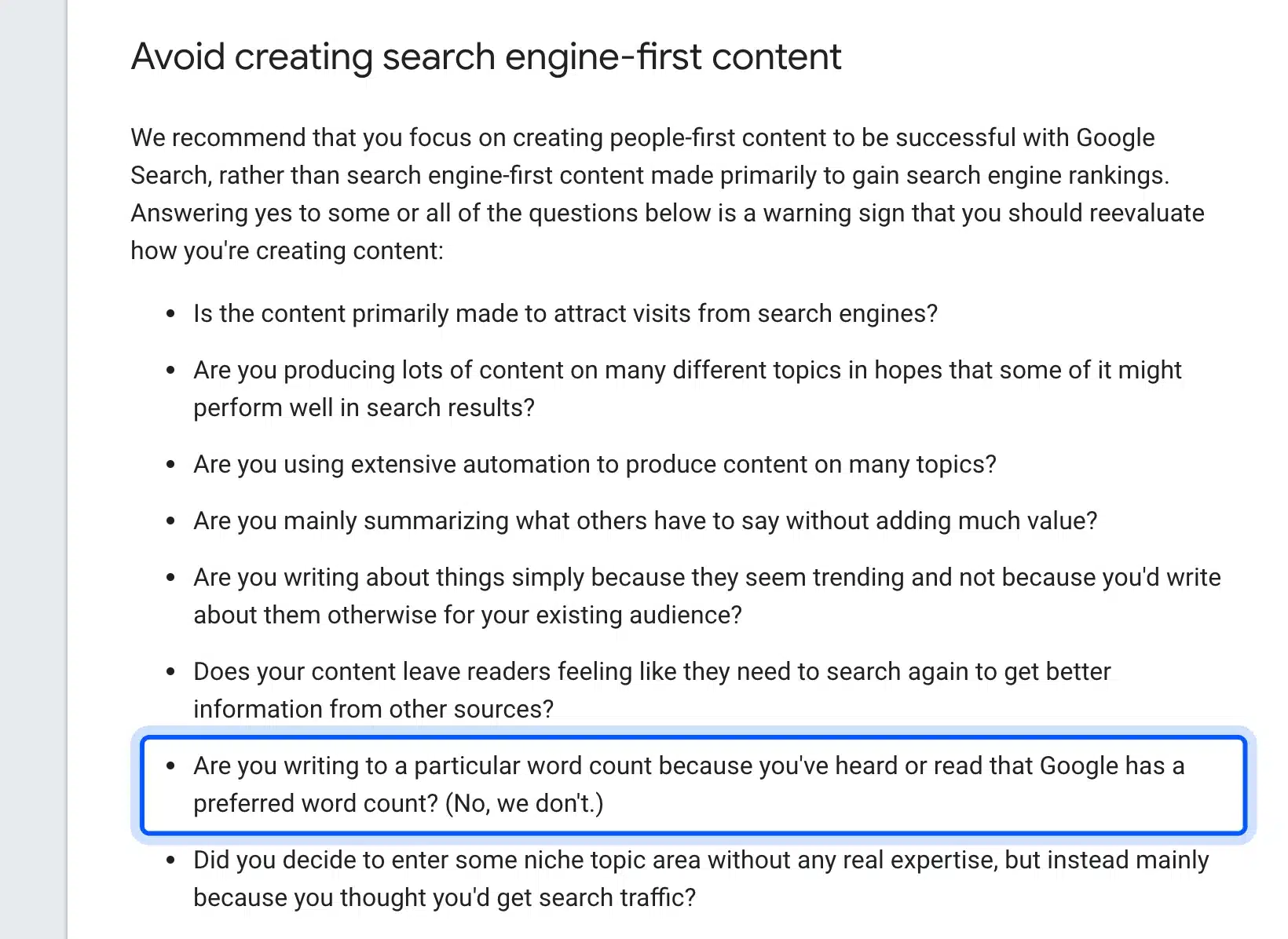
That changes how you brief a copywriter. Ask for the questions the page must answer, not for 1,000 words. A category page that answers four buyer questions in 150 words beats one that answers none in 600.
The same guide asks whether the main heading gives a descriptive summary and avoids exaggeration. So “Best Leather Wallets Ever” fails twice. “Leather Wallets for Men: Slim, RFID and Bifold Styles” passes, because it says what is on the page.
Common SEO Copywriting Mistakes
The most common SEO copywriting mistakes come from writing for a keyword tool instead of a buyer. Each one below showed up in our before copy, and each has a quick fix. Run the copy through a SERP preview and a readability checker, and most of them surface in minutes.
We found each of these by reading the before copy against the two tools. The list is in the order we would fix them on a real store page.
- Keyword repeats: Twelve uses in 127 words read as spam to people and to Google. Use the keyword once in the title, once in the copy, and natural variants elsewhere.
- Vague claims: “Best quality” proves nothing. Name the material, the size or the warranty instead.
- Long sentences: Our before copy averaged over 60 words a sentence. Split anything past 25 words.
- Truncated titles: A title that ends in “…” loses its last promise. Test the width before publishing.
- Generic anchors: “Click here” tells nobody where the link goes. Name the page in the anchor.
- Stale copy: Copy that mentions a sale from two years ago costs trust. Our guide to content decay shows how to find pages that have slipped.
Fix them in that order and stop when the copy reads well out loud. A page does not need every fix to beat a keyword-stuffed rival. It needs to be clearer to the person comparing the two.
How to Learn SEO Copywriting
You can learn SEO copywriting by rewriting real pages and measuring each version with free tools. Start with one product or category page you own. Rewrite the title, meta description and first paragraph, then check them in a SERP preview and Hemingway before and after.
Then read the source rules rather than summaries of them. Google’s SEO Starter Guide covers titles, snippets and links in one place, and the helpful content guide covers the reader side.
Keep a swipe file of titles that made you click in a search result. Note why each one worked: a number, a clear promise, or a detail the others left out.
Practice the research half too. Search ten keywords in your niche and write down the page type that ranks for each. That habit alone stops most intent mistakes.
To become an SEO copywriter, build a small portfolio of before and after rewrites with the measurements attached. Clients trust a title that went from 836 to 474 pixels more than a list of adjectives about your writing.
Writing for product pages is a good place to start. Our guide to writing product descriptions with ChatGPT shows where AI drafts help and where they need a human edit.
When to Use SEO Copywriting Services
SEO copywriting services make sense when a site has many money pages and no one with time to rewrite and test them. A store with 300 category and product pages cannot rewrite them one evening at a time. A service does the research, rewrite and measurement in batches.
What to ask any provider is simple. Ask for before and after numbers on titles, readability and click-through rate. Ask how they check search intent.
A provider who only promises keyword density is selling the before copy from this post.
Ask to see one live page they rewrote and the Search Console numbers from before and after. A real case with a date and a query tells you more than any pitch deck.
Price usually follows the number of pages and how much research each needs. A batch of category pages with one template costs less per page than ten unique service pages.
Copy is only one part of ranking, though. If the pages are slow, badly linked or blocked from indexing, better words will not lift them.
Our WordPress SEO services cover the technical side that has to be right before copy can work. Our comparison of technical SEO vs content SEO explains how the two fit.
Conclusion
SEO copywriting works when the same words fit the search result, answer the reader and support the sale. Our example rewrite cut the title from 836 to 474 pixels and the reading grade from post-graduate to grade 5. The keyword went from 12 repeats to one.
Test every title in a SERP preview and every paragraph in a readability checker before it goes live. Then judge the result in Search Console on clicks, because the numbers in a tool only show that the copy fits.
Frequently Asked Questions (FAQs)
Q1. Is SEO copywriting still worth it with AI search?
Yes. AI answers and search results both draw on pages that give a direct answer. Google’s helpful content guide rewards people-first content, which is what good SEO copy is.
Q2. How long should SEO copy be?
As long as it takes to answer the buyer’s questions. Google’s helpful content guide says it has no preferred word count. A category page might need 150 words, while a service page might need 800.
Q3. Can I use ChatGPT for SEO copywriting?
You can use it for a first draft or for title options, then edit it yourself. AI drafts often repeat keywords and add vague claims, so test the result in a SERP preview and Hemingway. Add the product facts only you know.
Q4. How many keywords should one page target?
One main keyword plus close variants and related terms. Google’s title link guidance says there is no reason to repeat words in a title. Cover the related questions instead.
Q5. What is the difference between a copywriter and an SEO copywriter?
A copywriter writes to persuade. An SEO copywriter also researches the search results, writes titles that fit the snippet, and checks that the page matches search intent. The persuasion skills are the same.
Q6. How do I measure whether SEO copy works?
Watch clicks and click-through rate in Google Search Console for the target query, comparing a few weeks before and after the change. Rankings and sales follow later. A SERP preview and readability score only show the copy is ready to test.