
GEO vs SEO is a question of where your content shows up. SEO earns a ranked link in search results, while GEO, or generative engine optimization, earns a mention or citation inside an AI answer. Both reward the same useful and well-structured pages. Most of the work overlaps.
Classic SEO itself splits into technical SEO and content SEO, and both matter for AI answers too.
I checked the GEO side of devdiggers.com in October 2026 with five tests you can repeat. They cover AI crawler access, robots.txt, our llms.txt file, the results page and our Search Console data. Two of the results were not what I expected.
You get a plain definition of each, a side-by-side table of the differences, and those five checks with the real output. After that comes an answer to whether GEO will replace SEO, and where to spend your time first.
What Is GEO in SEO?
GEO stands for generative engine optimization, the work of getting content quoted or cited in AI answers. The term comes from a 2023 research paper about tools like ChatGPT and Perplexity. It builds on SEO rather than replacing it, because AI engines read the web pages search engines already index.
The original GEO paper by a team led from Princeton University introduced the name and a benchmark called GEO-bench. It reported that its methods could boost visibility in generative engine answers by up to 40%.
So “GEO SEO meaning” has a short answer. GEO is the part of search work aimed at AI answers, and SEO is the part aimed at ranked links.
Some people call the same idea AEO, answer engine optimization, or LLMO. The names differ, but they all describe being the source an AI tool pulls its answer from.
What Is SEO?
SEO, or search engine optimization, is the work of ranking a page in the list of results on Google, Bing and other search engines. It covers crawling and indexing, page speed, keywords, headings, content quality and links. The reward is a click from the results page to your site.
Google’s SEO starter guide lists the basics: help Google find your pages, write content people find useful, and describe each page with a clear title. None of that has changed with AI search.
SEO is measured in rankings, impressions and clicks. Search Console reports all three for every page and query. Progress is easy to track.
GEO vs SEO: Key Differences
The main difference in GEO vs SEO is the result each aims for. SEO wants a whole page to rank as a link, and success is a click. GEO wants one passage to be quoted inside an AI answer, and success is a mention, often with no click.
Here is how the two compare on goal, unit, result and measurement:
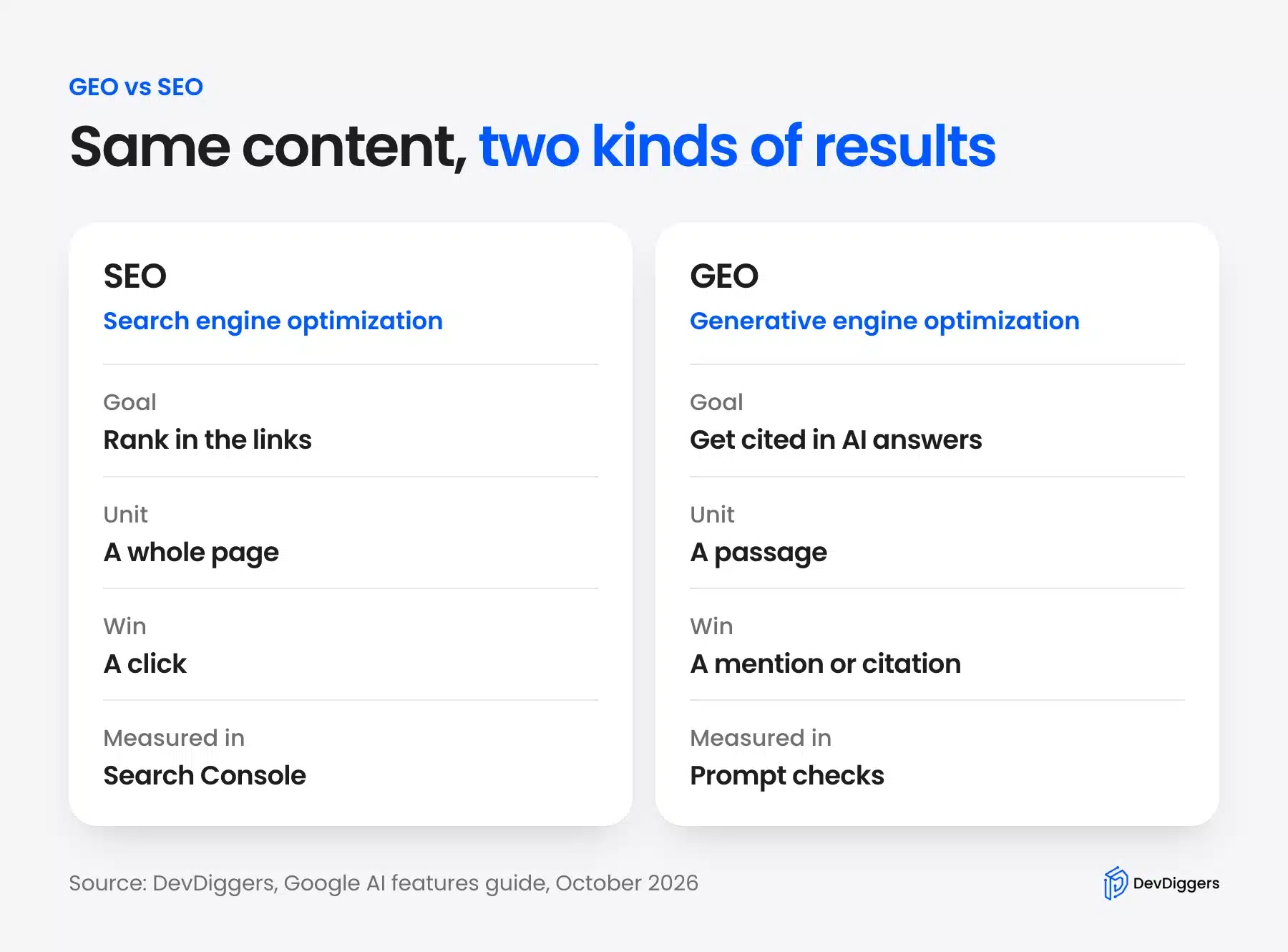
- Unit of content: SEO ranks a page, while GEO pulls a passage. That is why the first paragraph under each heading matters so much for GEO. It is the part that can stand alone as a complete answer.
- Measurement: SEO has Search Console and decades of tools. GEO has no single report yet. Many teams run a fixed list of prompts in AI tools and log whether they appear.
- Traffic: An AI answer often satisfies the reader without a click. A citation still builds trust in your name, but it shows up as fewer visits than a top ranking would bring.
Google itself says the two are not separate jobs. Its guide to AI features and your website says AI Overviews and AI Mode need no extra steps. SEO best practices still apply.
How GEO and SEO Work Together
GEO and SEO work together because AI answers draw on pages that search engines already crawl, as Google’s AI features guide explains. A page that ranks well is easier to find. A page written in clear, sourced passages is easier to quote.
The overlap is large. Both need crawlable pages, a clear heading structure, accurate facts with sources, and an author or brand that readers can trust.
The GEO extras are small changes to how you write. Open each section with a two or three sentence answer, put numbers next to their source, and phrase headings the way people ask questions.
The GEO paper found that adding statistics, quotations and cited sources raised visibility the most. Those are also habits that make a page more useful to human readers.
How to Check Your Site for GEO and SEO
To check your site for GEO and SEO, first test whether AI crawlers can reach your pages and what robots.txt allows. Then read your llms.txt file, see who ranks for your main query and open Search Console. Each check takes a minute with curl or a browser.
I ran all five on devdiggers.com in October 2026. The steps below show the output.
Step 1: Check That AI Crawlers Can Reach Your Pages
An AI engine can only cite a page its crawler can fetch. Request the page with each AI crawler’s user agent and confirm a 200 status. A firewall or bot rule can block them without you knowing.
Here is the test on this page with five crawler names:
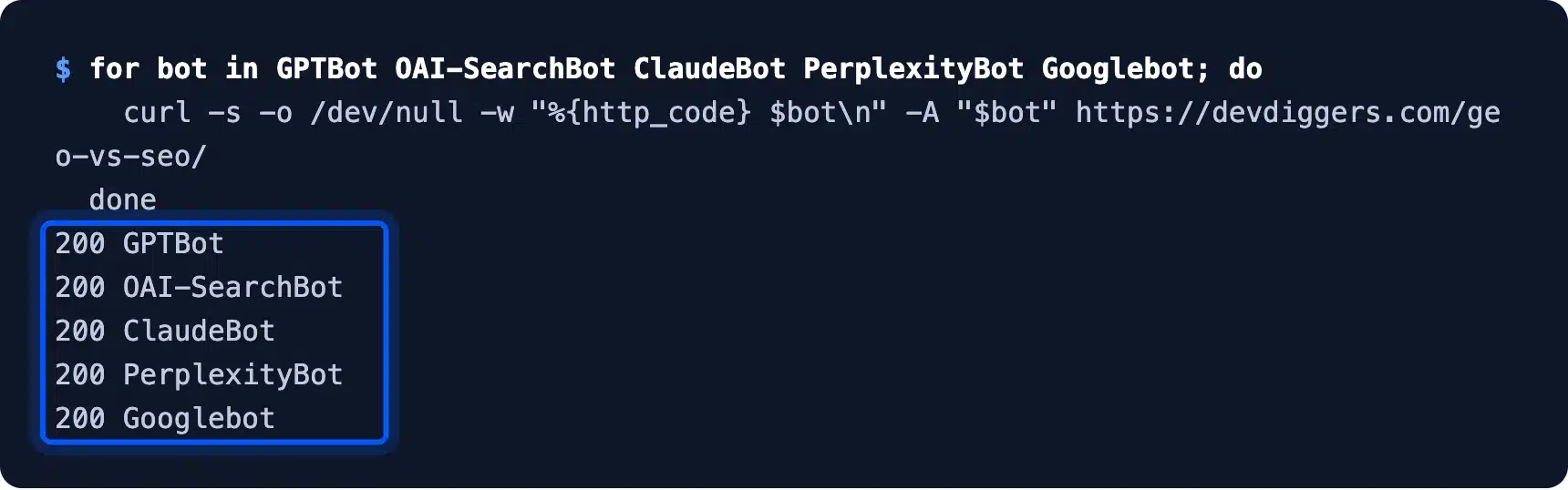
All five returned 200, including GPTBot, ClaudeBot and PerplexityBot. Our Cloudflare setup does not block these names, which OpenAI’s crawler documentation lists for OpenAI.
This test only sends the name and not the real crawler’s IP address. A firewall that checks IPs could still treat the real bot differently. OpenAI also publishes the IP ranges its bots use.
Note the split between training and search bots. GPTBot collects data for model training, while OAI-SearchBot fetches pages for ChatGPT search answers.
Step 2: Check Robots.txt for AI Bot Rules
Robots.txt can allow or block each AI crawler by name. Open it and look for user-agent lines that name AI bots, and for any “Disallow: /” line that blocks the whole site.
Our file has a single rule group for every crawler and no full-site block:
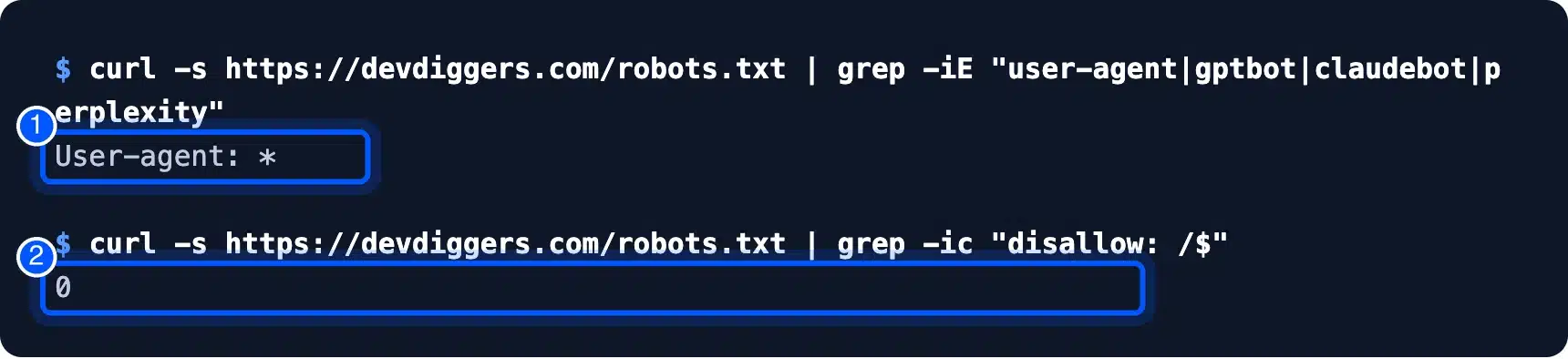
So every AI crawler follows the same rules as Googlebot. They may crawl the whole site apart from wp-admin, WooCommerce logs and add-to-cart URLs.
That is a choice we made, and it is not a default to copy blindly. A site that wants to stay out of model training can block GPTBot and still allow OAI-SearchBot. Its pages can then still appear in ChatGPT search.
Blocking training bots is one layer, and you can prevent content scraping on a WordPress site with several more.
Step 3: Check Your llms.txt File
An llms.txt file is a plain text list of your key pages, written for AI tools to read. Open your domain followed by /llms.txt and check that the pages you most want cited are on the list. If your site has none, you can generate an llms.txt file from your sitemap and test which AI crawlers your robots.txt lets in.
Rank Math generates ours. On the day I checked, it listed 98 posts, and this page was not one of them:
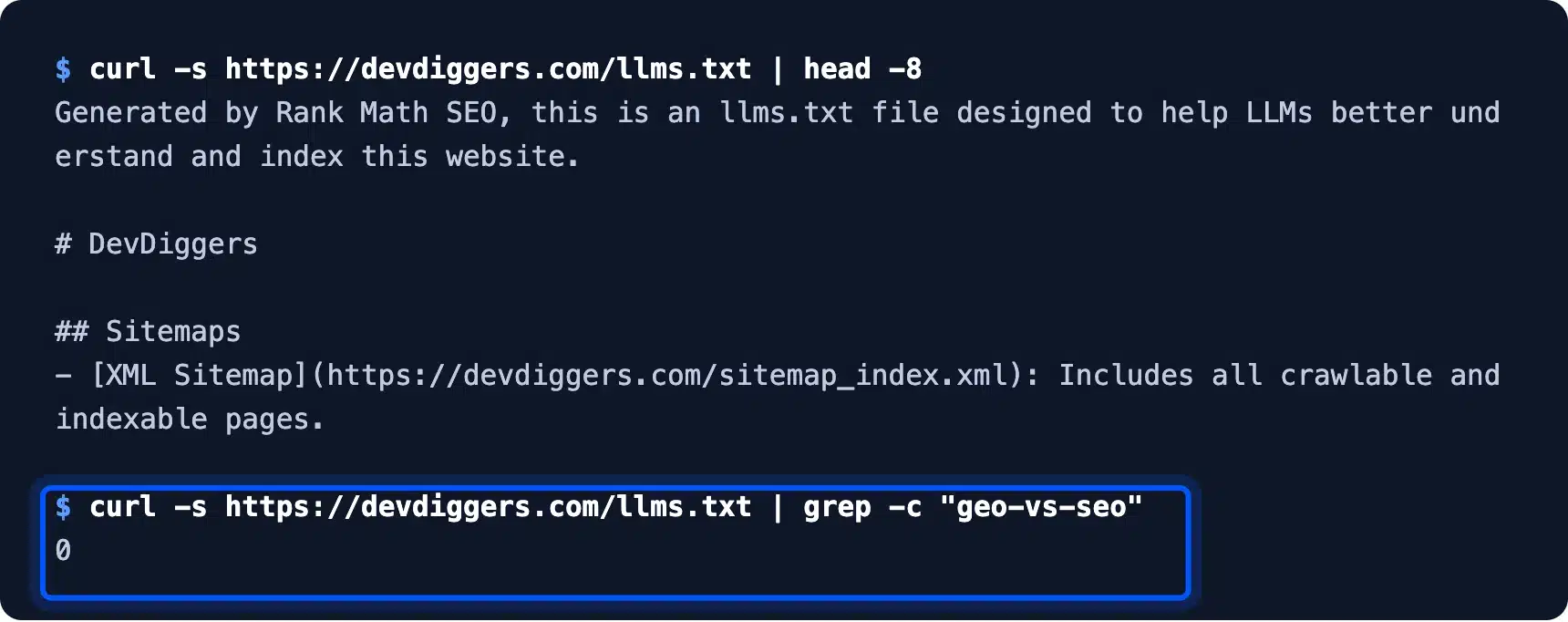
The likely reason is simple. The old version of this page carried a noindex tag, and the page was also missing from the sitemap, which lists only indexable content.
That is a useful lesson for GEO. Any setting that hides a page from search engines tends to hide it from AI tools as well. Check indexing first.
No major AI company has confirmed that it reads llms.txt. Treat it as a cheap extra and not a ranking factor. Spend more time on the pages themselves.
Step 4: Check Who Ranks for Your Query
Search your main query and note what kind of page holds each spot. Forums, videos and short guides mean the topic rewards a different format, and AI engines often cite the same sources.
When videos hold those spots, our guide to video SEO shows how to compete for them.
Here are the top six results for “GEO vs SEO” when I checked:
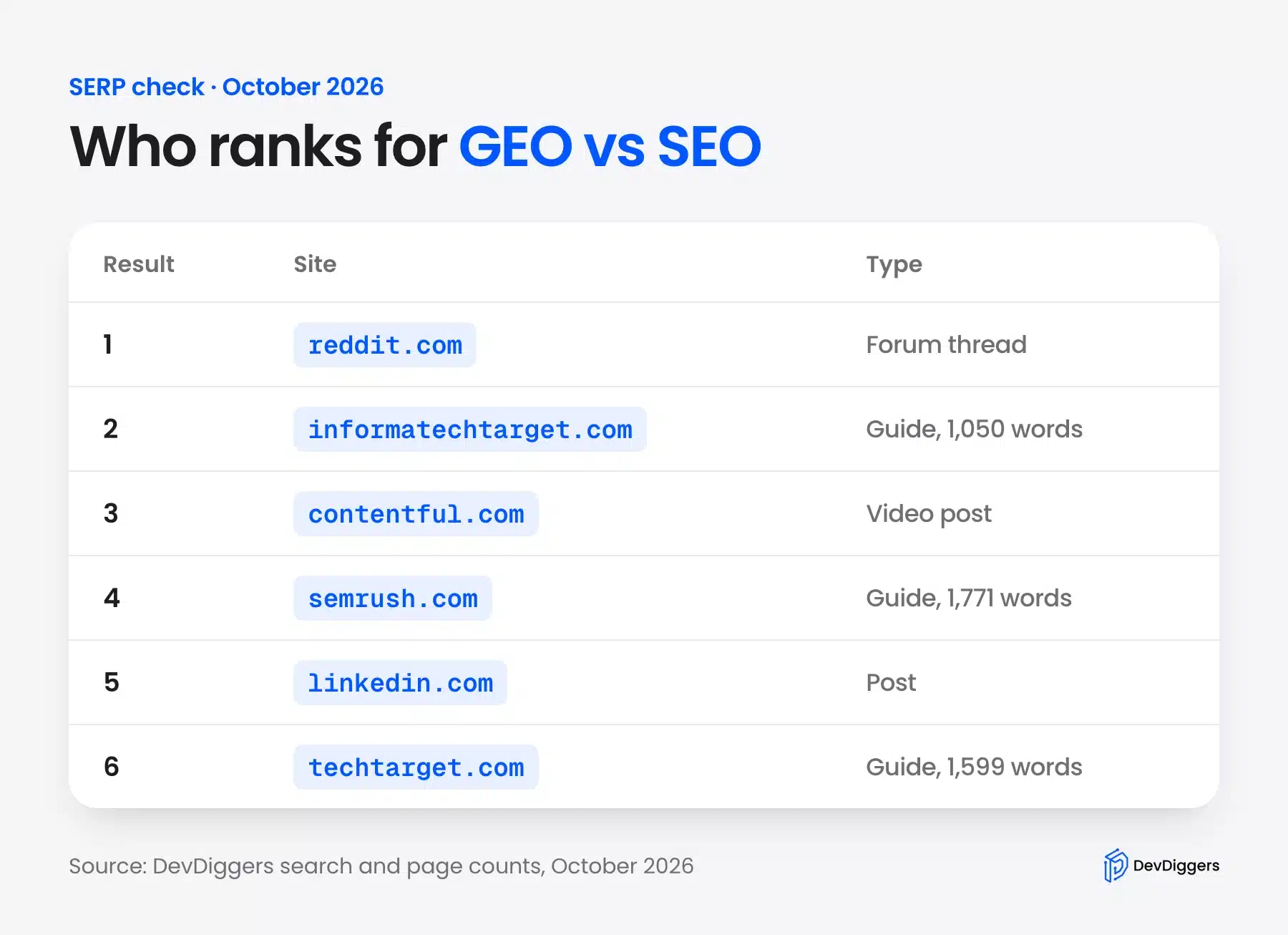
A Reddit thread held the first spot, and LinkedIn appeared at fifth. The written guides that ranked ran 1,050 to 1,771 words.
That tells two stories. Short, direct guides can rank for this query, and people also want opinions from practitioners in forums.
For GEO, it suggests one more task. Answering real questions in public forums and posting on LinkedIn can put your name in the sources AI tools read.
Step 5: Check What Search Console Already Shows
Search Console shows which queries already bring your page into Google results. Open Performance, filter by the page and read the Queries tab. Those queries show the questions people already ask about the topic.
From June 2025 to October 2026, this page showed for these queries:
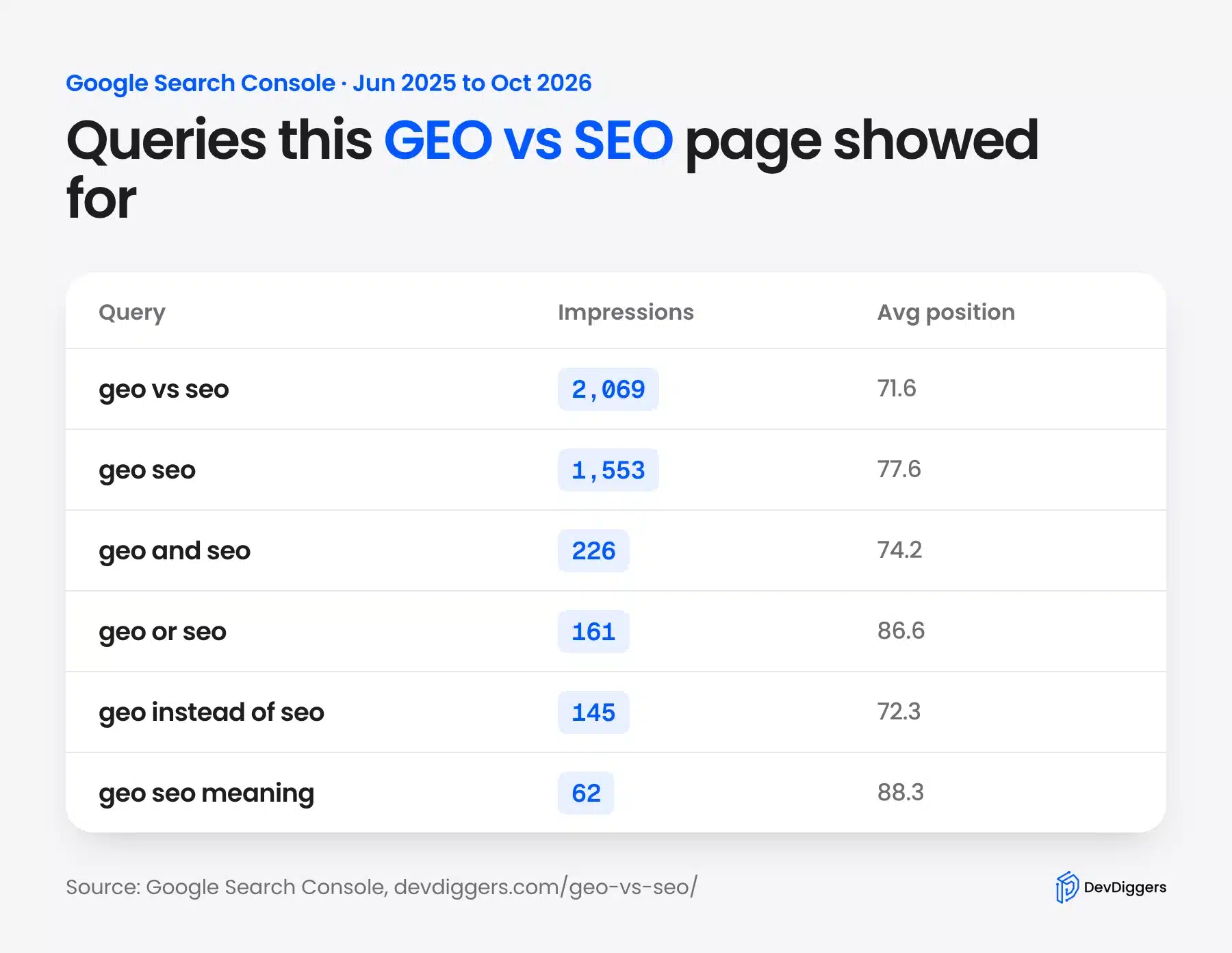
“GEO vs SEO” led with 2,069 impressions, and “GEO SEO” followed with 1,553. Every query sat beyond position 70. The page earned no clicks at all.
Two of those queries became headings in this rewrite. “GEO and SEO” and “GEO instead of SEO” each get their own section. The page answers them directly.
For a full prompt-based audit, our guide to AI search visibility shows how to test 20 prompts across AI tools for free.
GEO Instead of SEO: Will GEO Replace SEO?
GEO will not replace SEO, because Google’s AI features guide says SEO best practices apply to AI Overviews with no extra steps. AI answers lean on the same crawled pages. GEO is a layer on top of SEO, and a site that drops SEO loses both.
People search “GEO instead of SEO” because AI answers reduce clicks. That part is real. It makes sense to track citations as well as visits.
But the inputs stay the same. A page that cannot be crawled, indexed or trusted will not be cited, however it is written.
The sensible split is to keep doing SEO and to write every page so its passages can stand alone. That one writing habit serves both kinds of result.
New pages still start with search. Submit your website to Google Search so it is crawled, and publishers can also submit their site to Google News.
Does GEO or SEO Matter More?
SEO matters more today for most sites because a ranked link earns a click while an AI answer often does not. GEO matters more for brand mentions in topics where people ask AI tools for recommendations. The cheapest plan is to do SEO first and then shape each page so it can be quoted.
For a small WordPress or WooCommerce site, the order is clear in practice. Fix crawling and indexing and write useful pages that answer real queries. Then tune the openings of each section.
Product pages need the same care. Our guide to writing product descriptions with ChatGPT shows how to draft them while keeping the facts AI tools quote.
If you want a team to handle both, our WordPress SEO services cover technical fixes, content and AI search checks.
Conclusion
GEO vs SEO is not a choice between two strategies. SEO earns ranked links, GEO earns citations in AI answers, and both grow from crawlable, useful, well-sourced pages.
Our own checks show how closely they connect. Every AI crawler could reach our site. Yet this page was missing from llms.txt for the same reason it was missing from search: a noindex tag.
So do SEO first and then write each section so it opens with a clear answer. Check AI crawler access and your Search Console queries once a quarter.
Frequently Asked Questions (FAQs)
Q1. What does GEO stand for in marketing?
GEO stands for generative engine optimization. It means shaping content so AI tools cite it in their answers, as defined in the original GEO paper.
Q2. Is GEO the same as local SEO?
No. In older SEO writing, “geo” sometimes meant geographic targeting for local search. Today GEO usually means generative engine optimization. Check which meaning a guide uses before following it.
Q3. Do I need special tools for GEO?
No. Curl, robots.txt, Search Console and a fixed list of prompts cover the basics. Paid tools add automated prompt tracking, but they measure the same thing: whether AI answers mention you.
Q4. Does blocking GPTBot hurt GEO?
Blocking GPTBot keeps your pages out of OpenAI’s model training. ChatGPT search uses OAI-SearchBot. You can block one and allow the other according to OpenAI’s crawler documentation.
Q5. How long does GEO take to show results?
AI tools that search the web live can cite a page soon after it is indexed. Answers drawn from model training change only when a model is retrained, which can take months.
Q6. Does structured data help GEO?
Structured data helps search engines understand a page, which supports both SEO and AI features. Google’s AI features guide says no special markup is required. Write good content first.